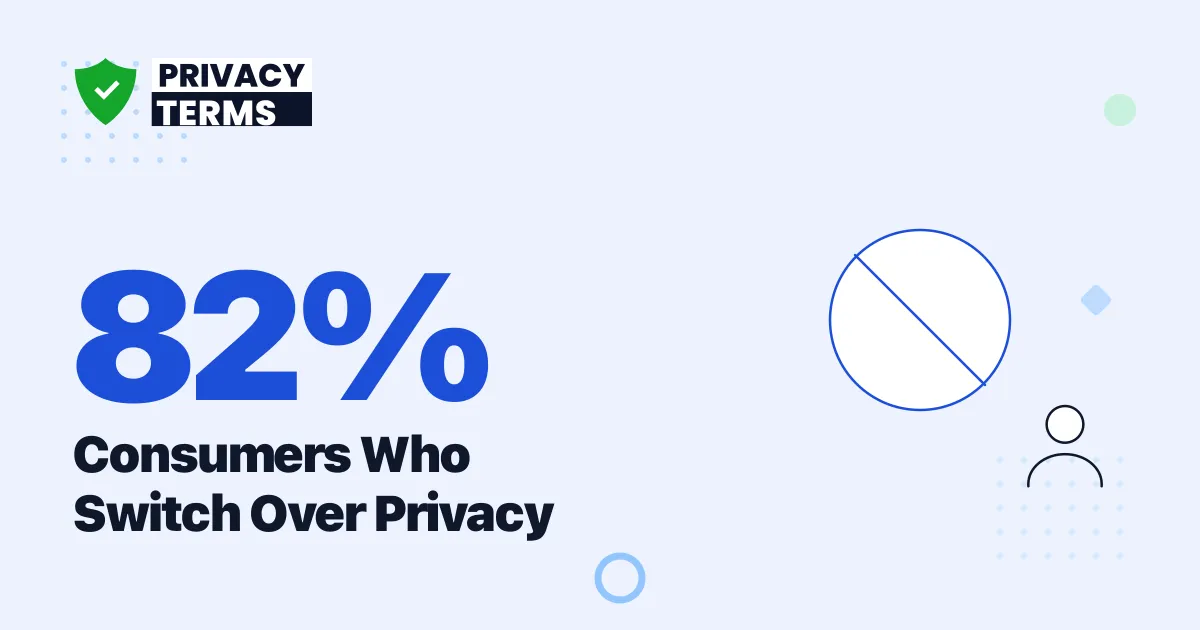
82% of consumers say they stopped buying from a brand in the past 12 months because of how the company used their personal data, according to Thales's 2025 Digital Trust Index, a survey of 14,009 consumers across 14 countries published in March 2025. Switching over privacy is no longer a fringe reaction. It has become close to a default consumer response, and the brands that avoid it skew toward the handful of sectors people already trust with sensitive data.
The pattern shows up everywhere researchers look for it: in Cisco's annual consumer surveys, in Thales's global trust index, and in how organizations themselves are now budgeting for privacy as a customer-retention line item rather than a pure compliance cost. Below is what the two most-cited consumer surveys report, the age groups driving the behavior, the industries still holding onto trust, and what businesses are doing in response.
What percentage of consumers have switched brands over privacy?
82% of consumers abandoned a brand in the past 12 months specifically because of how they perceived the company was using their data, per Thales's 2025 Digital Trust Index. That figure sits well above the narrower "switched providers over data policies" number Cisco's Consumer Privacy Survey tracks each year, because Thales asks about any perceived misuse of data, while Cisco asks specifically about switching a company or provider outright.
| Data point | Share of consumers | Source | Year |
|---|---|---|---|
| Abandoned a brand over data use, past 12 months | 82% | Thales Digital Trust Index | 2025 |
| Would not purchase from an organization they do not trust with data | 75%+ | Cisco Consumer Privacy Survey | 2024 |
| Switched providers over data policies, ages 25 to 34 | 49% | Cisco Consumer Privacy Survey | 2024 |
| Switched providers over data policies, ages 75 and older | 18% | Cisco Consumer Privacy Survey | 2024 |
Figure 1: Four different survey questions, all pointing the same direction. Sources: Thales 2025 Digital Trust Index; Cisco 2024 Consumer Privacy Survey.
Every measure agrees on direction even though the exact wording of each question changes the number. Whether a survey asks about outright brand abandonment, a refusal to purchase, or switching a provider, the share of consumers reporting privacy-driven action clears a third of respondents at the low end and reaches four in five at the high end.
Which age group is most likely to switch brands over privacy?
Younger consumers act on privacy concerns far more than older ones. 49% of consumers aged 25 to 34 have switched companies or providers over data policies or data-sharing practices, compared with just 18% of those 75 and older, according to Cisco's 2024 Consumer Privacy Survey, which polled thousands of respondents across 12 countries.
The gap is not just about switching. The same Cisco wave found that younger respondents are also far more likely to submit a formal data request, such as asking a company to access, correct, or delete their personal information, than older respondents are. Younger consumers are the segment most willing to read a privacy policy closely enough to notice a problem, and the segment most willing to leave once they find one. A site whose visitors skew under 35 is dealing with the age bracket most primed to walk, not just complain.
Why do consumers switch brands over data privacy?
The reasons trace a fairly direct line from expectation to disappointment. 86% of consumers expect a baseline level of data privacy rights from every company they interact with online, per Thales's 2025 Digital Trust Index. At the same time, 63% say too much of the responsibility for protecting that data falls on the individual consumer rather than the business collecting it, and 19% say they were told their own data had been compromised in the past year.
Figure 2: How privacy expectations and trust breakdowns relate to the 82% abandonment figure. Source: Thales 2025 Digital Trust Index. Note: these are separate survey questions from the same research wave, presented as a narrative sequence rather than a tracked individual-level path.
A company does not need a headline-grabbing breach to trigger this. Perceived overreach, an unclear data-sharing practice, or a confusing consent flow can push a consumer into the same "abandoned" bucket as someone who lived through an actual security incident. That is also why data privacy statistics consistently show more consumers reporting privacy-driven action than the number who report having experienced a confirmed data breach themselves: the behavior is triggered by perception and disclosure quality, not only by confirmed harm.
Which industries keep the most consumer trust?
Banking holds onto the most consumer trust of any sector Thales tracked, at 44%, followed closely by government at 42%. News media sits at the opposite end, trusted by just 3% of consumers. Across all 13 sectors in the survey, not one broke the 50% trust mark.
| Sector | Consumer trust score | Rank among 13 sectors |
|---|---|---|
| Banking | 44% | Most trusted |
| Government | 42% | 2nd most trusted |
| News media | 3% | Least trusted |
Figure 3: Highest and lowest trusted sectors out of 13 surveyed. Source: Thales 2025 Digital Trust Index.
Banking and government are also the only two sectors, alongside insurance, whose trust scores held steady or rose slightly compared with the prior year's edition of the same survey. Every other sector lost ground. Regulation and long-standing security expectations appear to buy those three sectors a measure of goodwill that less-regulated industries do not get, even though none of them are anywhere close to earning trust from a majority of consumers.
Are businesses responding to privacy-driven switching?
Yes, and the shift shows up directly in budgets. 38% of organizations now spend USD 5 million or more annually on privacy, up from just 14% a year earlier, according to Cisco's 2026 Data and Privacy Benchmark Study, which surveyed more than 5,200 IT, technology, and security professionals with privacy responsibilities across 12 markets.
Figure 4: Year-over-year jump in large-scale privacy budgets, largely attributed to AI governance demands. Source: Cisco 2026 Data and Privacy Benchmark Study.
The spend is not happening in a vacuum. It is a direct response to research like Thales's and Cisco's own consumer wave showing that a meaningful share of customers will leave over a data-use problem. If your business collects personal information from site visitors and has not reviewed its consent flows or disclosures recently, you can generate a privacy policy that states your data practices in plain terms, which is the cheapest available signal a site has to offer a visitor deciding whether to trust it or move on.
Figure 5: How the data on privacy-driven switching and the business response have moved together. Sources: Pew Research Center (2023); Cisco Consumer Privacy Survey (2024); Thales Digital Trust Index (2025); Cisco Data and Privacy Benchmark Study (2026).
A company that has not touched its privacy disclosures since before this run of survey waves is operating on old assumptions about how forgiving its customers are. The consumers most likely to notice, the 25 to 34 year old bracket, are also disproportionately the group companies are trying to acquire and retain right now. The same generational pattern of skepticism shows up in other trust-adjacent consumer behavior too: research on sign-up form honesty finds that users who do not trust a company with their data are also more likely to falsify what they enter into that company's forms in the first place, which is a second, quieter cost of the same underlying trust problem.
The Bottom Line
The headline number is not close: 82% of consumers have walked away from a brand over data privacy in the past 12 months, and the behavior is concentrated hardest among the 25 to 34 year old bracket that most businesses are actively trying to grow. Trust is not evenly distributed either. Banking and government hold onto real credibility with consumers while most other sectors, especially news media, do not. None of the 13 sectors Thales tracked broke 50% trust, which means every business, regardless of industry, is closer to the losing side of that trust gap than the winning one. Businesses are responding with real budget, not just messaging: privacy spend over USD 5 million a year nearly tripled in a single year. For a site of any size, the practical read is the same one every year of this data has pointed to: a current, accurate, plainly written privacy policy is a small cost against an 82% risk.
Frequently Asked Questions
What percentage of consumers have switched brands over privacy? 82% of consumers say they stopped buying from a brand in the past 12 months because of how the company used their personal data, according to Thales's 2025 Digital Trust Index, based on 14,009 respondents across 14 countries.
Which age group is most likely to switch brands over privacy? Consumers aged 25 to 34 switch most often: 49% have switched companies or providers over data policies, compared with just 18% of consumers aged 75 and older, per Cisco's 2024 Consumer Privacy Survey.
Why do consumers switch brands over data privacy? 86% of consumers expect a baseline level of data privacy rights from every company they deal with, and 63% believe too much of the burden for protecting that data falls on them rather than the business, according to Thales's 2025 Digital Trust Index. 19% say they were told their data was compromised in the past year.
Which industries do consumers trust most with their data? Banking is the most trusted sector at 44%, followed by government at 42%, while news media is the least trusted at just 3%, per Thales's 2025 Digital Trust Index. None of the 13 sectors surveyed crossed 50% trust.
Where the Numbers Come From
- Thales. (2025). "2025 Digital Trust Index, Consumer Edition." Survey of 14,009 consumers across 14 countries, conducted by Censuswide with The Red Consultancy on behalf of Thales, published 18 March 2025. Source of the 82% brand abandonment, 86% expected rights, 63% responsibility, 19% compromise, and sector trust figures.
- Cisco. (2024). "Cisco 2024 Consumer Privacy Survey." Global consumer survey covering 12 countries. Source of the 49% vs 18% generational switching figures and the 75%+ won't-purchase figure.
- Cisco. (2026). "2026 Data and Privacy Benchmark Study." Survey of more than 5,200 IT, technology, and security professionals with privacy responsibilities across 12 markets. Source of the 38% vs 14% privacy-spend figures.
- Cisco Newsroom. (2026). "AI Fuels Surge in Data Privacy Investments and Redefines Governance, Cisco Reports." Press release covering the 2026 Data and Privacy Benchmark Study's spending and governance figures.
- Pew Research Center. (2023). "How Americans View Data Privacy." Source of the 72% regulation-support figure referenced in the timeline.
Note: All figures verified as of July 2026. The Thales 2025 Digital Trust Index and Cisco's annual surveys are each refreshed roughly once a year; this post's figures are scheduled for review at least twice a year to catch new survey waves.