Most privacy policy guides describe a document that doesn't exist anywhere: an idealized checklist of clauses assembled from a dozen different companies' legal pages. That's useful as far as it goes, but it skips the part people actually struggle with, which is what a real policy looks like once it's assembled and published, with real headings in a real order, doing real work.
So instead of another checklist, here's our own privacy policy at privacyterms.io, taken apart section by section. It's a live, published document, not a mockup, and it isn't a showcase of the fanciest possible clauses. It's a working example of a compliant policy doing its job in plain English. Below is what each section actually contains, why it's required, and what it's protecting you (or your users) from if it's missing.
What each section must contain
| What it must state | Why it's required | |
|---|---|---|
| Data collected | Automatic vs user-provided data | Separates data types under law |
| Exact data types | Specific fields, named | Vague wording fails an audit |
| Disclosure and security | Who touches data, how it is kept safe | Avoids overpromising on security |
| User rights | Each GDPR right listed alone | One sentence gives no way to act |
| Cookies | What cookies do, named vendors | Readers need to know who has access |
| Transfers and changes | Acquisition and update handling | Leaves no question unanswered |
| Contact | One real point of contact | Satisfies the right-to-exercise rule |
Reading top to bottom, the sections build on each other rather than standing alone:
What Data You Collect, Stated Up Front
The opening substantive section of any privacy policy has one job: tell the reader, without hedging, what data you're gathering. Ours splits it into two buckets, non-personally-identifying information (browser type, language preference, referring site, timestamps, the kind of thing a server logs automatically) and personally-identifying information collected only when a visitor chooses to hand it over.
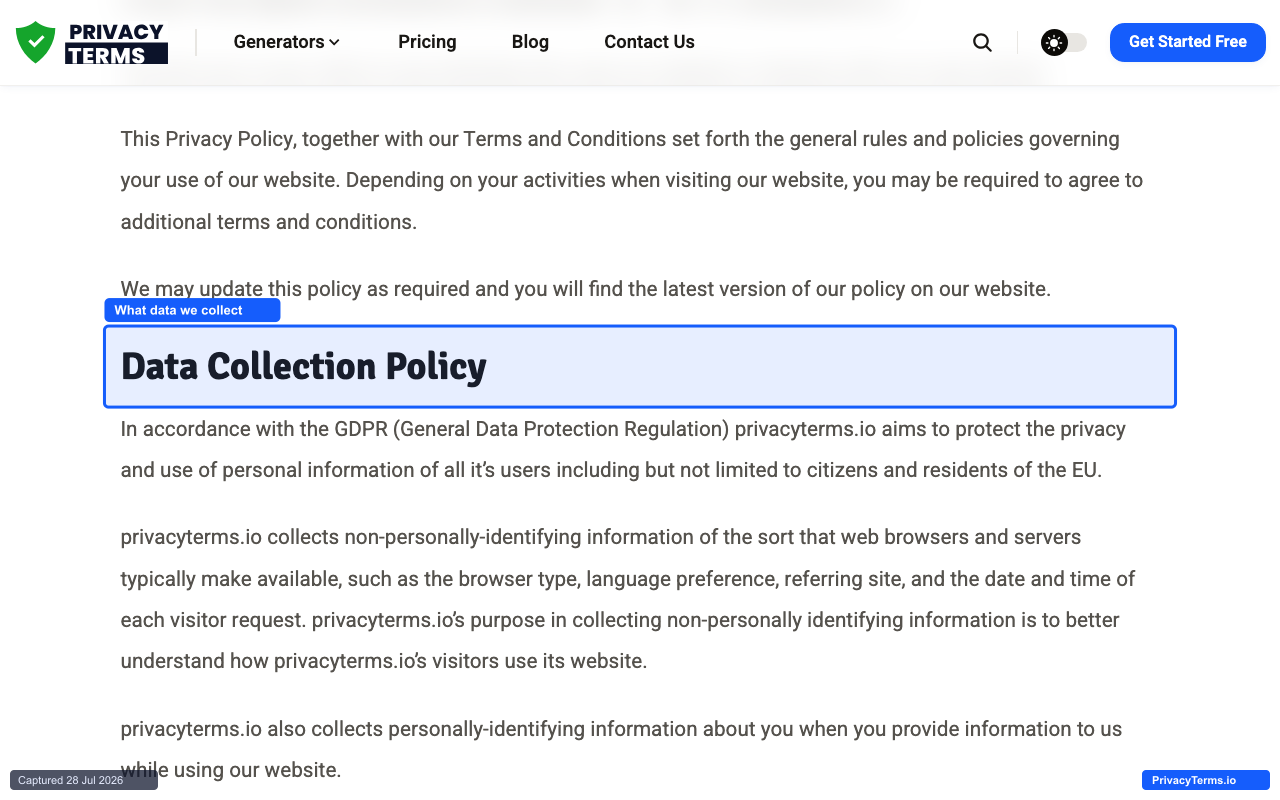
The opening data section separates what's collected automatically from what a visitor has to actively provide.
This distinction matters legally, not just stylistically. GDPR and CCPA both treat "personal data" as anything that can identify a person, directly or indirectly, but they don't require every website to treat an IP address log the same way it treats a name and payment card. Stating the split up front tells a regulator, and a reader, that you've thought about the difference rather than lumping everything into one vague sentence about "information we may collect."
Right below it, a short section answers a question almost no template bothers with: where is the data physically stored? Ours says plainly that servers are located in the U.S.A. If you serve EU residents and store their data outside the EU, this is exactly the kind of sentence that needs to exist, because it's the trigger for talking about international transfer safeguards elsewhere in your terms.
The Exact Data Types, Named
A section that says "we collect personal information" and stops there isn't doing much. The next section in ours names the actual fields: full name, email address, phone number, company street address, payment details, tied to the specific interaction that collects them (completing a generator form, buying a policy through PayPal).
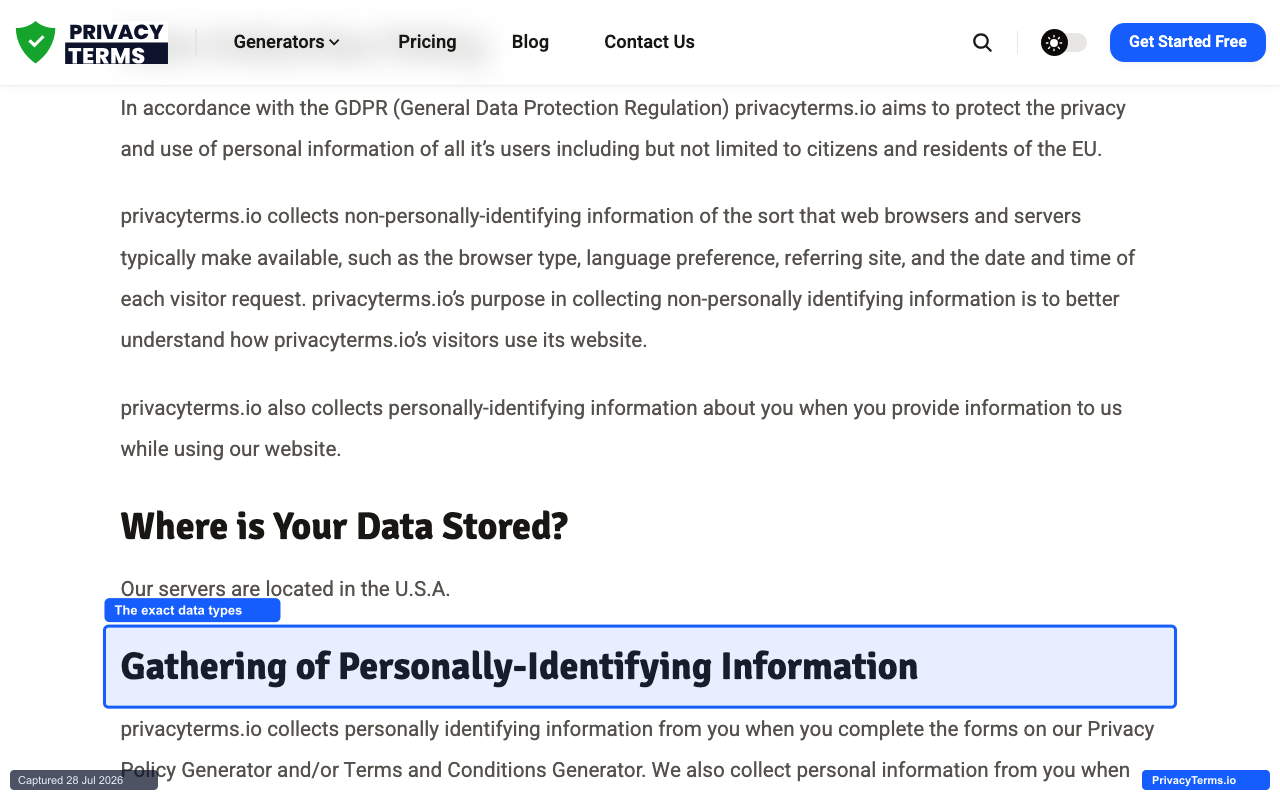
Naming the specific data types collected, rather than describing them abstractly, is what regulators and careful readers are actually looking for.
Naming fields specifically, rather than describing them abstractly, is one of the more common gaps in privacy policies that get flagged in audits. If your generator or checkout form collects a company address and a phone number, your privacy policy needs to say so specifically. A generic "we may collect information you provide" clause reads fine to a casual visitor but doesn't hold up if a data protection authority asks you to demonstrate that your stated purposes match your actual collection.
Where the Data Goes Next
Two shorter sections follow that a lot of policies skip entirely or bury in a single sentence. The first, third-party disclosure, states who else touches the data: in our case, PayPal for transactions, plus a general clause about disclosure when required by law. It also states explicitly that personal information isn't sold or rented to third parties, a sentence that's become close to a baseline expectation since CCPA gave "sale" a formal legal definition that covers more than a literal cash transaction.
The second, security, is deliberately honest rather than reassuring. It says PrivacyTerms.io uses commercially acceptable means to protect personal information, and then says plainly that no method of transmission or storage is 100% secure. A short subsection under it calls out HTTPS specifically, since encrypting data in transit is the one security measure almost every visitor can verify for themselves by looking at the address bar. Overpromising security ("your data is completely safe with us") is a liability risk if you're ever breached; describing what you actually do is both more accurate and more defensible.
A links-to-external-sites clause closes out this group, disclaiming responsibility for the privacy practices of any third-party site a visitor might click through to. It's a small clause, but it matters anywhere your content or your product links off-site, which for most businesses is nearly everywhere.
User Rights, Spelled Out Individually
This is the section that GDPR effectively requires you to write, and it's the one most templates get lazy about. Ours lists each right individually, in plain language, rather than as a single sentence claiming "you have GDPR rights": the right to be informed, the right of access, rectification, erasure, restricting processing, objecting to processing, and data portability.
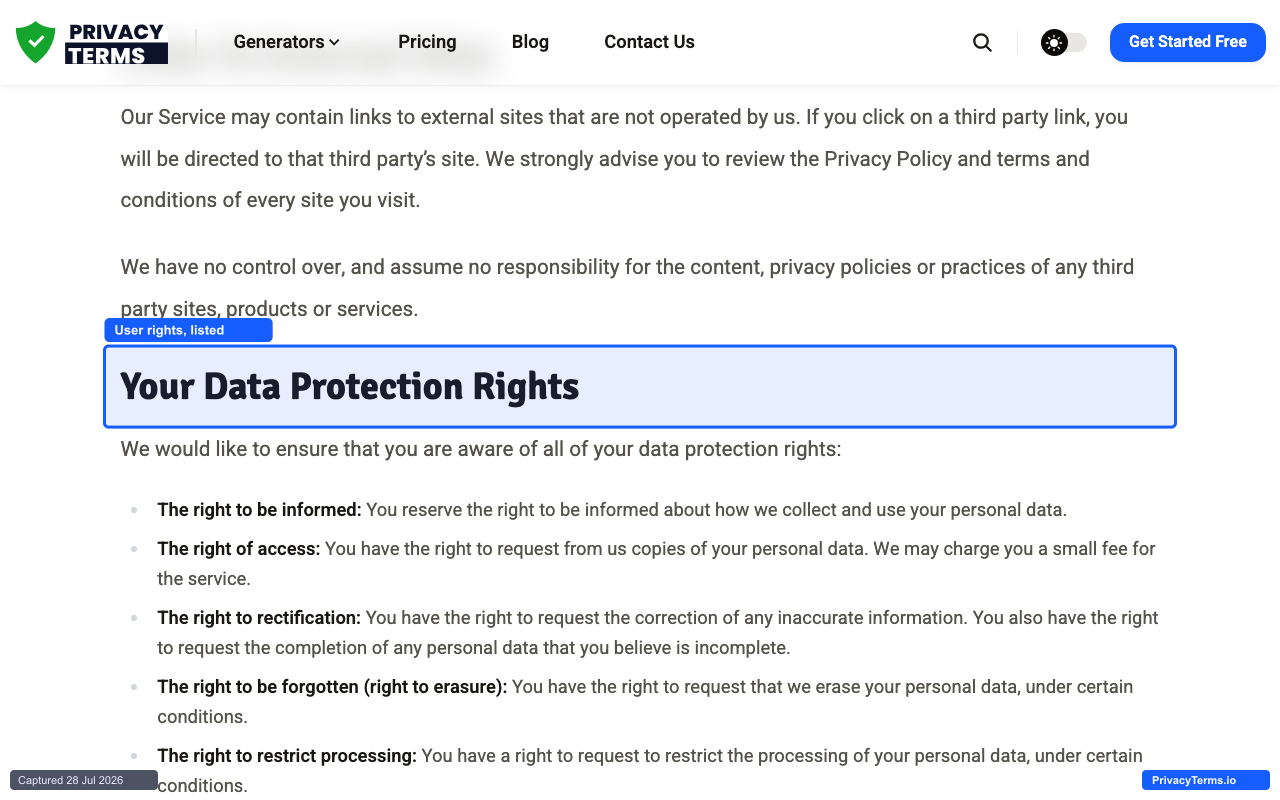
Each right gets its own line and its own plain-language explanation, rather than a single sentence claiming blanket compliance.
Listing rights individually isn't decoration. GDPR Articles 15 through 21 define these as distinct, separately enforceable rights, and a policy that compresses them into "you have all applicable data rights under GDPR" gives a reader no way to know what to actually ask for. Writing "the right to be forgotten" as its own line, with its own sentence explaining what it means, is what turns a legal requirement into something a non-lawyer can act on: they can point to the exact sentence when they email support asking you to delete their account.
How Cookies Are Disclosed
The cookies section explains what a cookie is in plain terms, states that we use them to identify and track visitor usage and preferences, and tells visitors how to opt out by adjusting browser settings, with the honest caveat that some features may not work properly without them.
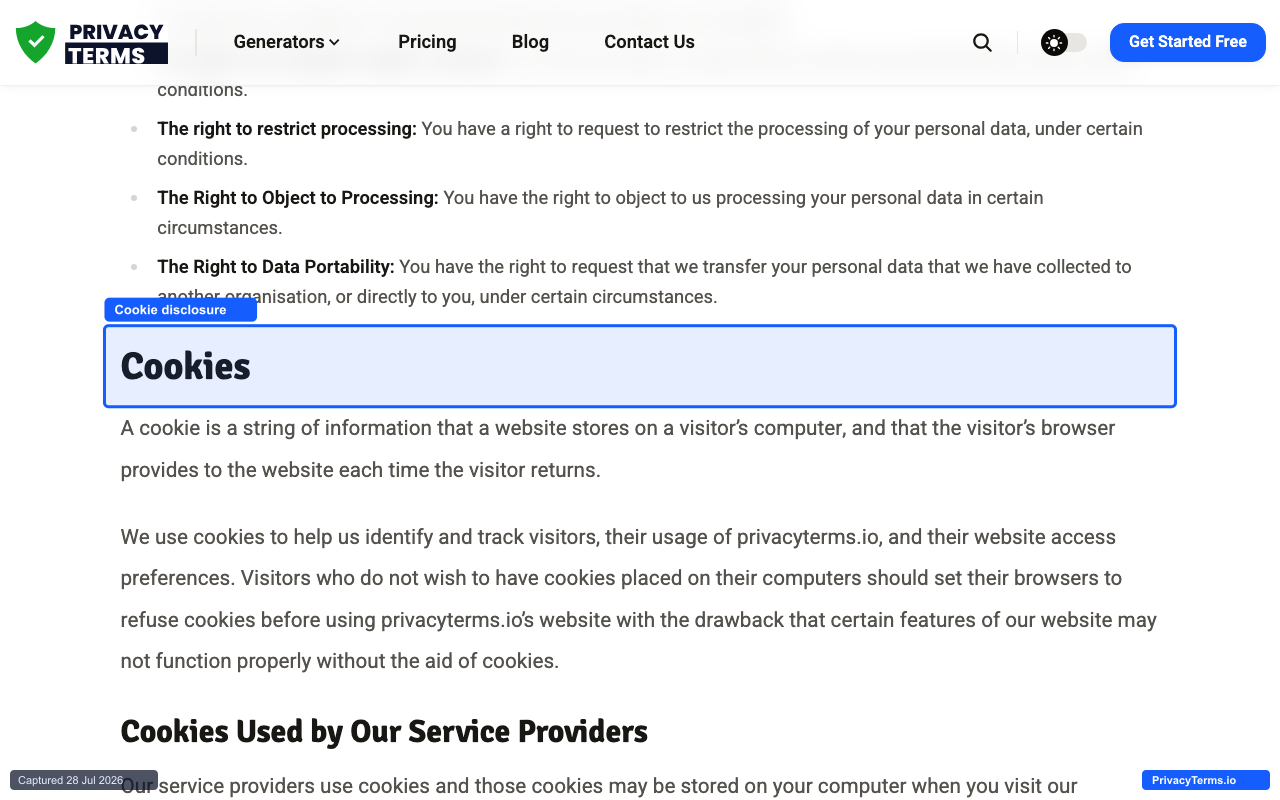
A named third-party subsection (Google Analytics) with a link to that provider's own privacy policy, rather than a generic mention of "analytics tools."
Underneath, a named subsection discloses Google Analytics specifically, explains what it gathers, and links straight to Google's own privacy policy. This is the pattern worth copying: don't write "we may use third-party analytics tools," name the tool. A reader (or a regulator) shouldn't have to guess which vendors have access to visitor data. If you use more than one analytics or advertising tool, this is the section that grows, one named subsection per vendor.
The Sections Nobody Reads Until They Need Them
Two more short sections round out the substance of the document before it closes. A business transfers clause covers what happens to user data if the company is acquired or goes out of business: it becomes part of the assets transferred, and the new owner can continue using it under the same policy. It's an unglamorous clause, but leaving it out doesn't protect users, it just leaves the question unanswered for the one moment it would actually matter.
A privacy policy changes clause states that the policy can be updated at PrivacyTerms.io's discretion, that visitors should check back for changes, and that continued use after an update counts as acceptance. This is the clause that keeps the rest of the document alive: without it, technically every edit could be argued to need fresh consent from every existing user.
Closing With a Way to Reach You
The policy ends the way every compliant policy should: with a real point of contact.
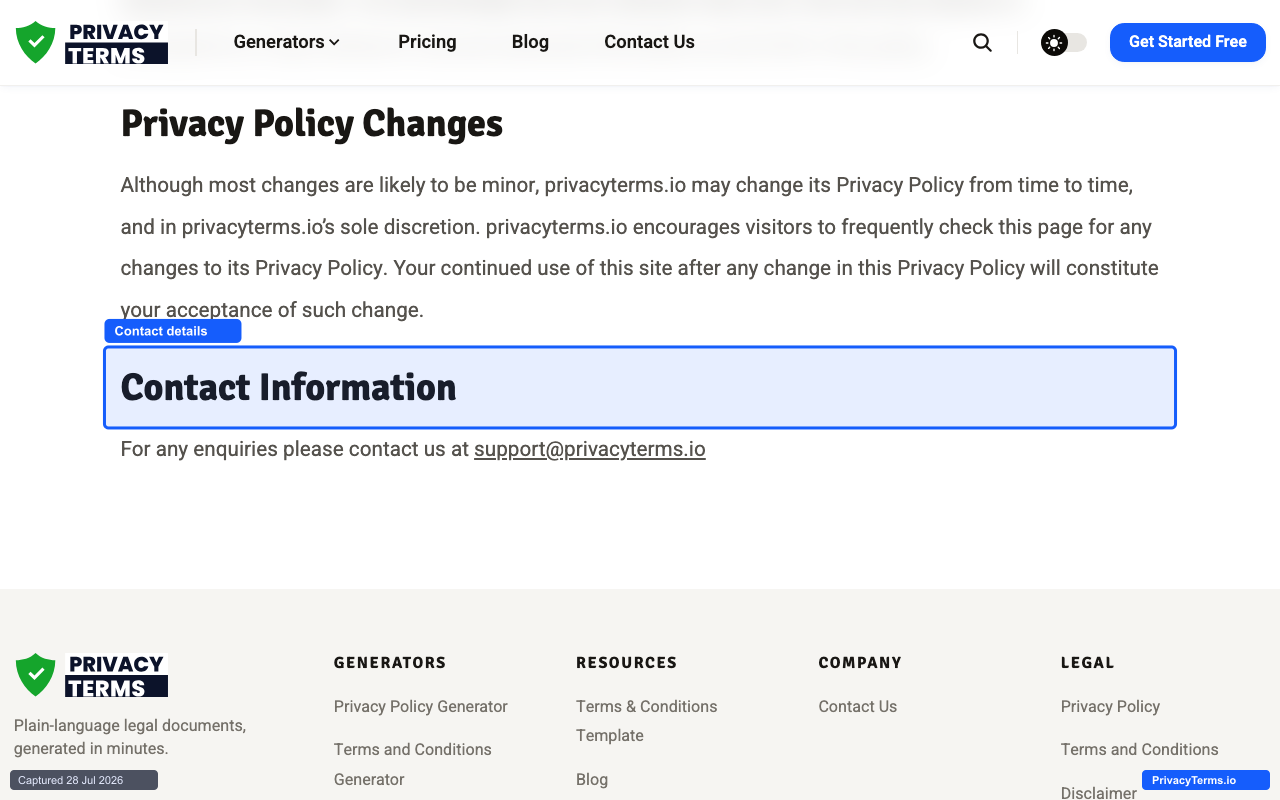
One line, one working email address. Short sections are fine as long as they're actually there.
That's it: one line, one email address. It doesn't need to be longer than that. GDPR and CCPA both require that users have a straightforward way to exercise the rights listed earlier in the document, and a working support address that people actually check satisfies that requirement better than a contact form buried three clicks deep.
What This Adds Up To
Read start to finish, our policy isn't long, and it isn't written in dense legal language. It states what's collected, why, who else sees it, how long it's kept, what rights a user has over it, and how to reach someone about it, each in its own clearly labeled section. That structure, not the specific wording, is what makes a privacy policy compliant: a regulator or a careful user needs to be able to find the answer to a specific question without reading the whole thing.
If you're writing or rewriting your own, you don't have to start from a blank page and hope you've covered everything a real policy needs. Our privacy policy generator builds this same section structure automatically from a short questionnaire about your business, so the anatomy above happens by default instead of by memory.