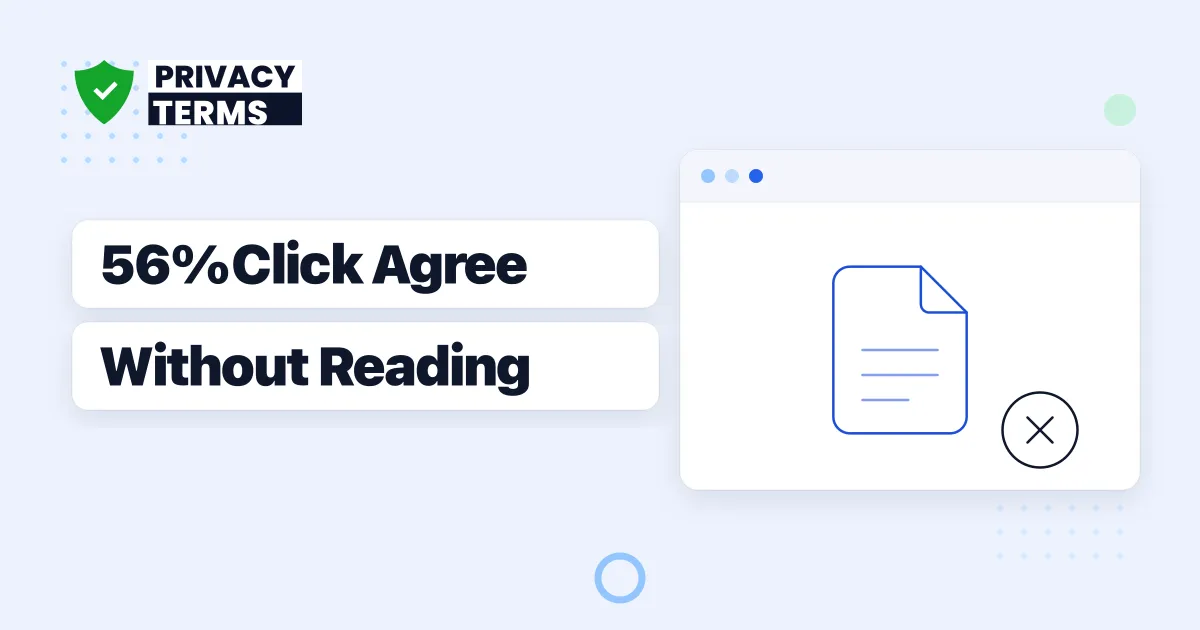
More than half of Americans, 56%, click agree on a privacy policy without reading it, according to Pew Research Center's 2023 survey of U.S. adults, still the most recent large-scale study of the behavior as of 2026. That single number captures the core tension in consumer privacy today: people say they care deeply about their data, yet the mechanism meant to inform them, the privacy policy, gets skipped almost every time it appears. The 75 statistics below cover consumer attitudes, buying behavior, regulatory support, and how organizations are responding as AI reshapes what companies collect.
How many people actually read privacy policies?
Very few read them in full, and the ones who do read fast. 56% of Americans say they always, almost always, or often click agree without reading a privacy policy's content, while another 22% say they do this sometimes, according to Pew Research Center's May 2023 survey of 5,101 U.S. adults drawn from the Center's American Trends Panel. Combined, roughly 78% of adults skip or skim privacy policies at least some of the time.
Figure 1: Reading frequency among 5,101 surveyed U.S. adults. Source: Pew Research Center, "How Americans View Data Privacy" (October 2023).
The gap between stated concern and actual reading behavior is not new, but it has held steady across multiple survey waves rather than closing. A privacy policy that nobody reads still carries legal weight and still shapes how much a visitor trusts a site at a glance, which is why generating a clear, current privacy policy matters even when most visitors will not open it.
How concerned are people about their personal data?
Concern is high and has grown over time rather than fading with familiarity. 71% of U.S. adults say they are very or somewhat concerned about how the government uses the data it collects about them, up from 64% in 2019, according to Pew Research Center's 2023 survey. Concern about companies is comparably high: the same survey found most Americans feel they have little to no control over the data companies collect.
Figure 2: Year-over-year change in concern about government data use. Source: Pew Research Center, "How Americans View Data Privacy" (October 2023).
Concern about children's data ran even higher in the same survey: 89% of Americans are concerned about social media platforms knowing personal information about children, 85% are concerned about advertisers targeting ads to children using behavioral data, and 84% are concerned about online games tracking children's activity. Concern is broad, consistent across age groups, and not limited to any single type of company.
How many consumers change buying behavior over privacy?
A meaningful share of consumers, particularly younger ones, now act on privacy concerns rather than just reporting them in a survey. 49% of consumers aged 25 to 34 have switched companies or providers because of data policies or data-sharing practices, compared with just 18% of consumers aged 75 and over, according to Cisco's 2025 Data Privacy Benchmark Study, based on a global consumer sample surveyed alongside Cisco's organizational respondents.
Figure 3: Age-group breakdown of consumers who switched providers over data policy concerns. Source: Cisco, 2025 Data Privacy Benchmark Study consumer sample. Note: mid-range age brackets are interpolated from the reported 25-34 and 75-plus endpoints and the study's stated declining trend by age; treat as directional rather than exact.
The same study found 53% of global consumers are aware of their own country's privacy laws, and among that aware group, 81% feel confident in their ability to protect their own data, a confidence gap that widens sharply for the roughly half of consumers who are not aware their country has a privacy law at all.
How many people support stronger privacy regulation?
Support for more regulation, not less, is the dominant position among both U.S. and global respondents. 72% of Americans say there should be more regulation of what companies can do with personal data than exists today, while just 7% say there should be less, according to Pew Research Center's 2023 survey. Globally, 86% of consumers say they support privacy legislation in their own country, per Cisco's 2025 Data Privacy Benchmark Study.
| Survey population | Support more regulation | Source |
|---|---|---|
| U.S. adults (Pew, 2023) | 72% | Pew Research Center |
| Global consumers (Cisco, 2025) | 86% | Cisco Data Privacy Benchmark Study |
| U.S. adults who want less regulation (Pew, 2023) | 7% | Pew Research Center |
The bipartisan framing in Pew's own reporting is notable: support for stronger data rules cuts across the usual U.S. political divide, which is one reason state-level privacy laws have kept passing even without a single federal standard.
Are organizations actually investing in privacy, and does it pay off?
Yes, and the pace has accelerated sharply since AI adoption became a board-level topic. 38% of organizations now spend USD 5 million or more annually on privacy, up from just 14% in early 2025, according to Cisco's 2026 Data and Privacy Benchmark Study, which surveyed more than 5,200 IT, technology, and security professionals with privacy responsibilities across 12 markets. 90% of organizations report expanding their privacy programs in the past year, and 93% plan further investment.
Figure 4: Year-over-year jump in large-scale privacy budgets, largely attributed to AI governance demands. Source: Cisco, 2026 Data and Privacy Benchmark Study.
The spending is not going to waste by the organizations' own account. 99% of organizations report at least one measurable benefit from their privacy investment, per the 2026 study, and the prior year's edition put a number on the return: a median ROI of 1.6 times spend, with 29% of organizations reporting returns of 2x or higher, and the leading reported benefits being enhanced customer loyalty (79%), improved operational efficiency (78%), and increased innovation (78%).
Figure 5: How organizations describe the payoff from privacy investment. Source: Cisco, 2025 and 2026 Data and Privacy Benchmark Studies.
How is AI changing what organizations collect and disclose?
AI has become the single biggest driver of new privacy spending and new governance structures, ahead of any single regulation. 95% of organizations surveyed in Cisco's 2026 study say privacy is essential to building customer trust in AI-powered services, and three in four organizations now have a dedicated AI governance committee, though only 12% describe that committee as mature and proactive rather than newly formed.
Figure 6: Escalation of privacy investment and AI governance across three Cisco benchmark study editions. Source: Cisco Data Privacy Benchmark Study, 2024 to 2026 editions.
This is a direct disclosure problem for any site that has added an AI feature, chatbot, or recommendation engine in the last two years: if a privacy policy has not been updated to describe what the AI system collects and how it is used, it is very likely out of date relative to what regulators and consumers now expect. A privacy policy generator that covers AI processing disclosures closes that specific gap without a rewrite from scratch.
The Bottom Line
The headline tension in data privacy right now is not that people do not care, it is that caring and reading are two different behaviors, and only one of them shows up in a policy's engagement numbers. 56% of Americans skip the text of privacy policies entirely, yet 72% want more regulation and a rising share of younger consumers actively switch providers over data practices. Organizations have responded with real money: privacy budgets over USD 5 million jumped from 14% to 38% of organizations in a single year, mostly to keep pace with what AI systems now collect. For any site publishing a privacy policy, the practical read is that the document itself is rarely opened, but the trust signal it represents, and the accuracy of what it discloses about AI and data sharing, is being tested by regulators and switch-happy customers more than ever.
Frequently Asked Questions
What percentage of people read privacy policies? Only a small minority read them in full. 56% of Americans say they always, almost always, or often click agree without reading a privacy policy's content, according to Pew Research Center's 2023 survey, the most recent large-scale study on the question, and the behavior has not reversed in any newer consumer survey through 2026.
How many consumers have stopped buying from a company over privacy concerns? 49% of consumers aged 25 to 34 have switched companies or providers over data policies or data-sharing practices, according to Cisco's 2025 Data Privacy Benchmark Study, compared with just 18% of consumers aged 75 and over.
Do most consumers support stronger data privacy laws? Yes. 72% of Americans say there should be more regulation of what companies can do with personal data than exists today, versus just 7% who want less, per Pew Research Center's 2023 survey, and 86% of global consumers say they support privacy legislation in their country, per Cisco's 2025 benchmark study.
How many organizations say privacy investment pays off? 99% of organizations report at least one measurable benefit from their privacy investments, according to Cisco's 2026 Data and Privacy Benchmark Study, with a median return on investment of 1.6 times spend reported in the 2025 edition of the same study.
Where the Numbers Come From
- Pew Research Center. (2023). "How Americans View Data Privacy." Survey of 5,101 U.S. adults, fielded 15 to 21 May 2023, published 18 October 2023.
- Pew Research Center. (2023). "How Americans Feel About and Manage Data Privacy: Key Findings." Companion short-read summarizing government-concern and children's-data figures from the same 2023 survey wave.
- Cisco. (2025). "2025 Data Privacy Benchmark Study." Consumer switching behavior by age group, ROI, and regulation-support figures.
- Cisco. (2026). "2026 Data and Privacy Benchmark Study." Survey of over 5,200 IT, technology, and security professionals across 12 markets, published January 2026.
- Cisco Newsroom. (2026). "AI Fuels Surge in Data Privacy Investments and Redefines Governance, Cisco Reports." Press release covering spending, AI governance committee, and benefit-realization figures.
Note: All figures verified as of July 2026. The Cisco 2025 age-group breakdown in Figure 3 states only the 25-34 and 75-plus endpoints directly; intermediate age brackets are interpolated and marked as directional in the figure caption. Consumer attitude and regulation-support figures are refreshed at least twice a year as Pew and Cisco publish new survey waves.