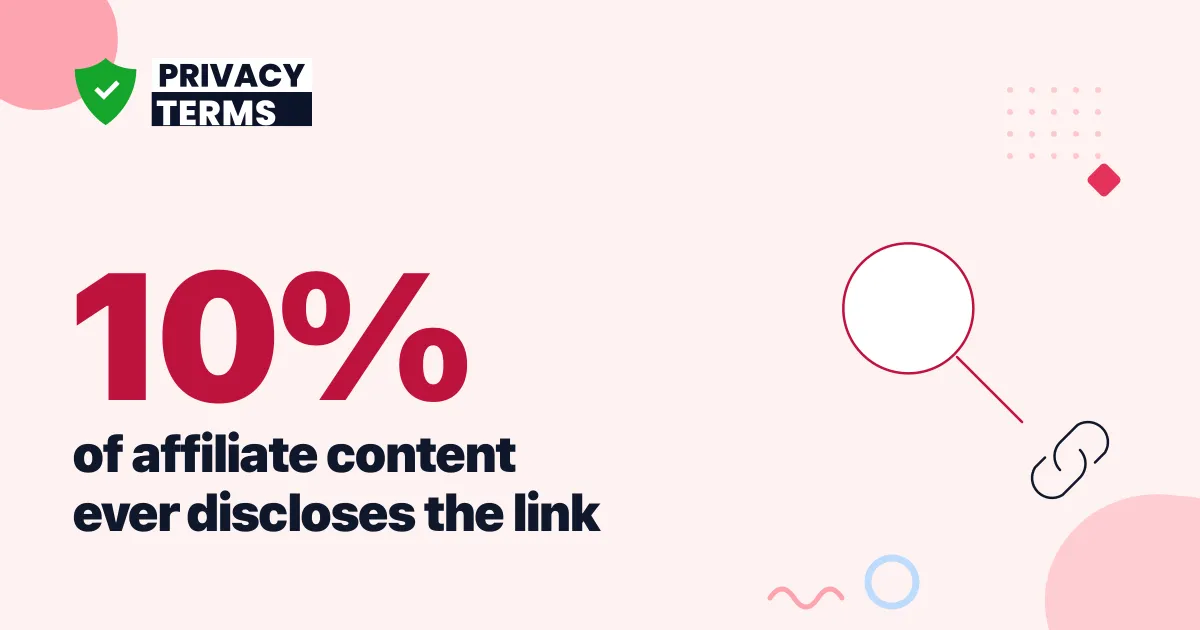
Only 10.49% of YouTube videos and 7.03% of Pinterest pins carrying affiliate links included any disclosure at all, per a Princeton University study of 2.6 million items collected in 2017 and published in November 2018. No comparably large study has measured text blogs on their own, but blogs run on the same affiliate networks and answer to the same FTC rule, so this remains the closest verified benchmark for how often affiliate content discloses the relationship today.
How many blogs disclose their affiliate links?
No large-scale study has audited text blogs specifically, separate from YouTube videos, Pinterest pins, or social posts. The closest verified benchmark comes from Mathur, Narayanan, and Chetty's 2018 study at Princeton University, which sampled 515,999 YouTube videos and 2.14 million Pinterest pins, filtered them down to the ones carrying an affiliate URL, and checked each one's description text for a disclosure statement. Blogs were not part of that sample, but they answer to the identical FTC endorsement rule and rely on the same affiliate networks, so these numbers are the best available stand-in until a blog-specific census exists.
Among the affiliate content the researchers could examine in English, disclosure was the exception rather than the rule. That gap is exactly what a website's disclaimer covering affiliate and sponsored links is meant to close, and it is why the FTC treats a missing disclosure on a blog post the same way it treats one missing from a YouTube video description.
What did the largest disclosure study find?
Out of 515,999 YouTube videos and 2.14 million Pinterest pins sampled between August and September 2017, only 3,472 videos and 18,237 pins contained an affiliate URL at all. Of the English-language subset of that affiliate content, just 10.49% of YouTube videos and 7.03% of Pinterest pins disclosed the affiliate relationship in any form.
Figure 1: Share of affiliate marketing content that carried any form of disclosure, by platform. Source: Mathur, Narayanan and Chetty, ACM CSCW 2018.
The researchers grouped disclosures into three formats: a bare "affiliate link" label, a "channel support" note asking viewers to use the link to help the creator, and an "explanation" disclosure that states the commission relationship in plain language, the format the FTC's guidelines explicitly recommend.
Figure 2: Prevalence of each disclosure format among YouTube videos with affiliate links. Source: Mathur, Narayanan and Chetty, ACM CSCW 2018.
The format the FTC recommends most was the rarest one creators actually used. A website disclaimer statistics breakdown covering fresher 2026 YouTube data shows the same pattern holding years later.
Has affiliate disclosure compliance improved since 2018?
Somewhat, though the gap remains wide. Sun, Vekaria, Shafiq, and Nithyanand's 2026 study, published at ICWSM, analyzed a 10-year dataset of over 2 million YouTube videos from nearly 540,000 creators. Among the 139,900 English-language videos carrying affiliate links, 45.52% included some form of disclosure, up sharply from the 2018 study's 10.49%. But only 12.20% of videos met the full "clear and conspicuous" FTC standard, meaning most of that improvement came from vague or ambiguous disclosures rather than genuinely compliant ones.
Figure 3: Any-disclosure rate compared with FTC-clear-compliance rate, across the two largest published studies. Sources: Mathur, Narayanan and Chetty (2018); Sun, Vekaria, Shafiq and Nithyanand (ICWSM 2026).
Both studies used different classification methods, so the two lines are not a perfect apples-to-apples trend, but the direction is consistent: disclosure has become more common, and disclosure that would actually satisfy the FTC remains rare.
What does Amazon require from blog affiliates?
Amazon's Associates Program is the affiliate network most blogs actually use. In the 2026 ICWSM study, Amazon accounted for 51.8% of all affiliate YouTube videos and 56.7% of affiliate channels, ranking highest across every content category the researchers examined, and in the 2018 study it was the most common affiliate program on both YouTube and Pinterest. Amazon's Associates Program Operating Agreement requires every participant to display the exact phrase "As an Amazon Associate I earn from qualifying purchases," or a substantially similar statement previously permitted under the agreement, placed clearly and prominently near the linked content.
Figure 4: A simplified compliance test based on Amazon's Operating Agreement and the FTC's endorsement guidelines. Sources: Amazon Associates Program Operating Agreement; Federal Trade Commission, 2023 Endorsement Guides.
Amazon's requirement is specific and unambiguous, which makes it one of the easiest disclosure rules for a blog to meet outright, and one of the easiest for an auditor or a reader to check.
Does the disclosure gap show up outside YouTube and Pinterest too?
Yes, and the pattern holds across formats. On Twitter/X, roughly 95% of sponsored posts carried no disclosure hashtag at all across more than 100 million tweets studied from 268 major US brands between 2014 and 2021, according to Ershov, He, and Seiler's 2025 Marketing Science study. Compliance also varies by content category on YouTube: Howto & Style videos, the closest analog to a blog-style product review, still ran 55.9% non-compliant in the 2026 study, while Comedy content, where affiliate use is rarer but disclosure habits are weaker, hit 92.3% non-compliant.
Figure 5: Key research and regulatory milestones in affiliate and sponsorship disclosure, 2017 to 2026. Sources: Mathur, Narayanan and Chetty (2018); Federal Trade Commission (2023); Sun, Vekaria, Shafiq and Nithyanand (ICWSM 2026); Ershov, He and Seiler (2025).
| Study | Platform | Sample size | Any-disclosure rate |
|---|---|---|---|
| Mathur et al., 2018 | YouTube | 515,999 videos sampled, 2,250 with affiliate links (English) | 10.49% |
| Mathur et al., 2018 | 2.14 million pins sampled, 11,468 with affiliate links (English) | 7.03% | |
| Sun et al., 2026 | YouTube | 2 million videos sampled, 139,900 with affiliate links (English) | 45.52% |
| Ershov et al., 2025 | Twitter/X | Over 100 million tweets, 268 brands | About 5% |
Table 1: Any-disclosure rate across the largest published affiliate and sponsorship disclosure studies. Sources listed in full below.
The Bottom Line
Every large study measured here, a 2018 audit of 2.6 million YouTube videos and Pinterest pins, a 2026 audit of 2 million more YouTube videos, and a 2025 audit of over 100 million tweets, finds the same underlying pattern: most affiliate links and sponsored content still are not disclosed the way the FTC requires, even where compliance has improved. No study has isolated blogs specifically, but blogs monetize through the same affiliate networks these studies measured, chiefly Amazon Associates, and carry the same legal obligation. A site running product reviews, roundups, or recommendation links with an Amazon tag or any other commission-based URL can close that gap directly with a disclaimer that covers affiliate and sponsored content alongside the general liability language most sites also need. For a deeper look at how affiliate disclosure has trended on YouTube specifically through 2026, see our website disclaimer usage and risk breakdown, and for practical wording examples, see our guide to writing an affiliate disclosure.
Frequently Asked Questions
What percentage of affiliate content actually discloses the link? Only 10.49% of YouTube videos and 7.03% of Pinterest pins carrying affiliate links included any disclosure at all, per a 2018 Princeton University study of 2.6 million sampled items. A 2026 follow-up study of 2 million YouTube videos found the rate had risen to 45.52%, though only 12.20% of videos met the FTC's clear-compliance standard.
Is there a study that measures blog disclosure specifically? No large-scale study has isolated text blogs from YouTube, Pinterest, or Twitter/X content. Blogs run on the same affiliate networks, chiefly Amazon Associates, which alone accounted for 51.8% of all affiliate YouTube videos in the 2026 study, and answer to the identical FTC rule, making these platform studies the closest available proxy.
What disclosure language does Amazon require from affiliates? Amazon's Associates Program Operating Agreement requires publishers to display the exact phrase "As an Amazon Associate I earn from qualifying purchases," or a substantially similar statement, clearly and prominently on their site.
How does the affiliate disclosure gap compare to sponsored social media posts? It is consistent across formats. On Twitter/X, roughly 95% of sponsored posts carried no disclosure hashtag at all across more than 100 million tweets studied from 268 major US brands between 2014 and 2021, according to a 2025 Marketing Science study, close to the pattern found in affiliate marketing content on YouTube and Pinterest.
Where the Numbers Come From
- Mathur, A., Narayanan, A., and Chetty, M. (2018). "Endorsements on Social Media: An Empirical Study of Affiliate Marketing Disclosures on YouTube and Pinterest." Proceedings of the ACM on Human-Computer Interaction, Vol 2, CSCW, Article 119. 515,999 YouTube videos and 2.14 million Pinterest pins sampled; 10.49% and 7.03% of affiliate content disclosed respectively.
- Sun, C., Vekaria, Y., Shafiq, Z., and Nithyanand, R. (2026). "Turning Trust to Transactions: Tracking Affiliate Marketing and FTC Compliance in YouTube's Influencer Economy." ICWSM 2026. 2 million videos analyzed over 10 years; 45.52% of affiliate videos carried some disclosure, 12.20% were clearly FTC-compliant.
- Ershov, D., He, Y., and Seiler, S. (2025). "Frontiers: How Much Influencer Marketing Is Undisclosed? Evidence from Twitter." Marketing Science, summarized via CEPR/VoxEU. Over 100 million tweets analyzed, 2014-2021, 268 major US brands, roughly 95% of sponsored posts undisclosed.
- Amazon.com, Inc. "Associates Program Operating Agreement." Required disclosure language for all Amazon affiliate publishers.
- Federal Trade Commission. (2023). "Federal Trade Commission Announces Updated Advertising Guides to Combat Deceptive Reviews and Endorsements." Press release, June 29, 2023, first Endorsement Guides update since 2009.
Note: All figures verified as of September 2026. The 2018 Princeton study remains the only large-scale academic measurement of affiliate disclosure prevalence with a fully disclosed sample size and methodology; no comparable study has yet isolated text blogs on their own. Figures are refreshed at least twice a year as newer studies become available.