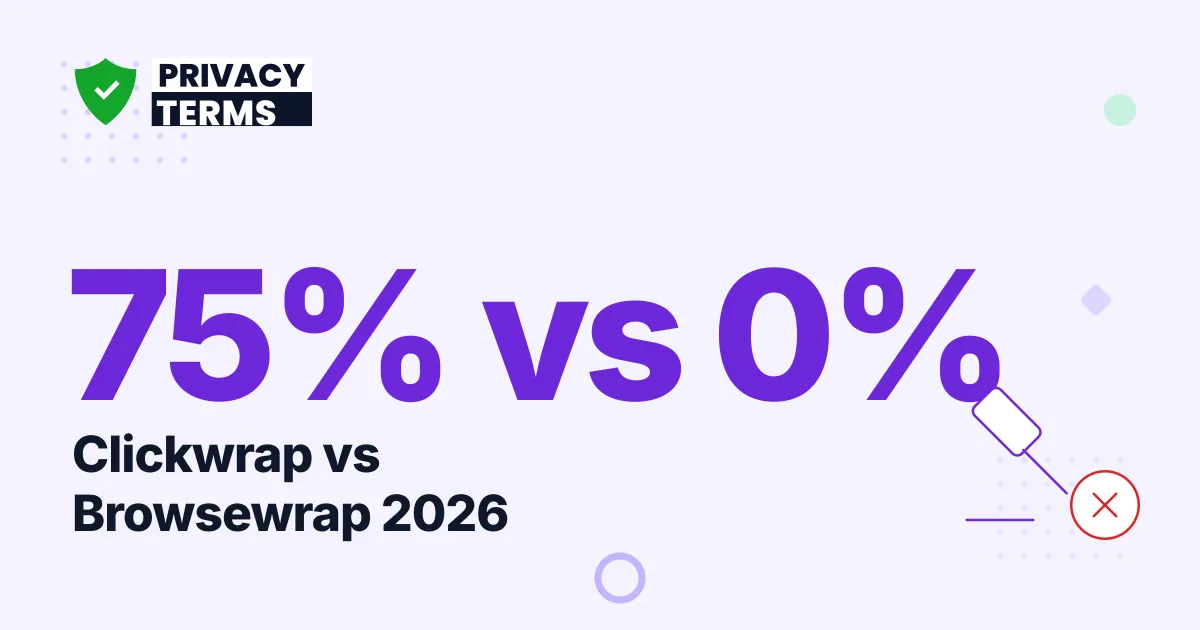
Clickwrap agreements were enforced in 75% of litigated court cases in 2021, while browsewrap agreements were enforced in exactly 0%, according to Ironclad's Clickwrap Litigation Trends Report (2022 edition). That 75-percentage-point gap is the clearest empirical evidence available that courts treat an affirmative click as categorically different from simply browsing a website.
How often do courts enforce clickwrap agreements?
Courts enforced 75% of litigated clickwrap agreements in 2021, per Ironclad's tracking, and that rate has moved substantially over the four years the report covers. In 2018, clickwrap won 97% of cases. That fell to 80% in 2019 and 70% in 2020 as courts started demanding stronger proof of acceptance, then climbed back to 75% in 2021 as companies adjusted to what judges wanted to see.
Figure 1: Clickwrap's court win rate fell sharply, then partly recovered. Source: Ironclad, Clickwrap Litigation Trends Report, 2021 and 2022 editions.
The two courts most often cited for this pattern are instructive. In Liptak v. Accelerated Inventory Management, a federal court found a binding agreement because the borrower clicked a button labeled "I Agree" to a specific loan document. In Ramirez v. Electronic Arts, the court reached the same conclusion because EA required a button click before a user could access online game features. Both cases involved a "single purpose" button, one whose only function was accepting the contract, which Ironclad's report flags as the strongest predictor of enforcement.
How often do courts enforce browsewrap agreements?
Browsewrap agreements were enforced in 0% of the cases Ironclad tracked in 2021, down from a low starting point in prior years. Only about 7% of all litigated online-agreement cases that year even involved a browsewrap claim, a sign that fewer companies are still relying on the format in the first place.
| Agreement type | Share of 2021 cases | Win rate (2021) |
|---|---|---|
| Clickwrap | 63% | 75% |
| Sign-in-wrap | 30% | 63% |
| Browsewrap | 7% | 0% |
Source: Ironclad, Clickwrap Litigation Trends Report, 2022 edition.
Case law explains why. In Nguyen v. Barnes & Noble, the Ninth Circuit refused to enforce a browsewrap agreement because nothing on the page put the user on notice that browsing meant agreeing. In Specht v. Netscape Communications, the court rejected a browsewrap link placed below the download button, reasoning that a reasonably prudent internet user had no way to know the terms existed without scrolling past the action they came to take. Hines v. Overstock.com followed the same logic: a browsewrap link buried at the bottom of the page failed to give users adequate notice. Every one of those rulings turns on the same missing ingredient: an affirmative act by the user, not just their presence on the site.
What is the difference between clickwrap, browsewrap, and sign-in-wrap?
Courts apply a two-part test to any online agreement: did the user get reasonable notice of the terms, and did the user take an action that affirmatively manifests assent to them. Where an agreement lands on that test determines which of the three labels it earns, and how likely it is to survive a challenge.
Figure 2: The two-part legal test courts apply before enforcing an online agreement. Source: Ironclad, Clickwrap Litigation Trends Report, 2021 edition, case-law analysis.
Clickwrap satisfies both prongs directly: the terms are shown, and the user clicks specifically to accept them. Sign-in-wrap satisfies the notice prong if the layout is clear, but its assent prong is weaker because the button's primary purpose is something else, like creating an account. Browsewrap usually fails the assent prong outright, since a user can complete their entire visit without ever taking an action tied to the terms.
Why do so few cases even involve browsewrap anymore?
Clickwrap accounted for 63% of all litigated online-agreement cases in 2021, versus just 7% for browsewrap, according to Ironclad. That gap reflects a business decision as much as a legal one: companies that have watched browsewrap lose in court for two decades have largely stopped relying on it.
Figure 3: Clickwrap now dominates the caseload it once shared with browsewrap. Source: Ironclad, Clickwrap Litigation Trends Report, 2022 edition.
The shift shows up across every industry Ironclad tracked in 2021. Ecommerce companies made up 13% of clickwrap litigation, the largest single industry, and won more than 60% of their cases; the losses that did occur were concentrated among companies still using sign-in-wrap or browsewrap. Finance companies made up 11% of cases and won 73% of them, a notable reversal for an industry that avoided clickwrap entirely a few years earlier over enforceability doubts. Even our companion piece on how few people actually read what they are agreeing to, in our terms of service reading-time data, underscores why courts lean so heavily on notice and format rather than on whether a user genuinely reviewed the text.
How does enforcement vary between state and federal courts?
A 2025 Southern California Law Review study by Sophie Lee sampled 40 California online-contract cases decided between 2014 and 2024, split evenly between state and federal courts, and found federal judges considerably more willing to enforce every format than their state counterparts.
| Agreement type | State court win rate | Federal court win rate |
|---|---|---|
| Clickwrap / scrollwrap | 78% (7 of 9) | 100% (6 of 6) |
| Sign-in-wrap | 50% (2 of 4) | 40% (2 of 5) |
| Browsewrap | 38% (3 of 8) | 67% (6 of 9) |
Source: Sophie Lee, "Getting a Bad Wrap: An Analysis of Online Contract Cases in California After Step-Saver and ProCD," Southern California Law Review, Vol. 98, No. 2 (2025).
Of the 20 California state-court cases sampled, 9 involved clickwrap, 8 involved browsewrap, and 4 involved sign-in-wrap, with one case touching both browsewrap and sign-in-wrap elements. Federal courts split similarly, with clickwrap and scrollwrap combined appearing in 6 of the 20 cases, browsewrap in 9, and sign-in-wrap in 7. The study's central finding is that California courts have not settled on one uniform notice standard, instead deciding each case on the specific screen design in front of them, which is exactly why the 2021 nationwide 0% browsewrap figure should be read as a strong trend rather than an absolute rule.
Are courts getting stricter on online agreement formation in 2026?
Yes, and recent appellate rulings make that trend explicit rather than just statistical. The Eleventh Circuit's May 2026 decision in Tejon v. Zeus rejected a terms of service hyperlink written in small gray text beneath large red action buttons, with the majority stating plainly that the company should have used a clickwrap or scrollwrap format instead. That followed a similar warning from the Ninth Circuit in Chabolla v. ClassPass, and from the Seventh Circuit's more forgiving 2024 ruling in Domer v. Menard, which upheld a hybrid-wrap agreement only because the terms link sat directly beneath the submit button the user clicked.
Figure 4: Two decades of case law have narrowed the safe path to clickwrap and scrollwrap. Source: Ironclad case history; Nguyen v. Barnes & Noble, 763 F.3d 1171 (9th Cir. 2014); Domer v. Menard, 116 F.4th 686 (7th Cir. 2024); Tejon v. Zeus, 11th Cir. (2026).
The direction across every recent ruling is the same: judges are narrowing, not widening, the set of formats they consider reliably enforceable, and browsewrap sits furthest outside that narrowing set.
The Bottom Line
The gap between clickwrap and browsewrap is not a close call. A 75% win rate against 0% in the same year, confirmed by an independent 40-case academic study showing the same direction if not the same magnitude, is about as strong a signal as court data gets. If your site still relies on a browsewrap notice, or on a sign-in-wrap button whose primary purpose is not agreement, the enforcement math is working against you every year courts revisit the question. Drafting a clickwrap-ready terms and conditions page, one that pairs a checkbox with a hyperlinked agreement by default, is now the baseline expectation rather than a defensive extra. You can generate a clickwrap-ready terms and conditions page built around the notice-and-assent structure courts already reward, and if you would rather understand what a lawyer-drafted version costs first, see our data on terms and conditions lawyer fees for the market rate comparison.
Frequently Asked Questions
What percentage of clickwrap agreements are enforced in court? 75% of litigated clickwrap agreements were enforced in 2021, up from 70% in 2020, according to Ironclad's Clickwrap Litigation Trends Report (2022 edition). That is the highest confirmed rate since 2019's 80%, though still below 2018's 97%.
What percentage of browsewrap agreements are enforced in court? 0% of litigated browsewrap cases were enforced in 2021, per the same Ironclad report. A separate 2025 Southern California Law Review study of 40 California cases from 2014 to 2024 found a less extreme but still lopsided picture: browsewrap won 38% of the time in state court and 67% in federal court, against 78% and 100% for clickwrap.
What is the difference between clickwrap, browsewrap, and sign-in-wrap? Clickwrap requires an explicit action, typically checking a box or clicking a button labeled I agree. Browsewrap claims the user agreed simply by using the site, with no action required. Sign-in-wrap sits in between: the user clicks a button for an unrelated purpose, such as Sign Up, while a nearby notice states that doing so also means accepting the terms.
Are courts getting stricter on online agreement formation in 2026? Yes. The Eleventh Circuit's May 2026 ruling in Tejon v. Zeus rejected a hyperlinked terms of service buried in small gray text, echoing the Ninth Circuit's 2025 warning in Chabolla v. ClassPass that clickwrap and scrollwrap are becoming the only reliable safe harbors for online contract formation.
Where the Numbers Come From
- Ironclad. (2022). "Clickwrap Litigation Trends Report, 2022 Edition." Clickwrap 63% of 2021 cases at a 75% win rate; sign-in-wrap 30% of cases at 63%; browsewrap 7% of cases at 0%; overall online-agreement win rate 66% for 2021.
- Ironclad. (2021). "Clickwrap Litigation Trends Report, 2021 Edition." Clickwrap win rate 97% in 2018, 80% in 2019, 70% in 2020; overall online-agreement win rate 60% in 2020 versus 70% in 2019.
- Sophie Lee, Southern California Law Review. (2025). "Getting a Bad Wrap: An Analysis of Online Contract Cases in California After Step-Saver and ProCD." Vol. 98, No. 2. 40-case sample of California state and federal courts, 2014 to 2024.
- Justia. Domer v. Menard, Inc., 116 F.4th 686 (7th Cir. 2024), decided September 3, 2024.
- Eric Goldman, Technology and Marketing Law Blog. (2026). "11th Circuit Rejects TOS Formation, Tejon v. Zeus." Decided May 1, 2026.
Note: All figures verified as of September 2026. The 2021 case-year data is the most recent full-year breakdown publicly tracked by agreement type; case-law commentary on 2024 to 2026 rulings is included to show the direction courts have moved since, and this post will be refreshed if a newer litigation-tracking report is published.


![$3.31 Billion in Dark Pattern Fines: The Full Case List [2026]](/_astro/dark-pattern-fines-and-cases-2026.DzPrV2ck_Z9Uyfc.webp)