Most SaaS terms and conditions pages get written once, by whoever was available, and then left alone for years while the product they govern changes underneath them. The twenty pages below are the exception: they come from companies with enough scale and enough legal exposure that the document actually got engineered, not just drafted, and the engineering choices are visible if you know where to look. Some split their terms by customer tier, some route an entire agreement off to a different domain, some put a third-party fairness rating above the fold. None of it is boilerplate.
That is worth paying attention to whether you run a five-person SaaS or a five-hundred-person one, because a terms page is one of the few pieces of a product that a customer’s legal or procurement team actually reads line by line before a contract gets signed. A page that is vague about who it applies to, or buries a clause a buyer specifically needs to find, costs deals in a way a slightly plain design never will. The examples below are grouped by the kind of company running them, since a collaboration tool, a CRM platform, and a document-signing service each have a genuinely different shape of legal problem to solve.
What Makes a SaaS Terms and Conditions Page Worth Copying
A handful of structural choices show up again and again across the pages below, independent of how the company otherwise brands its legal hub:
- The scope is stated before the clauses are. A reader can tell, in the first paragraph or the first sidebar click, whether this specific document governs their plan, their role, or their account type.
- Self-serve and enterprise get separate documents, not one contract stretched to cover both a solo signup and a negotiated multi-year deal.
- Dispute-resolution and liability clauses get their own visible heading, not folded into a catch-all “Miscellaneous” section where a reader has no reason to look.
- Version history and effective dates are dated plainly, so a returning customer can tell whether anything changed since they last agreed to it.
- Product-specific risk, AI features, translation conflicts, data export windows, gets its own named clause instead of being absorbed into general boilerplate that was written before that feature existed.
Keep these five in mind while reading through the examples. Where a page skips one anyway and still works, or skips one and the gap actually matters, the entry below says so.
Collaboration & Productivity Tools
Workplace software has a structural problem none of these five entirely avoid: most people using the product never signed up for it themselves, someone else in their organization did. How each company splits rights and obligations between the paying customer and the individual clicking into a shared workspace is the thread worth watching across this group.
1. Slack
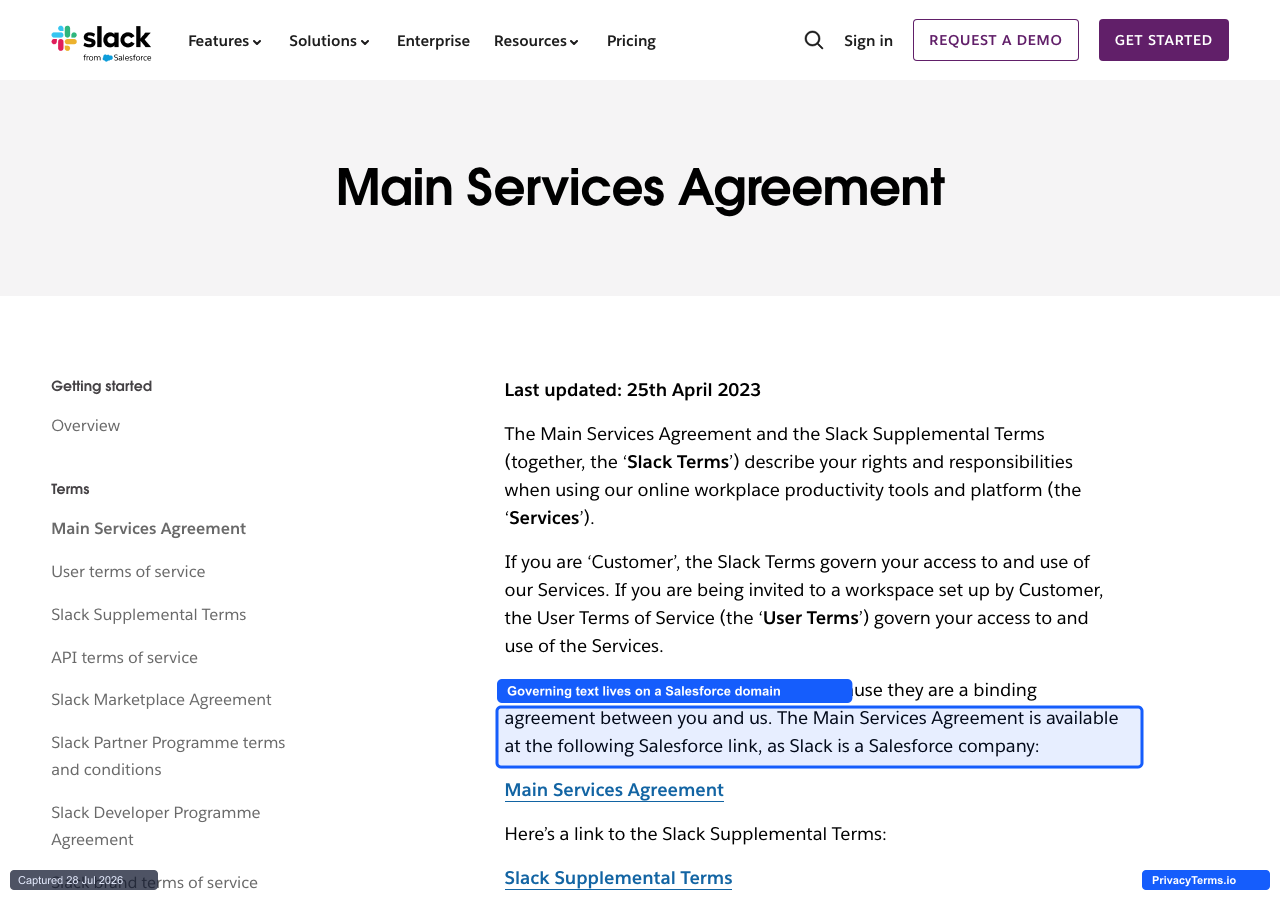
Slack's Main Services Agreement page, pointing to a Salesforce-hosted contract
Slack’s Main Services Agreement page is less a contract than a routing page: the paragraph under “Last updated: 25th April 2023” states plainly that “the Main Services Agreement is available at the following Salesforce link, as Slack is a Salesforce company,” and the actual governing text lives off-site on a Salesforce-hosted document rather than on slack.com itself. Before a reader even reaches that handoff, the page draws a clean split between two audiences: if you are “Customer,” the entity that set up the workspace, the Main Services Agreement governs you, while anyone merely invited into someone else’s workspace falls under the separate User Terms of Service instead. That two-tier structure matters for a workplace tool where most people who touch the product never bought it themselves, since it puts the liability and acceptable-use obligations on the paying organization rather than every individual clicking into a channel. The tradeoff is discoverability: a member who wants to know their own rights has to first figure out which of the two documents actually applies to them, and then, for Customers, follow an external link to a different company’s domain to read the real terms.
2. Figma
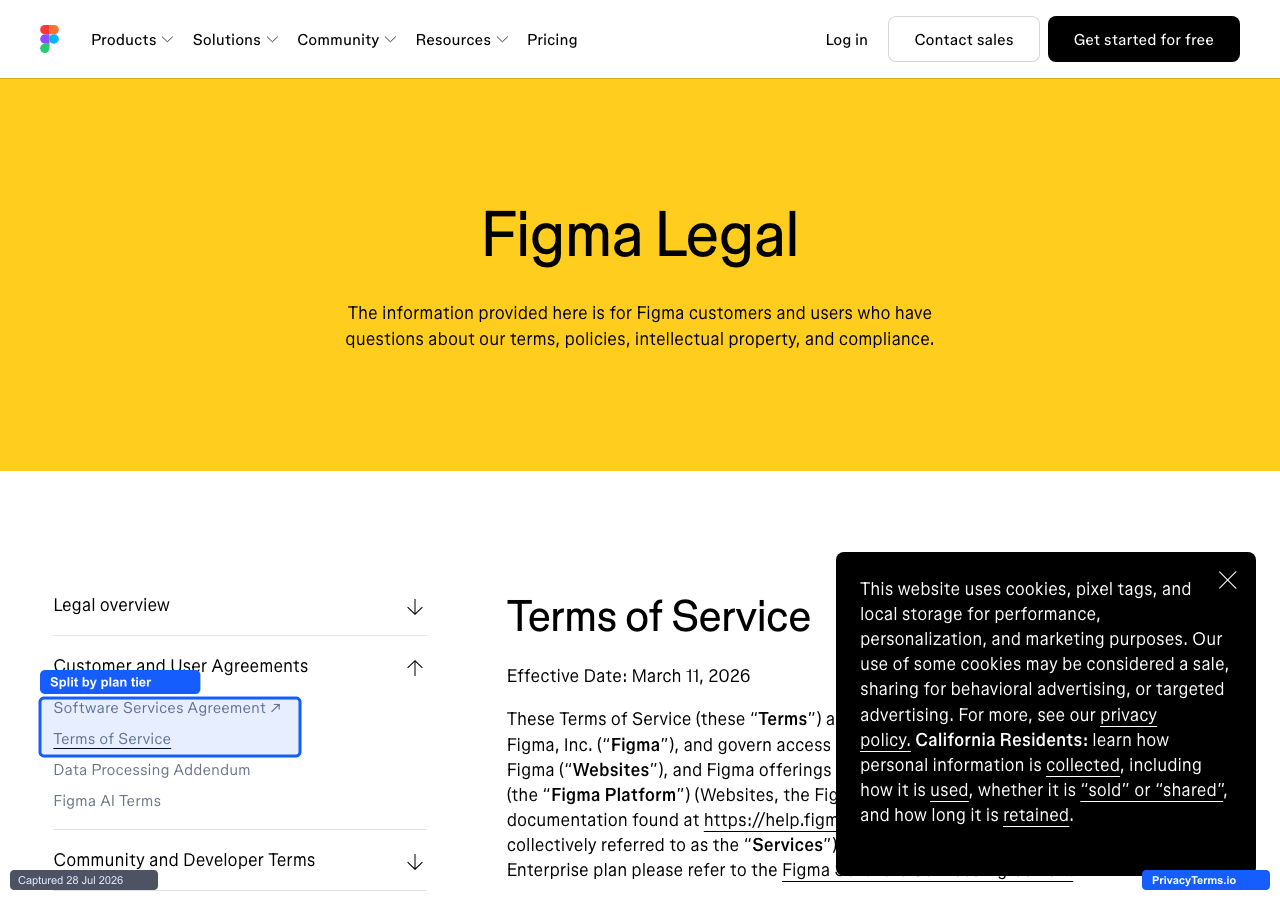
Figma's Legal hub sidebar, splitting Terms of Service from the Enterprise-only Software Services Agreement
Figma’s legal hub draws its plan-tier line directly into the sidebar navigation rather than a footnote: “Software Services Agreement” sits with an external-link arrow next to “Terms of Service,” the page currently open, and the intro paragraph itself instructs that for an “Enterprise plan please refer to the Figma” Software Services Agreement instead of the document being read. In practice that means Starter and Professional customers, the self-serve tiers signing up with a credit card, are bound by the public Terms of Service page, while Organization and Enterprise customers, who negotiate a contract, fall under a separate agreement entirely. For a design tool whose free and paid individual tiers exist right alongside enterprise deployments used by hundreds of seats, splitting the governing document by commercial tier rather than writing one contract to cover both is a sensible way to keep consumer-style terms readable without diluting the enterprise contract’s negotiated protections. The limitation is that a reader has no way to tell, from the Terms of Service page alone, which specific clauses would change under the Enterprise version without requesting that separate document.
3. Asana
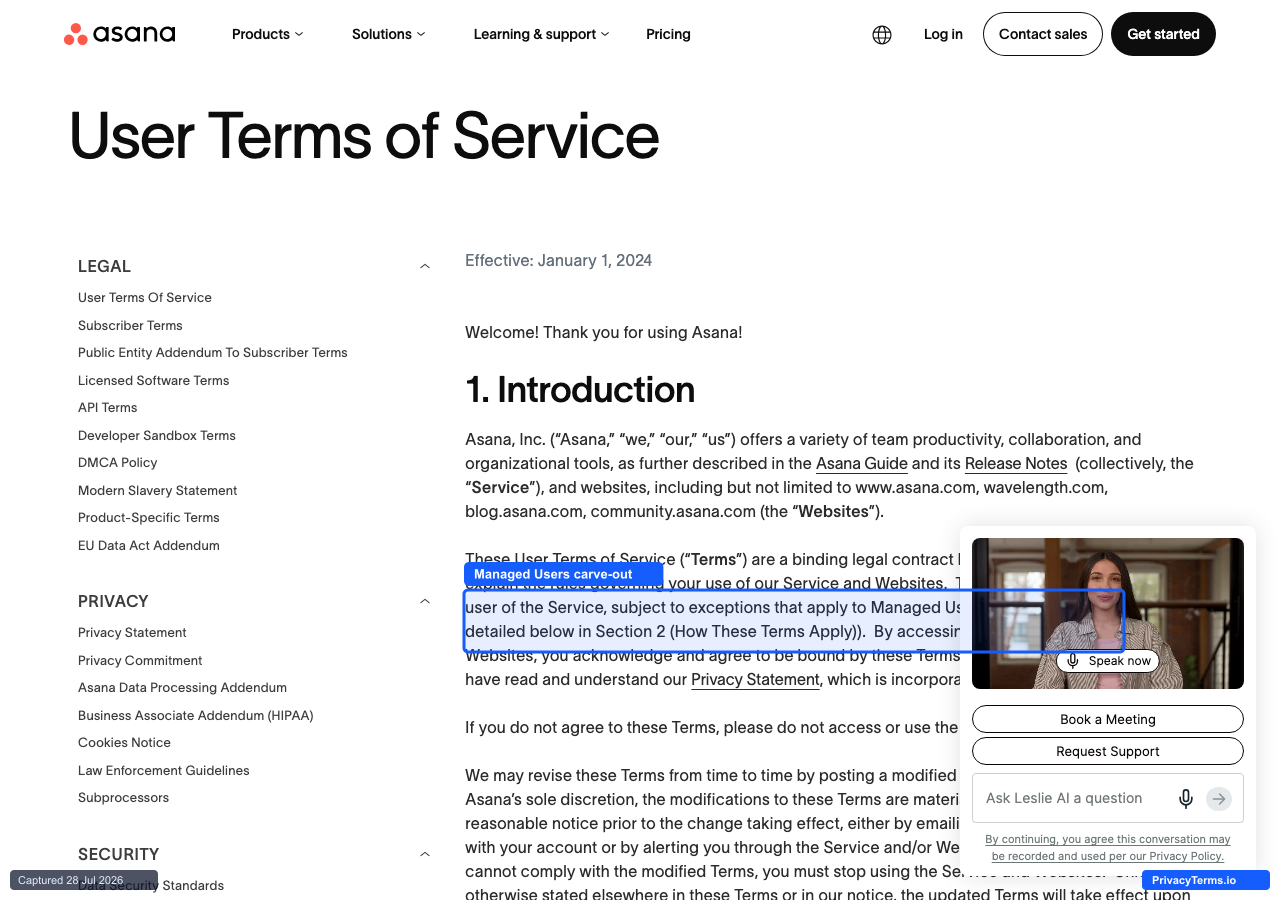
Asana's User Terms of Service, highlighting the Managed Users carve-out in Section 1
Asana’s User Terms of Service introduces a carve-out in its very first section that is easy to skim past: the Terms “are a binding legal contract” governing “your use of the Service and Websites,” but immediately qualifies that scope as “subject to exceptions that apply to Managed Users detailed below in Section 2 (How These Terms Apply).” A Managed User, in Asana’s structure, is someone added to a workspace an organization administers, so their actual rights and restrictions are set by their employer’s agreement with Asana rather than by the individual clicking through this page. That distinction is a genuinely useful one for a collaboration tool where a large share of accounts are provisioned by an IT admin rather than self-signed, since it avoids the awkward legal fiction of treating an assigned work account the same as a person who signed up on their own. The cost is that the document you are actually looking at, the User Terms most search results surface, does not fully describe what governs a large share of its own user base, and Section 2 has to be read before assuming the rest of the page applies.
4. Atlassian (Trello)
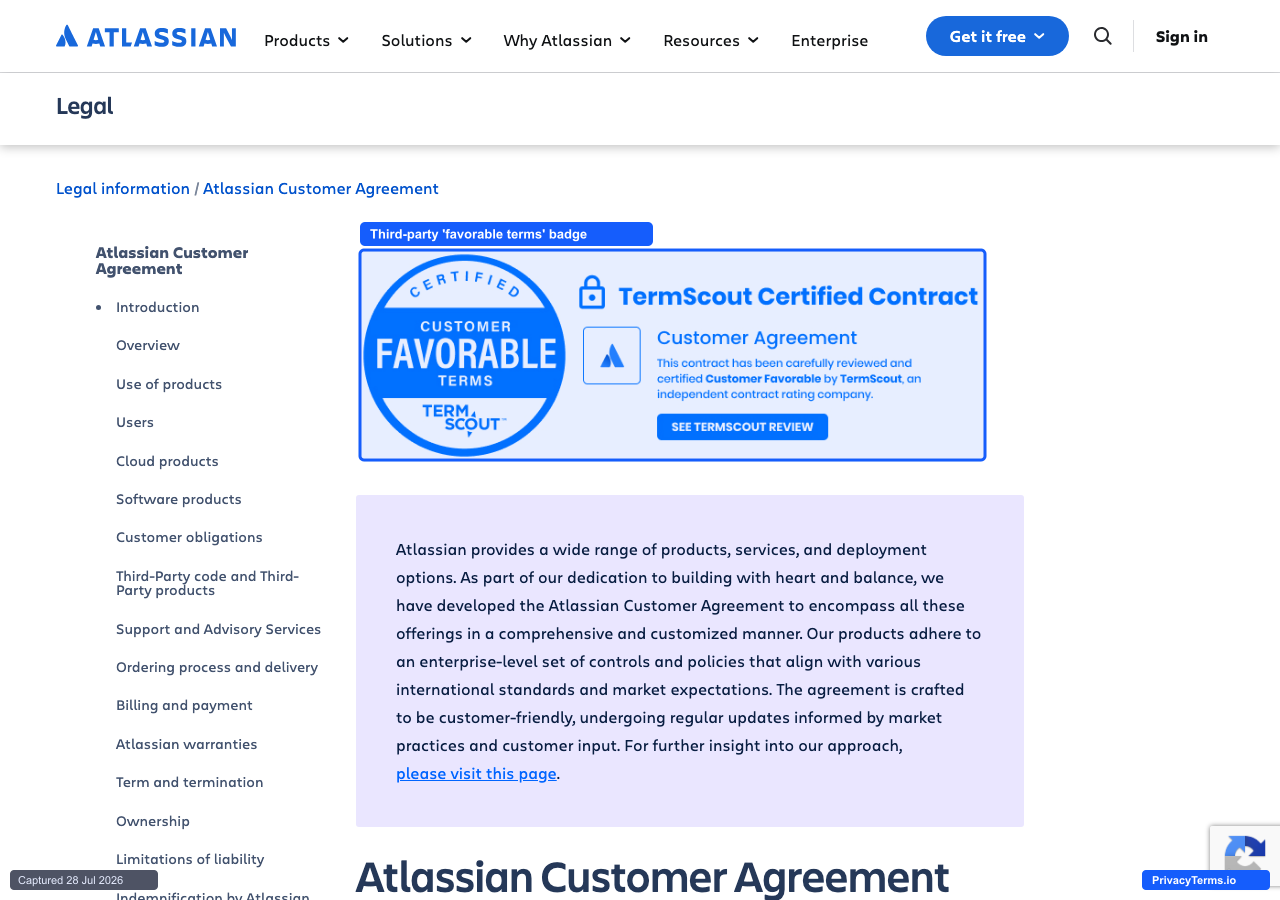
The Atlassian Customer Agreement covering Trello, with its TermScout "Customer Favorable" certification badge
The Atlassian Customer Agreement, the umbrella contract that now covers Trello alongside Jira and Confluence, opens with an unusual addition for a legal document: a boxed graphic reading “TermScout Certified Contract,” stamped “Certified Customer Favorable Terms,” describing itself as a contract “carefully reviewed and certified Customer Favorable by TermScout, an independent contract rating company.” Rather than writing a Trello-specific terms page, Atlassian folds every product, deployment option, and support tier into one agreement, with separate sections in the sidebar for “Cloud products” and “Software products” rather than separate documents per brand, which is a defensible way to keep one consistent liability and termination framework across an entire product family a customer might expand into over time. The third-party favorability badge is the more debatable choice: it is a legitimate, independently issued rating rather than a made-up seal, but placing a certification badge for the company’s own benefit at the very top of the contract a customer is about to be bound by reads more like marketing collateral than legal disclosure.
5. Miro
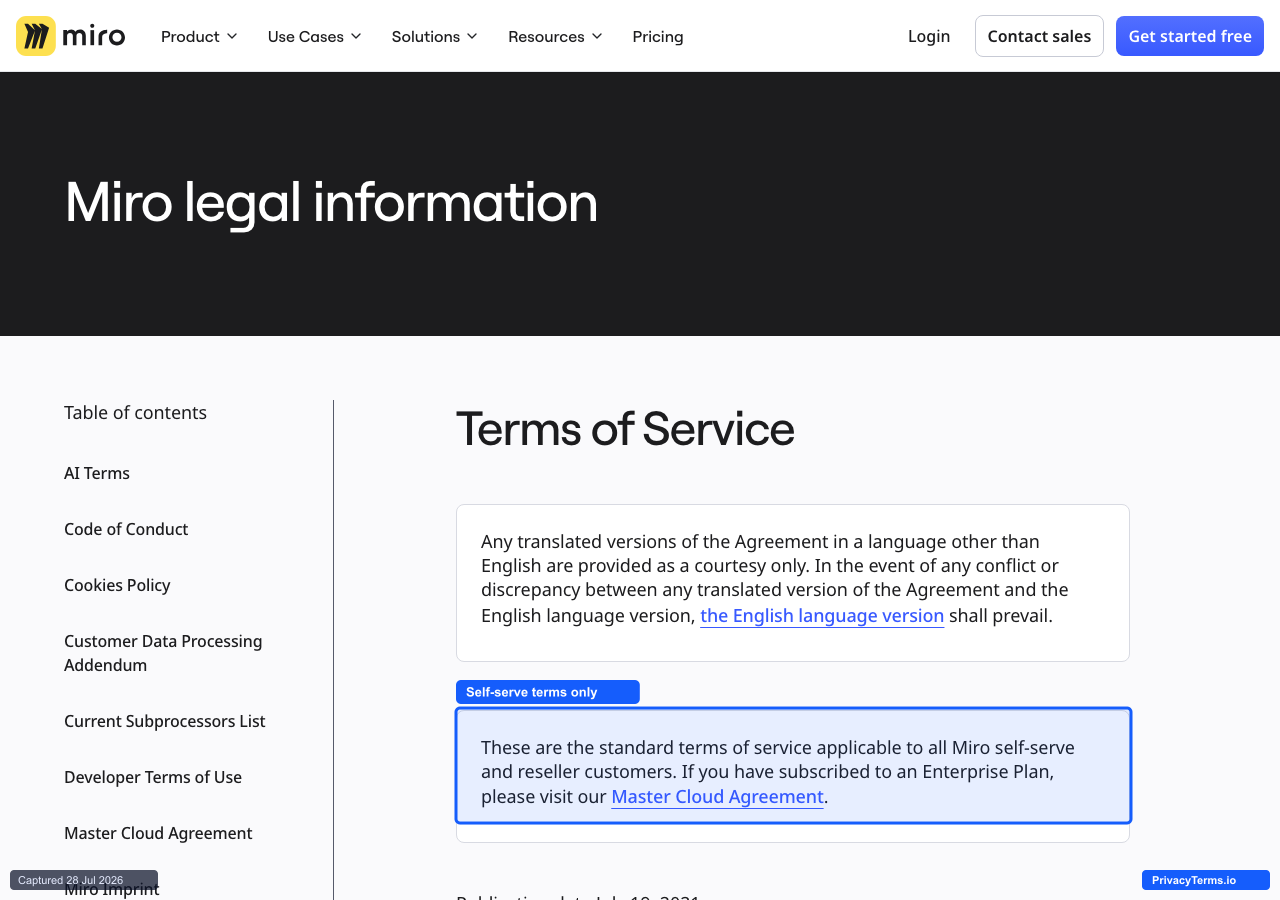
Miro's Terms of Service, stating upfront that it applies only to self-serve and reseller customers
Miro’s Terms of Service states its scope before the document even reaches “1. Introduction”: the second boxed notice on the page reads “these are the standard terms of service applicable to all Miro self-serve and reseller customers. If you have subscribed to an Enterprise Plan, please visit our Master Cloud Agreement.” That is the same self-serve-versus-enterprise split Figma makes elsewhere in this cluster, but Miro surfaces it as the first substantive statement a reader encounters rather than a sidebar link competing with a dozen other document titles, which means nobody gets three paragraphs into reading terms that do not apply to their plan before finding out. The adjacent notice, that translated versions of the agreement are “provided as a courtesy only” and the English version prevails in any conflict, is worth noting for the same reason: it is stated plainly and early rather than buried near the signature block, useful for a whiteboarding tool used by teams across dozens of countries who may be reading a translated version without realizing it is not the legally controlling one.
CRM & Marketing Platforms
Companies selling into a marketing or support workflow tend to sign up customers through a self-serve funnel first and a procurement review second, if ever. Two of the five below lean on a third-party contract rating to shortcut that review, a pattern worth studying on its own once you see how differently the other three handle disclosure instead.
6. HubSpot
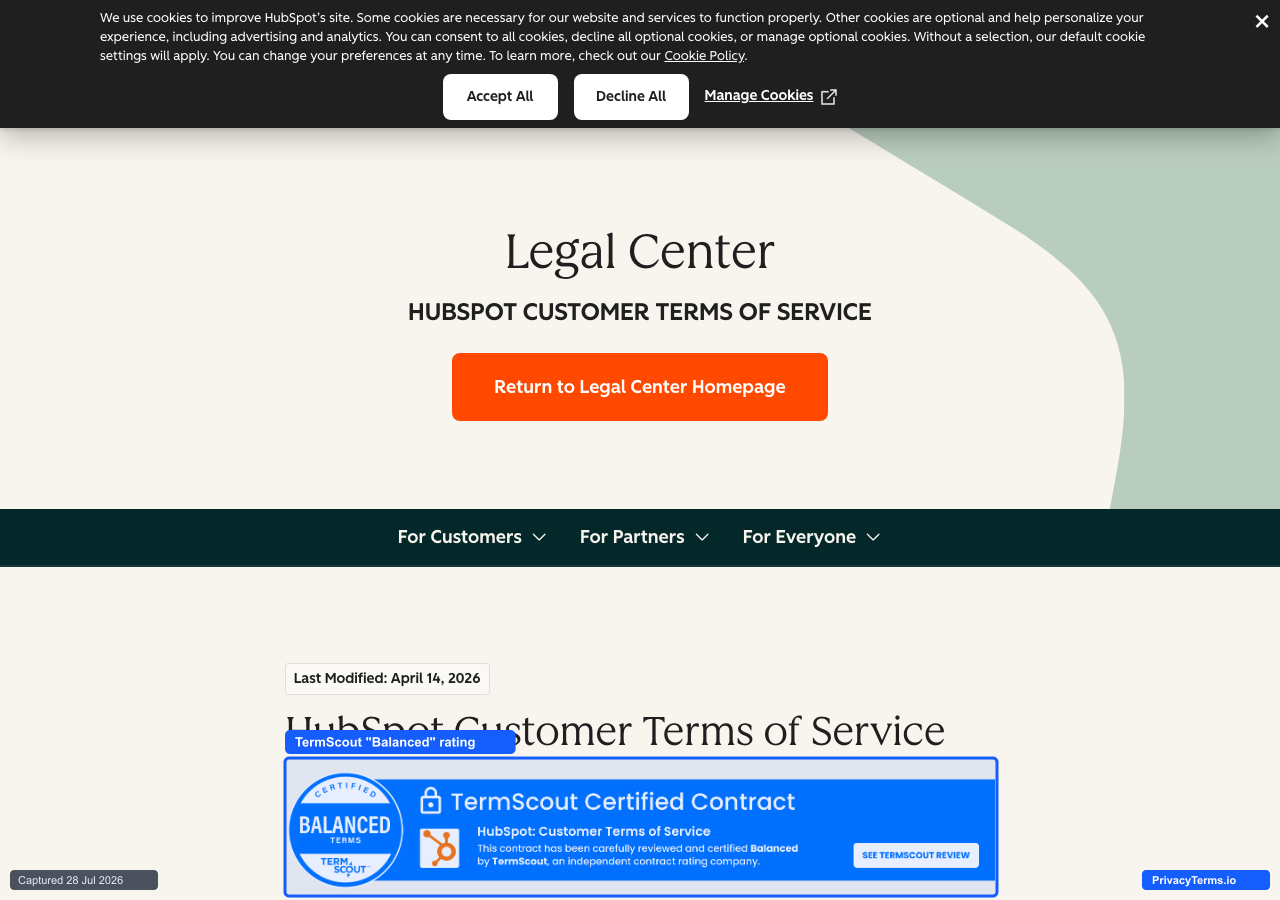
HubSpot's Customer Terms of Service page displaying a TermScout "Balanced" contract certification badge
HubSpot’s Customer Terms of Service page does something few SaaS legal pages bother with: it puts a third-party grade on the contract itself, a blue TermScout seal stating the agreement “has been carefully reviewed and certified Balanced by TermScout, an independent contract rating company,” sitting directly under the document title rather than buried in an appendix. For a CRM platform sold largely through a self-serve funnel where a small marketing team may never loop in counsel before clicking accept, a legible, independently audited signal of contract fairness does real work that dense clause text cannot: it tells a skimming buyer, at a glance, that a lawyer has already looked at this. The page also timestamps itself plainly, “Last Modified: April 14, 2026,” so a returning customer can tell at a glance whether anything has changed since their last review. The gap is that the badge states a conclusion without showing its work: it does not say which specific clauses, indemnification scope, termination notice, liability caps, earned the “Balanced” label on this pass, so a buyer who wants to verify the rating still has to read the underlying terms in full rather than trust the seal alone.
7. Mailchimp
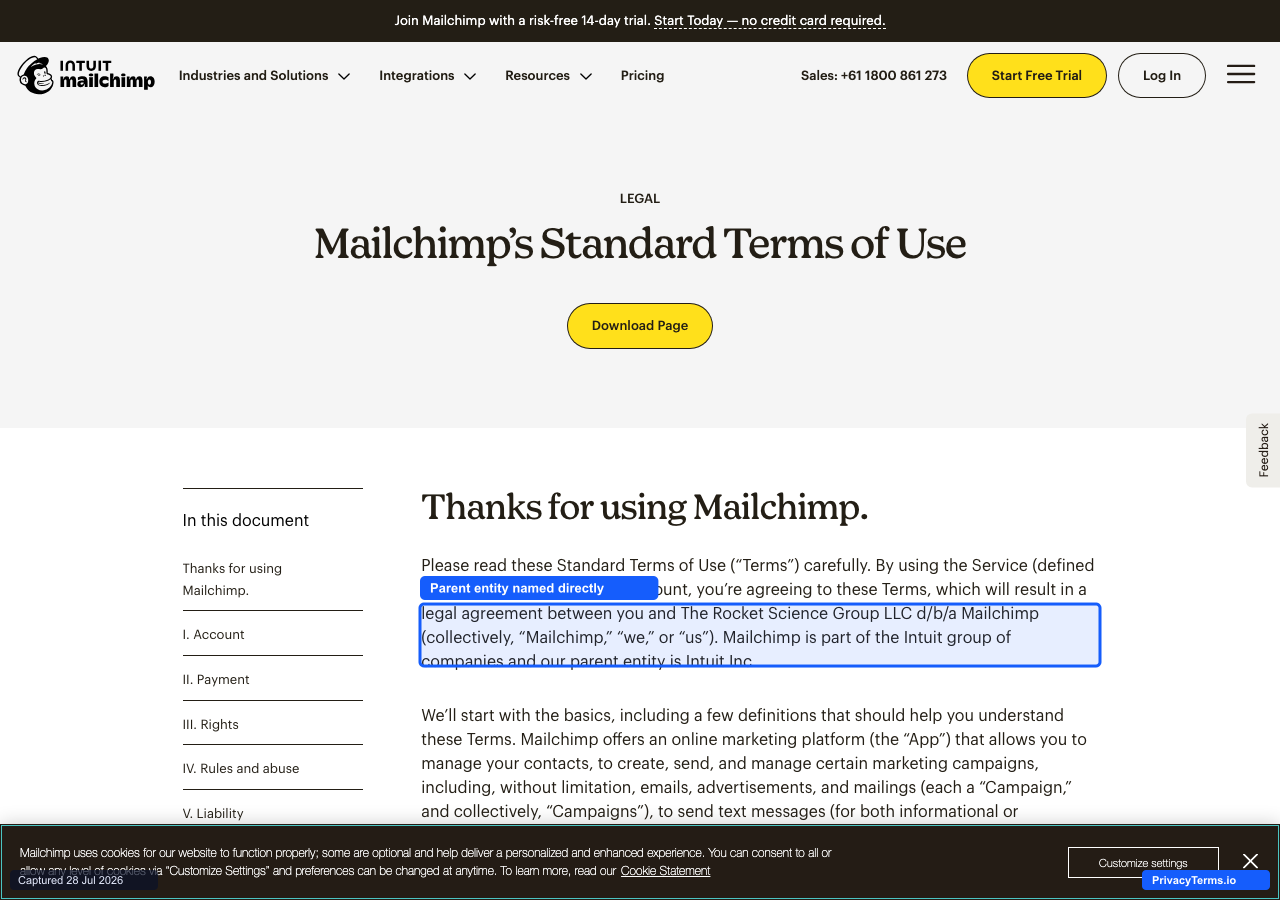
Mailchimp's Standard Terms of Use naming The Rocket Science Group and parent entity Intuit Inc. in its opening paragraph
Mailchimp’s Standard Terms of Use resolves a question a lot of marketing-platform customers do not think to ask until it matters: which legal entity actually holds their contact lists and campaign data. Rather than leaving that for a definitions section three screens down, the opening paragraph states it directly: “you’re agreeing to these Terms, which will result in a legal agreement between you and The Rocket Science Group LLC d/b/a Mailchimp,” immediately followed by “Mailchimp is part of the Intuit group of companies and our parent entity is Intuit Inc.” That is a genuinely useful disclosure for a company built through acquisition, since a small business owner uploading a customer email list reasonably wants to know if that data sits inside the same corporate family as a tax-prep and accounting giant before they agree to anything. What the terms page does not do is follow that sentence with any specifics about how data actually moves between Mailchimp and other Intuit products, that detail lives in the privacy policy instead, so a reader who stops at the naming of the parent company and assumes the terms page has told them the whole story about data sharing has not actually gotten a complete answer here.
8. Zendesk
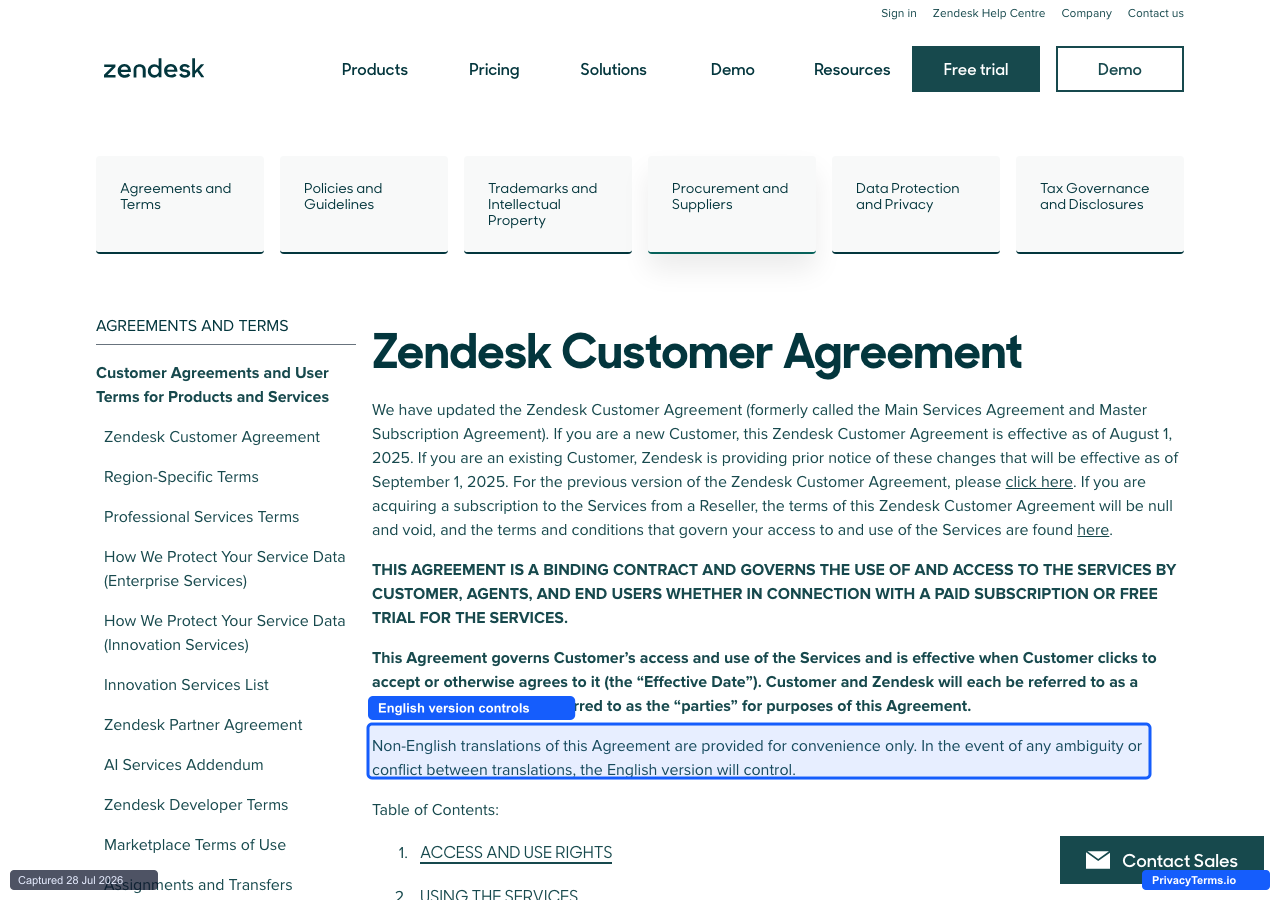
Zendesk Customer Agreement page showing its renamed title and English-controls translation clause
Zendesk’s current agreement opens by naming its own history rather than pretending it arrived fully formed: “We have updated the Zendesk Customer Agreement (formerly called the Main Services Agreement and Master Subscription Agreement),” effective August 1, 2025 for new customers and staggered a month later, September 1, for existing ones, so a long-time customer is not held to new terms the same day a brand-new signup is. Further down sits a clause worth studying for any support or CRM vendor selling into non-English-speaking markets: “Non-English translations of this Agreement are provided for convenience only. In the event of any ambiguity or conflict between translations, the English version will control.” That is the same function a governing-law clause serves for jurisdiction, just applied to language instead of courts, and it is an honest thing to state plainly rather than let a customer assume the translated copy they actually read is the binding one. The tradeoff is that a support team reading only the localized version has no way to know, from that version alone, where a translation might diverge from the English text that actually governs a dispute.
9. Intercom
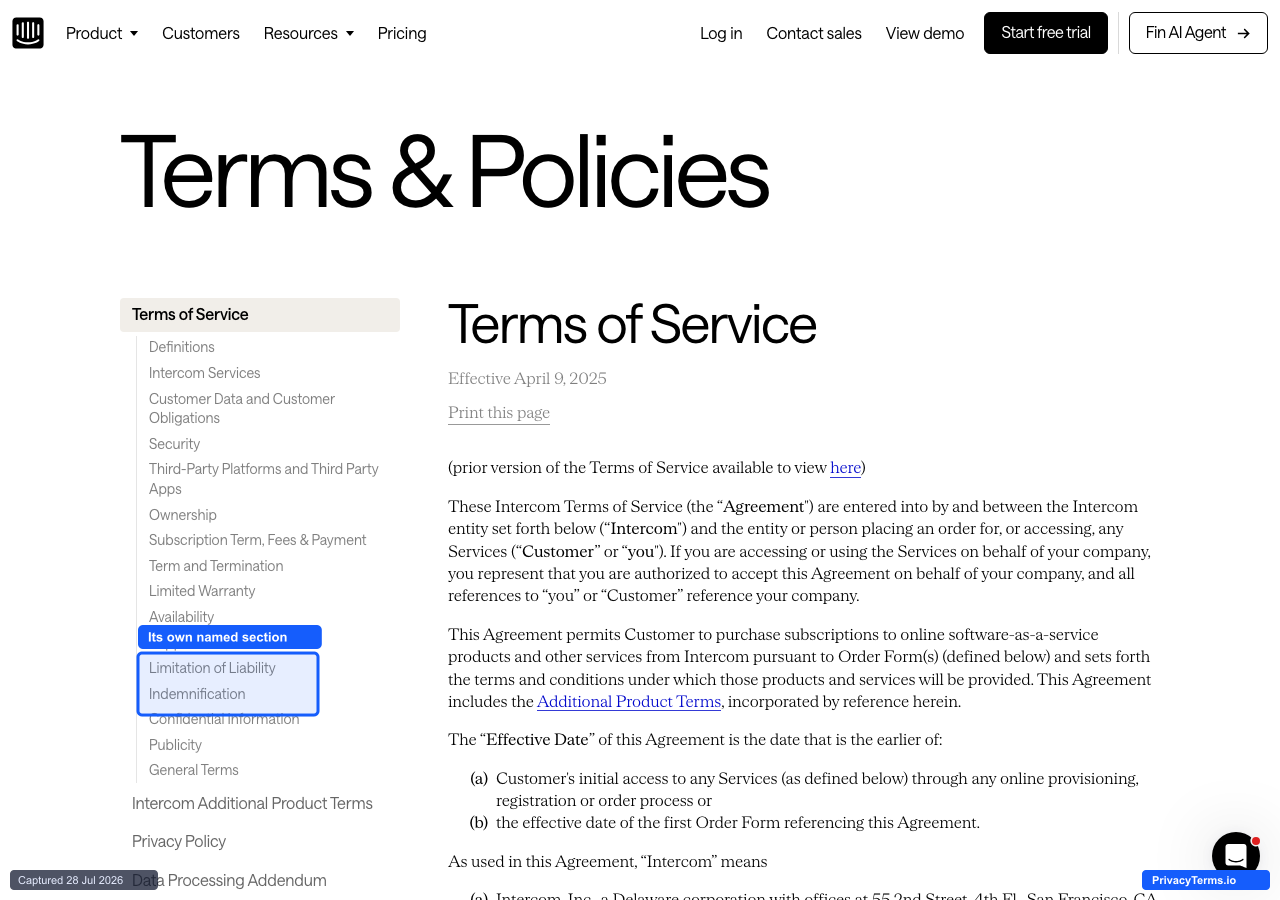
Intercom's Terms of Service table of contents with Limitation of Liability and Indemnification as separate named sections
Intercom’s Terms of Service, effective April 9, 2025 and linked against a prior version for anyone tracking changes, structures its left-hand table of contents so that “Limitation of Liability” and “Indemnification” sit as two separate, individually clickable entries rather than one combined “Legal” heading covering both. That distinction matters more for a customer messaging platform than it would for a simpler tool, since indemnification, who is responsible if a customer’s own conversation content triggers a third-party claim, is a genuinely different question from a liability cap on Intercom’s own service failures, and a support ops lead trying to answer one specific question during a procurement review can jump straight to the relevant section instead of reading a merged clause to figure out which sentence applies to their scenario. The limitation is that convenience stops at navigation: the page links to a prior version of the terms but does not summarize what actually changed between the two, so a returning customer who wants to know whether the liability or indemnification language shifted still has to open both versions and compare them clause by clause rather than read a changelog.
10. Freshworks
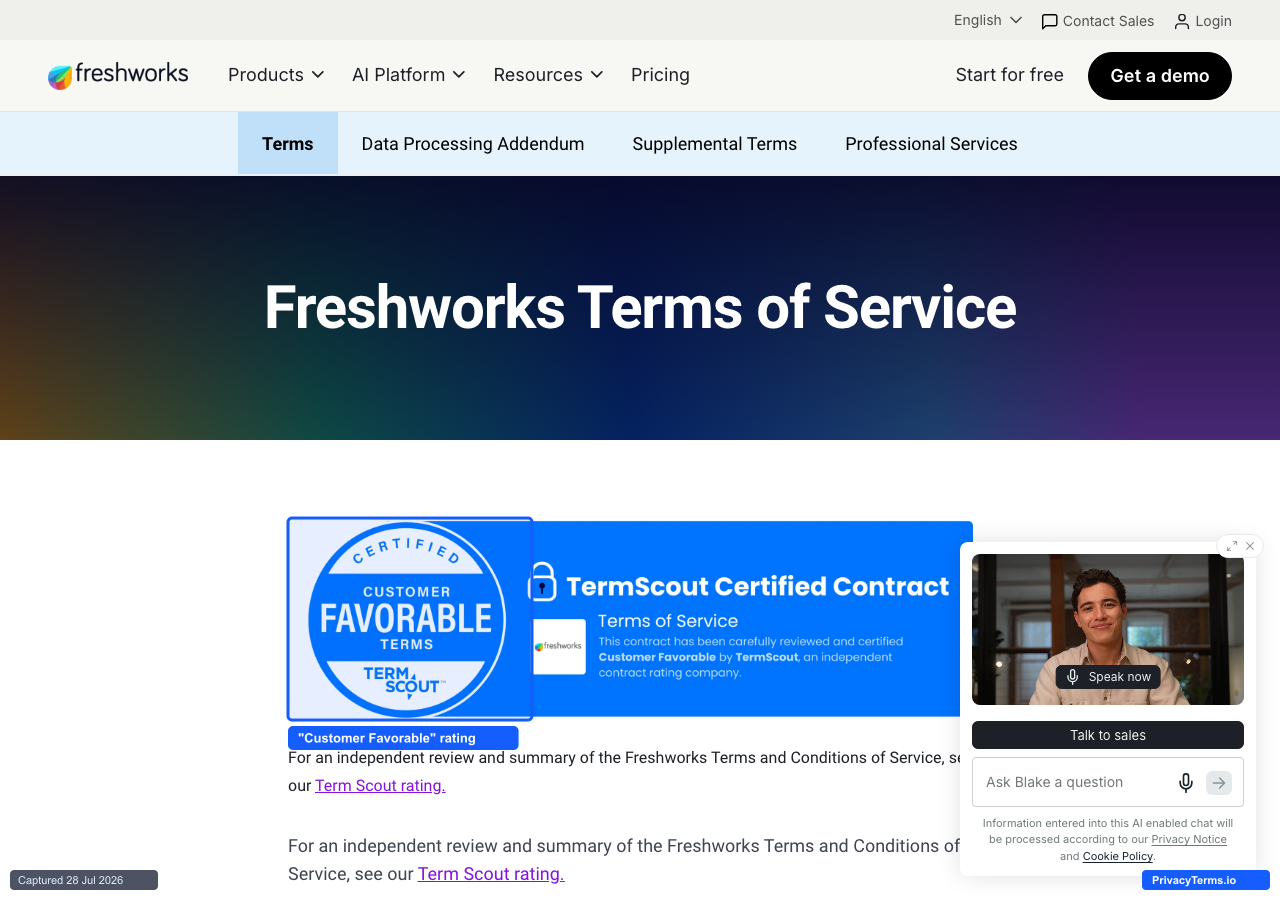
Freshworks Terms of Service page displaying a TermScout "Customer Favorable Terms" certification badge
Freshworks runs the same TermScout certification format HubSpot uses elsewhere in this cluster, but lands on a different verdict: a blue seal reading “CUSTOMER FAVORABLE TERMS” rather than the more neutral “Balanced” grade, with body copy underneath inviting readers to “see our Term Scout rating” before they get to a single clause of the actual agreement. Placing a favorable third-party grade above the fold, on a page whose entire purpose is disclosing terms a customer is about to be bound by, is a deliberate trust move for a company selling CRM, helpdesk, and marketing tools into the same competitive set as larger, better-known vendors: it gives a buyer comparing several platforms’ terms a reason to read Freshworks’ agreement first. The catch is the same one that applies to any self-reported grade: the badge states a conclusion, not the reasoning behind it, and a shopper who wants to know specifically why this contract rates as favorable, which liability, termination, or renewal clauses earned that label, has to click through to TermScout’s own site rather than find that reasoning on the terms page itself.
Commerce & Developer Infrastructure
Companies whose customers build businesses, or entire other products, on top of them face a different problem than a simple B2B SaaS seat license: the terms have to cover a merchant’s live storefront, a developer’s production integration, or a platform business layering several products together. Modular, split-by-product documents are the theme across this group.
11. Shopify
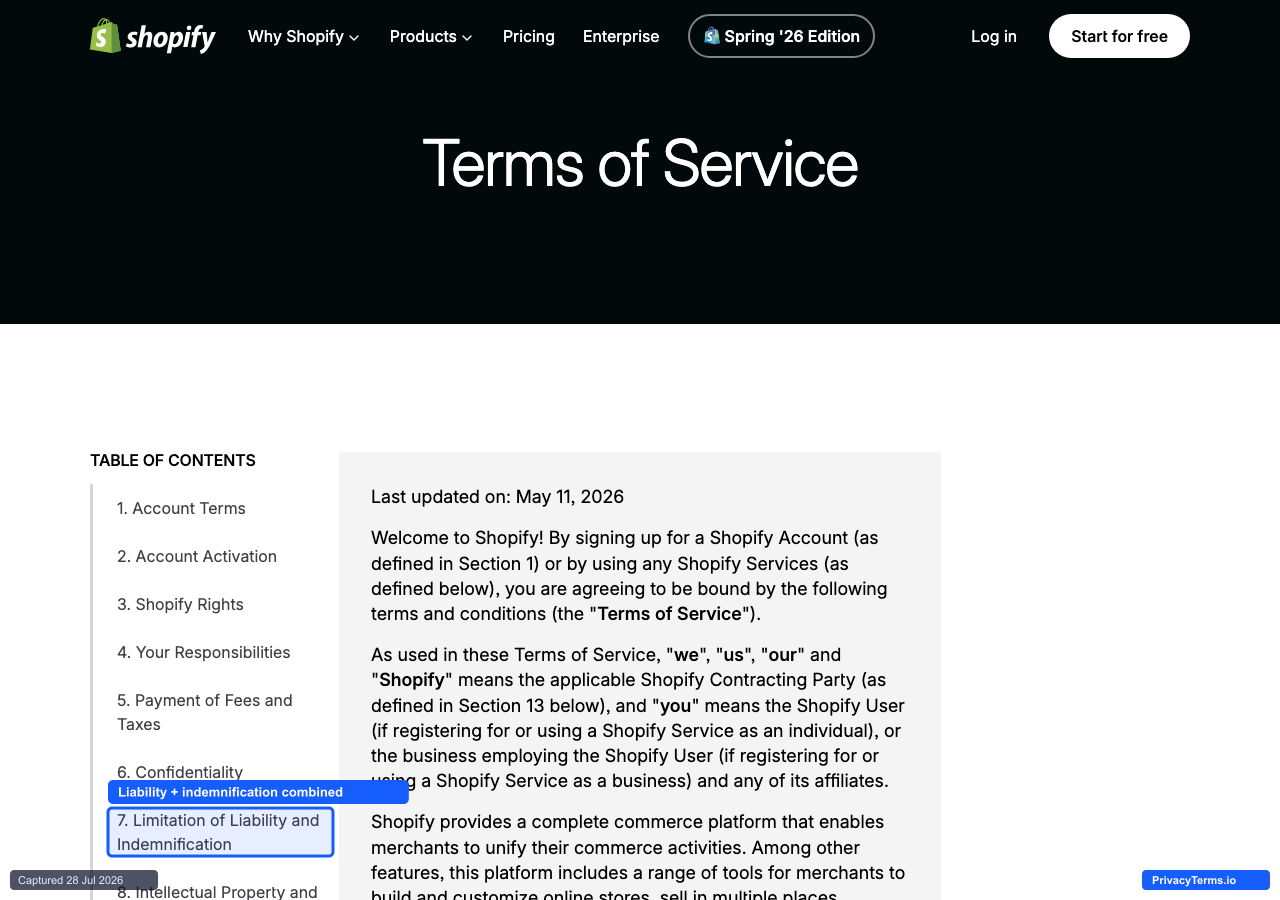
Shopify's Terms of Service table of contents, with Limitation of Liability and Indemnification combined into one section
Shopify’s terms page opens with a numbered table of contents that doubles as an on-page index, and one structural choice stands out: section 7 is titled “Limitation of Liability and Indemnification,” folding the merchant’s duty to defend Shopify against third-party claims into the same clause that caps Shopify’s own liability, rather than splitting the two into separate sections the way some peer platforms do. That pairing reads as a deliberate commercial trade, a platform hosting millions of storefronts wants its liability cap sitting beside the merchant’s indemnification obligation so the two are read together, but it also means a merchant skimming for “what happens if Shopify goes down” has to read past their own defense-and-indemnify duty first. Section 3, “Shopify Rights,” is worth the same scrutiny: it reserves Shopify’s ability to change, suspend, or discontinue any part of the service at its own discretion, language that carries more weight for a merchant running a live storefront than it would for an ordinary SaaS customer, since a suspended account can mean a suspended business overnight rather than a mere inconvenience.
12. Stripe
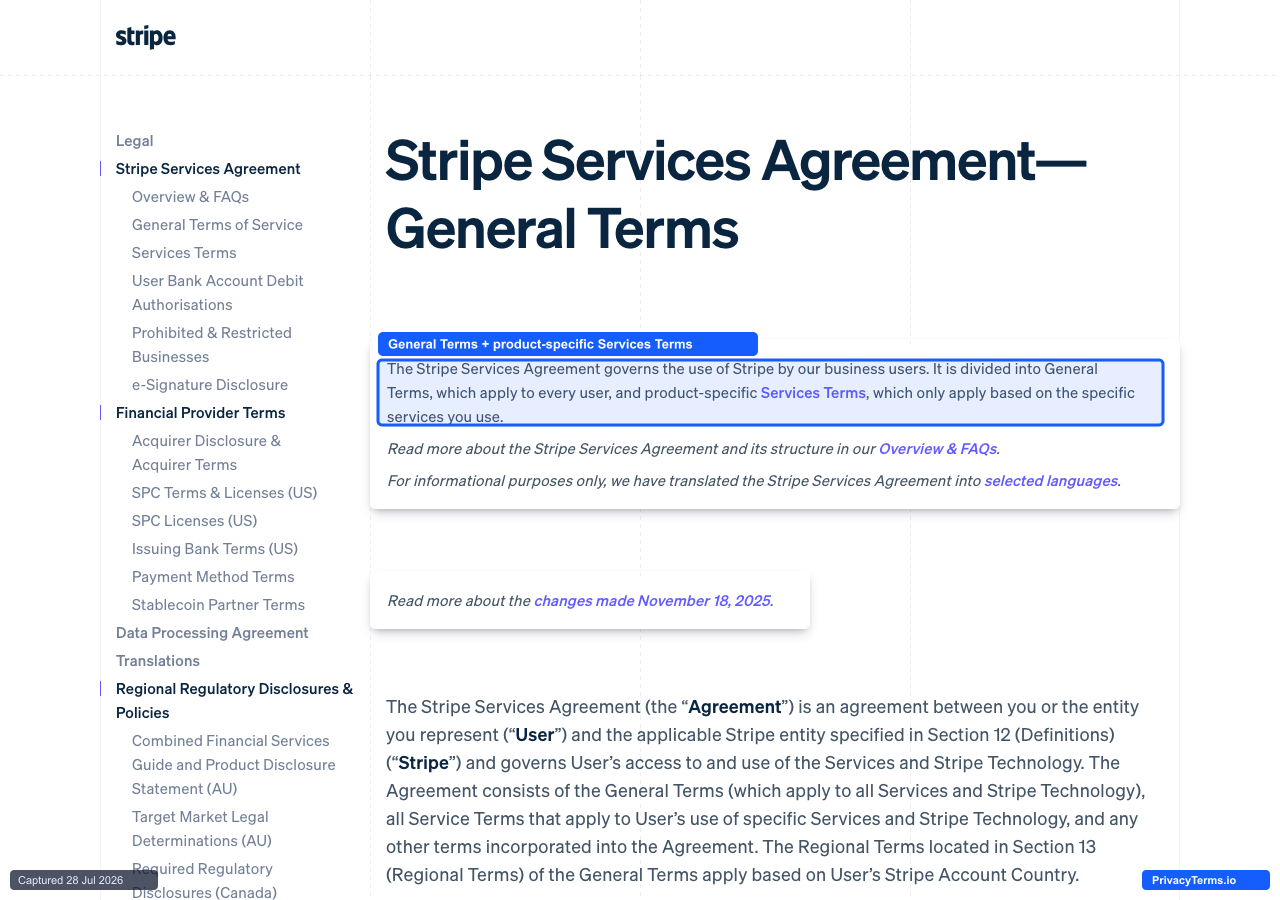
Stripe's Services Agreement overview explaining the split between General Terms and product-specific Services Terms
Stripe splits its terms into a modular structure rather than one monolithic document, and the page states the logic plainly: “The Stripe Services Agreement governs the use of Stripe by our business users. It is divided into General Terms, which apply to every user, and product-specific Services Terms, which only apply based on the specific services you use.” A merchant using Payments alone never has to read the Issuing or Connect-specific terms sitting in the sidebar, and Stripe can update one product’s terms without reopening the General Terms every business already agreed to. That modularity is well suited to a company whose customers range from a single-product checkout integration to a full multi-sided platform, since forcing every merchant through every product’s clauses regardless of what they actually use would bury the General Terms that matter to everyone under sections that apply to almost no one. The tradeoff is that “the terms” are no longer a single document a business can read once and consider done: a platform business using Connect, Issuing, and Payments together is bound by the General Terms plus three separate Services Terms, and has to track updates across all of them.
13. GitHub
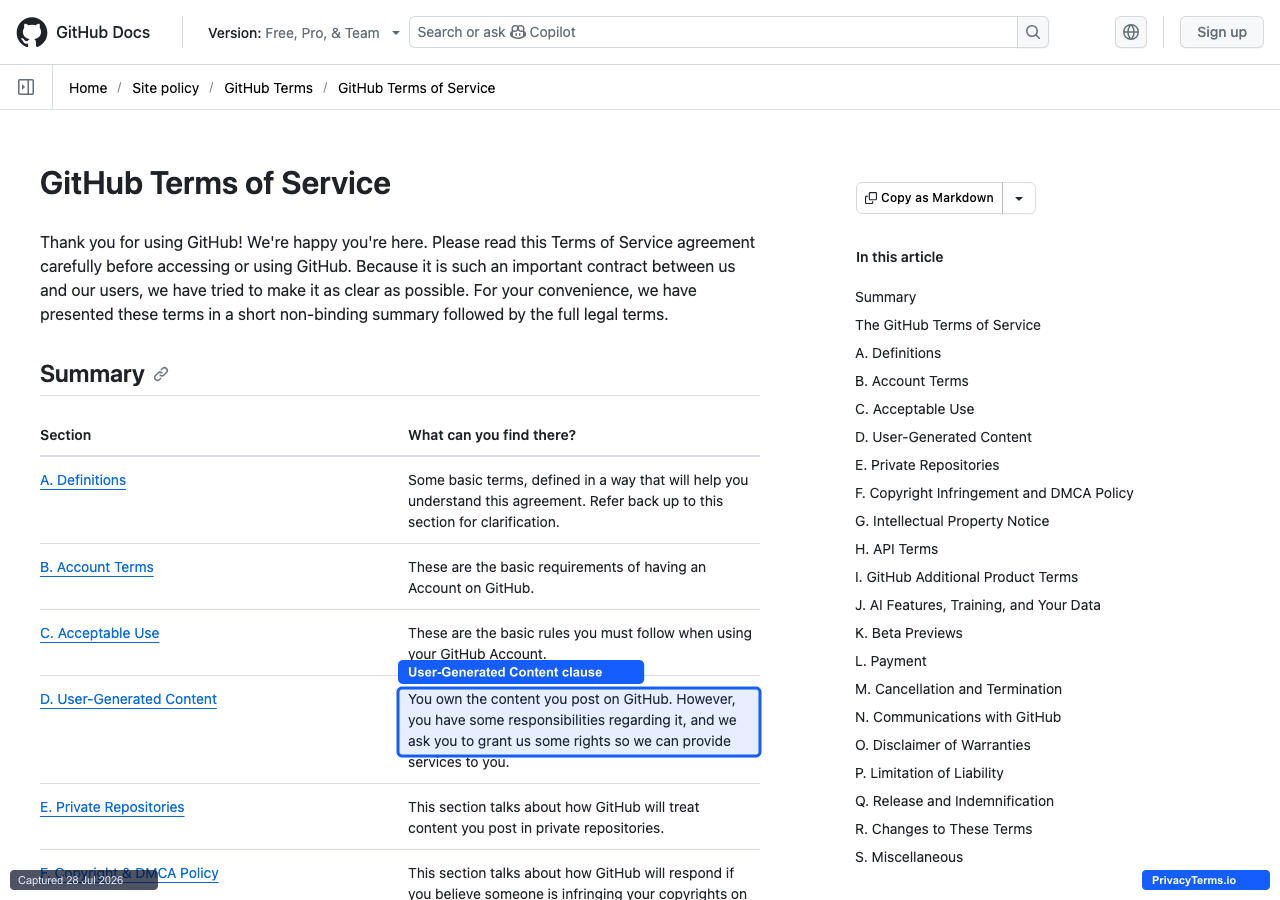
GitHub's Terms of Service summary table, with the User-Generated Content row highlighted
GitHub’s terms page leads with a plain-language summary table before the binding legal text, and the row for user content states the position directly: “You own the content you post on GitHub. However, you have some responsibilities regarding it, and we ask you to grant us some rights so we can provide services to you.” That framing, ownership stated first, license request stated second, is worth studying for any platform hosting user-submitted work, since it answers the question a contributor actually worries about (do I still own this) before asking for the license GitHub needs to display, fork, and serve the repository back to other users. The summary table format itself is a genuine structural choice too: eighteen sections each get a one-line, non-binding plain-English description before the enforceable clause, which lowers the real reading burden compared to a wall of legal prose with no index. The caveat is that the summary is explicitly non-binding, so a developer who only reads the table and skips the underlying section still has not actually reviewed what they agreed to.
14. Airtable
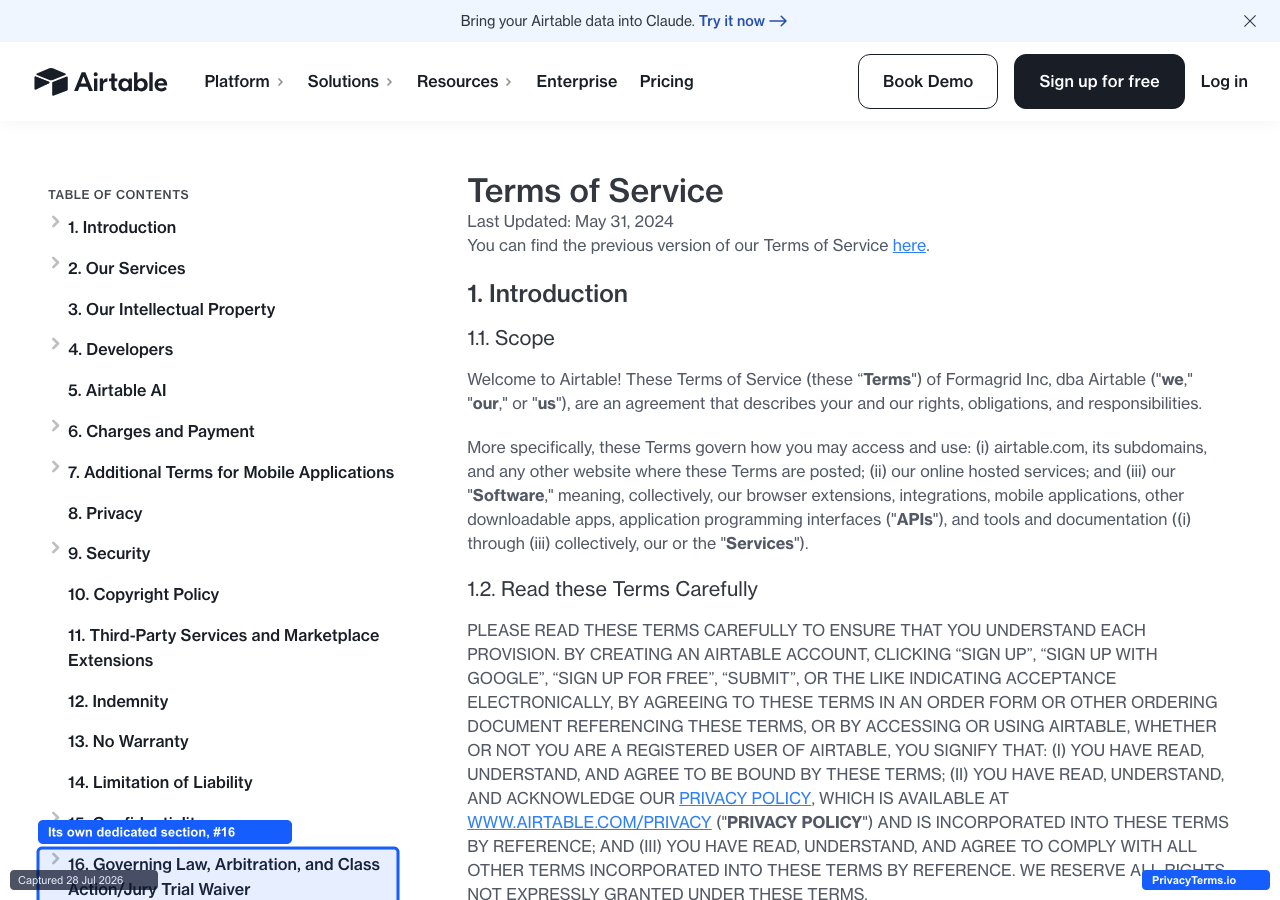
Airtable's Terms of Service table of contents, with section 16 (Governing Law, Arbitration, and Class Action/Jury Trial Waiver) highlighted
Airtable’s sixteen-section terms page gives arbitration and governing law their own dedicated slot, section 16, titled directly in the table of contents as “Governing Law, Arbitration, and Class Action/Jury Trial Waiver” rather than folding that clause into a general “Miscellaneous” section the way shorter terms pages often do. Naming a class-action and jury-trial waiver in the visible heading itself, instead of only inside the body text a reader has to open, is a level of up-front disclosure worth studying: a user scanning the table of contents sees exactly what dispute-resolution rights they are giving up before they ever click into the section. That transparency does not change what the clause actually does, a jury-trial and class-action waiver still pushes disputes into individual arbitration, which limits a customer’s practical options if Airtable’s service fails them at scale, but a heading that says so plainly is a more honest signal than a bland “Legal” label covering the same substance. The rest of the document follows the same pattern, developer-facing sections like “Developers” and “Airtable AI” get their own numbered headings rather than sitting buried inside a general terms-of-use section, which fits a platform whose customer base spans casual spreadsheet users and developers building on its API alike.
15. Twilio
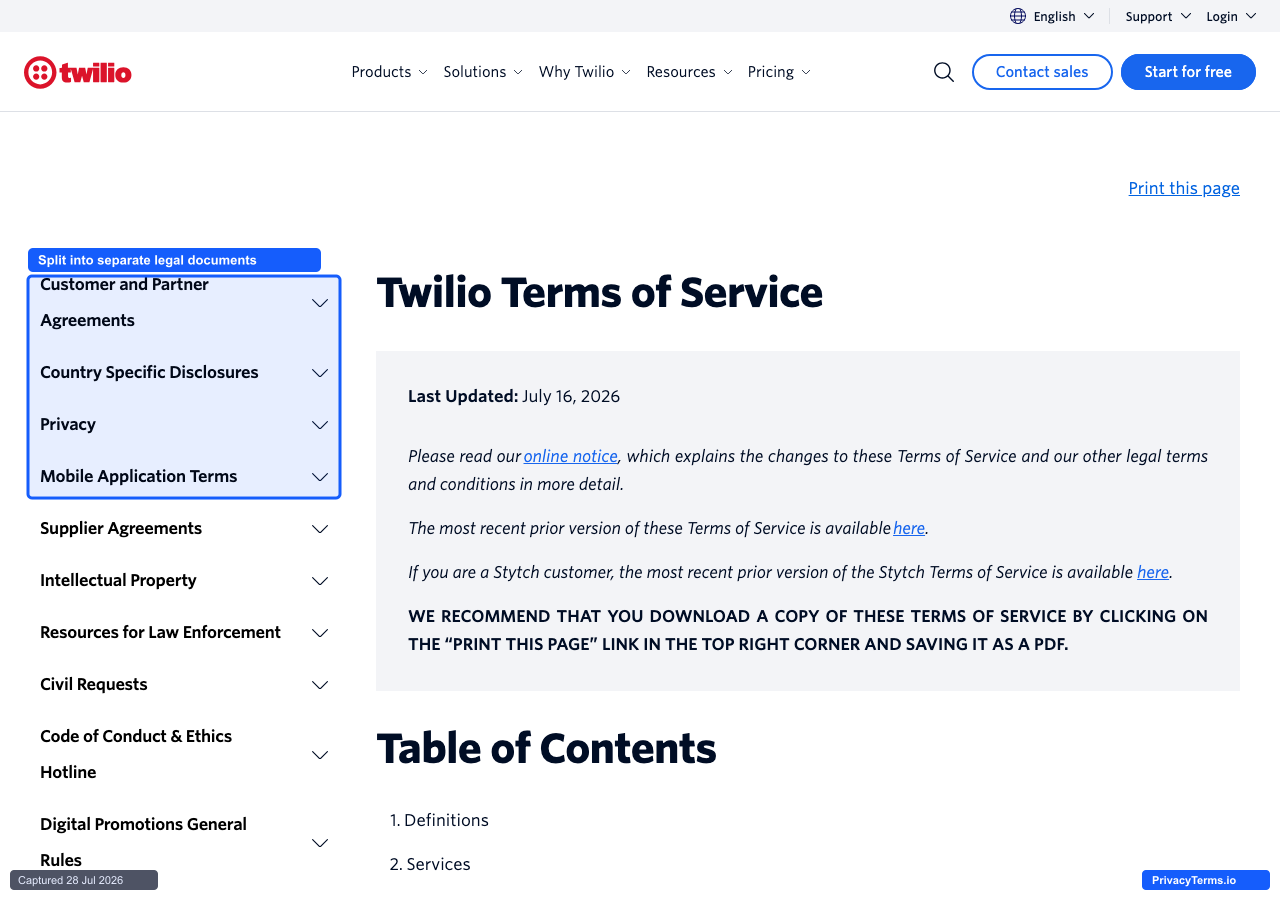
Twilio's Terms of Service page, with the sidebar's separate legal-document categories highlighted
Twilio does not run one long terms page so much as a hub that fans out to separate documents: the sidebar lists “Customer and Partner Agreements,” “Country Specific Disclosures,” “Privacy,” and “Mobile Application Terms” as their own distinct entries rather than sections within a single scrolling page, and the top of the main terms document itself recommends printing it to PDF for a stable copy, since the linked sidebar can update independently of whatever a customer saved. That structure fits a communications infrastructure company whose customers range from a solo developer sending SMS through an API to a regulated enterprise needing country-specific telecom disclosures, since a single merged document covering every jurisdiction’s requirements would bury the two or three sections any one customer actually needs under dozens that do not apply to them. The tradeoff shows up in exactly the way Twilio’s own advice hints at: because the terms are spread across multiple living documents rather than one dated version, a customer who wants a complete, current picture of their obligations has to track several separate pages instead of one, and the “last updated” date on the main page does not by itself confirm the linked country-specific or partner terms haven’t changed since.
Design, Docs & Scheduling
The last five sell products that either hold a customer’s creative work, sit in the middle of a legally binding transaction, or increasingly wrap an AI feature around a workflow that used to be purely deterministic. Each terms page below has adapted at least one clause specifically for that kind of product, rather than reusing generic SaaS boilerplate.
16. Canva
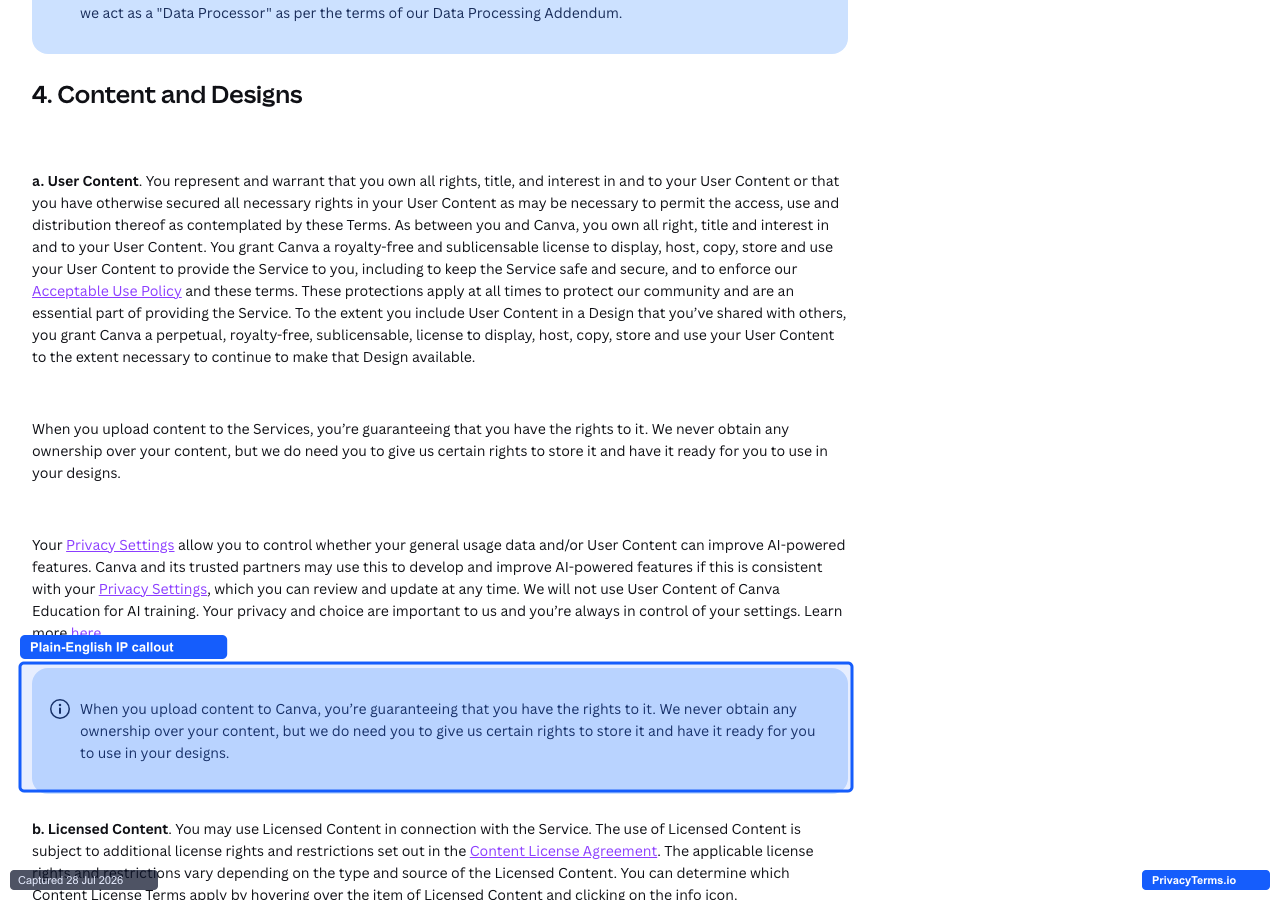
Canva's Terms of Use with its plain-English IP-ownership callout box highlighted
Canva’s Terms of Use handle intellectual property ownership the way the rest of its Terms handle everything else: a legal paragraph followed immediately by a shaded callout box restating the same point in plain language. Section 4a states that “as between you and Canva, you own all right, title and interest in and to your User Content,” then repeats the substance directly underneath in a blue info box: “We never obtain any ownership over your content, but we do need you to give us certain rights to store it and have it ready for you to use in your designs.” For a platform where millions of users upload logos, brand assets, and client work daily, restating the ownership clause in a sentence a non lawyer can actually parse is a real usability choice, not just decoration. The tradeoff sits one clause later: any User Content included in a Design you have shared with others carries a perpetual, not just ongoing, license back to Canva, specifically so shared or embedded designs keep rendering after you would otherwise expect the license to lapse. That is a reasonable technical necessity, but it is a broader grant than the plain language box implies, and the simplified summary does not mention the word perpetual anywhere near it.
17. Squarespace
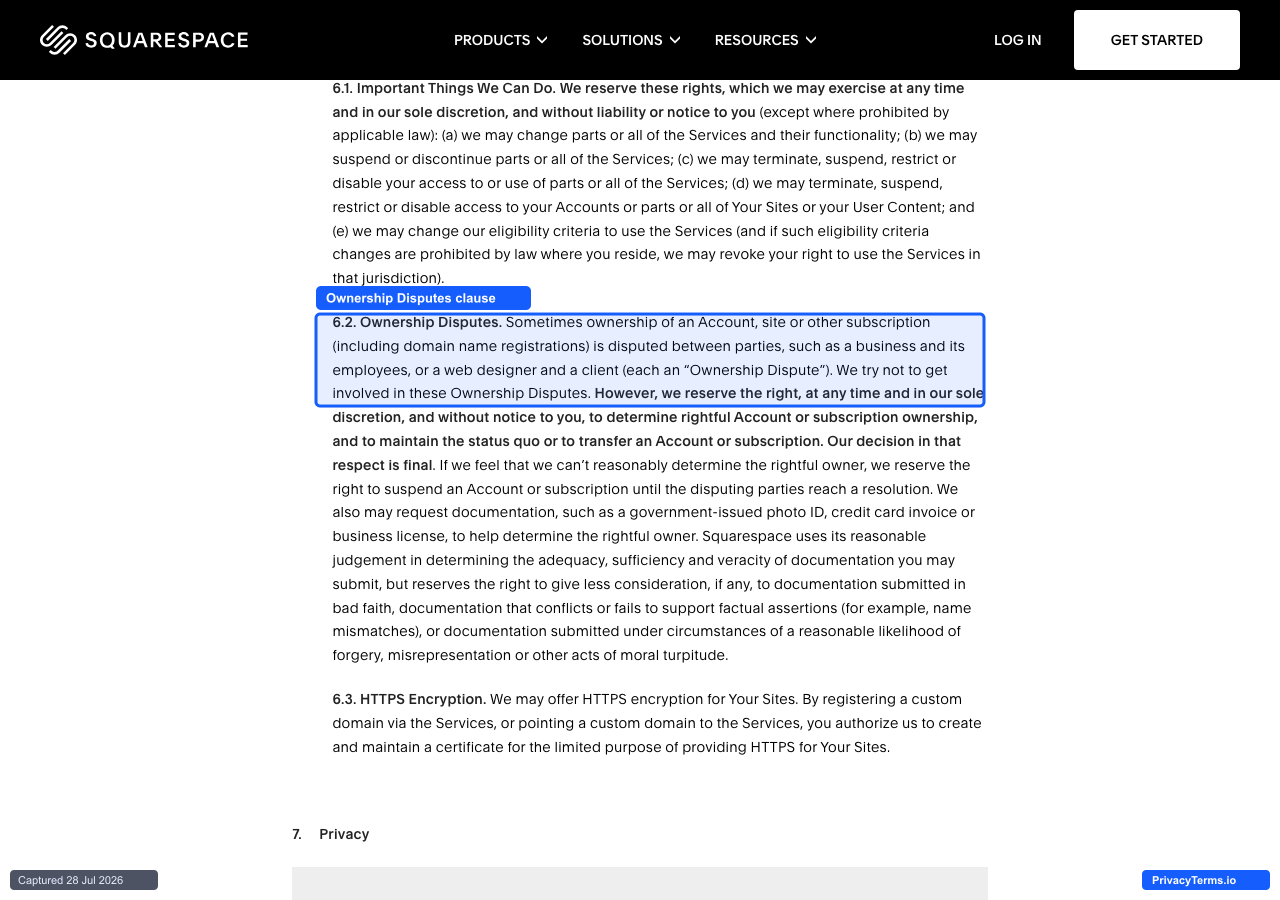
Squarespace's Terms of Service page showing its Ownership Disputes clause (Section 6.2)
Squarespace’s Terms of Service cover more than one product under a single agreement, spanning www.squarespace.com alongside Acuity Scheduling, its scheduling tool, which is likely why Section 6.2, titled “Ownership Disputes,” reads less like boilerplate and more like something written after real client conflicts. It states plainly that ownership of “an Account, site or other subscription” is sometimes “disputed between parties, such as a business and its employees, or a web designer and a client,” and that Squarespace reserves the right to determine rightful ownership at its sole discretion, a decision the Terms call final. That is a genuinely useful clause to study for any web design or agency facing product, since it names the exact dispute pattern, a freelancer building a site the client never gets full access to, that generic hosting terms rarely address directly. The tradeoff shows up a few clauses later in the liability section: outside the EU, Squarespace’s total liability for any claim is capped at whichever is greater of twenty US dollars or the fees paid in the prior twelve months, a ceiling low enough that a rightful owner determination gone wrong carries little financial remedy beyond a refund of recent subscription fees.
18. DocuSign
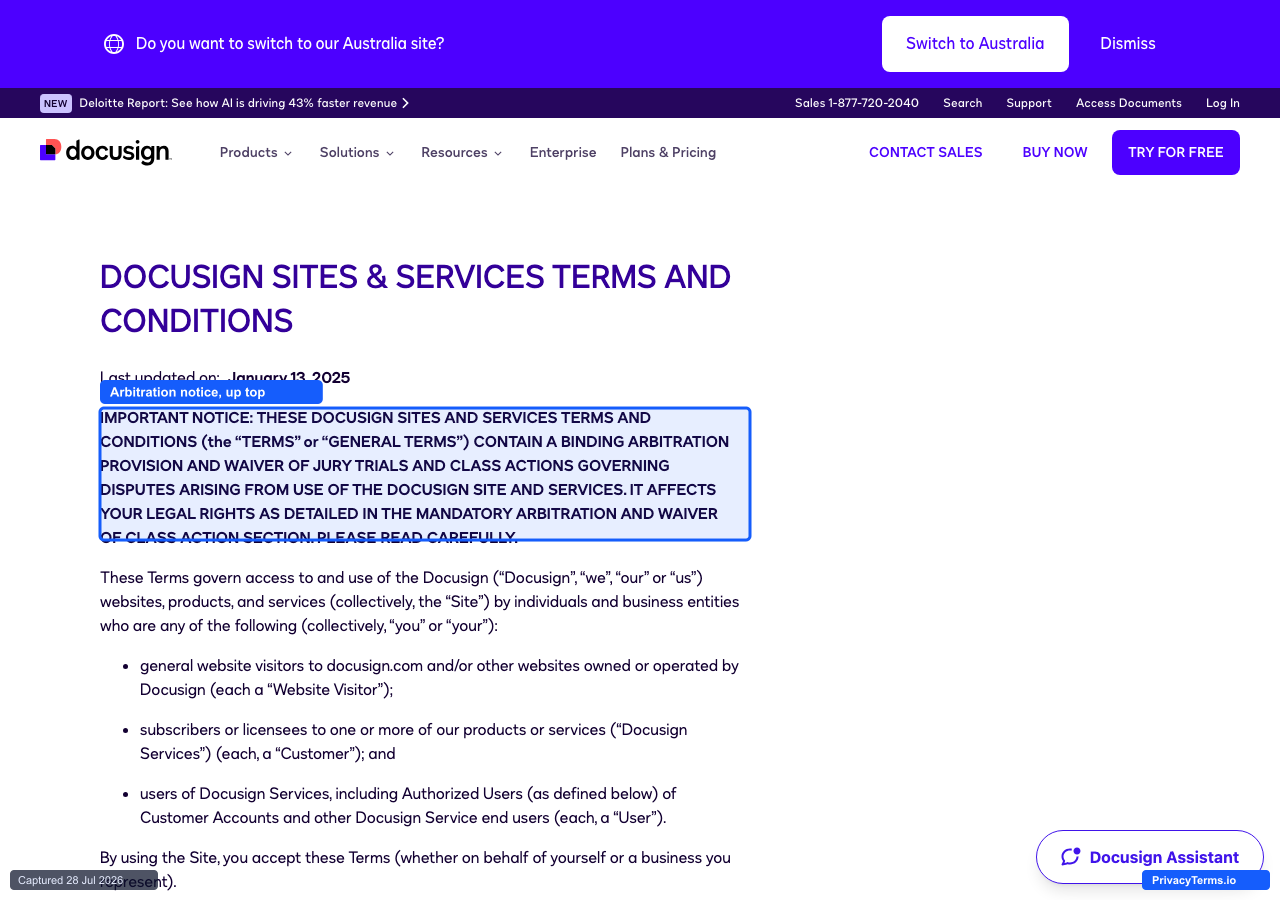
DocuSign's Terms and Conditions page with its boxed, all-caps arbitration notice directly under the headline
DocuSign puts its arbitration clause where almost nobody else in this roundup does: in a bolded, boxed paragraph directly under the page’s headline, before a single substantive term appears. It states, in full capitals, that the Terms “CONTAIN A BINDING ARBITRATION PROVISION AND WAIVER OF JURY TRIALS AND CLASS ACTIONS” governing disputes and instructs the reader to “PLEASE READ CAREFULLY,” well ahead of the actual Mandatory Arbitration section further down the page. That placement is a notable choice for a company whose product is electronic signatures: courts assessing whether an arbitration clause is enforceable often weigh how conspicuously it was presented to the person agreeing to it, and DocuSign is applying that same conspicuousness standard to its own contract that its own product exists to help other companies prove was met on their documents. The real limitation is that conspicuous placement does not make the clause less binding, only easier to notice, so a visitor still faces the same waiver of a jury trial and class actions as anyone whose arbitration clause was buried on page nine. Good disclosure design and a company’s substantive legal position toward its users remain two separate things.
19. Calendly
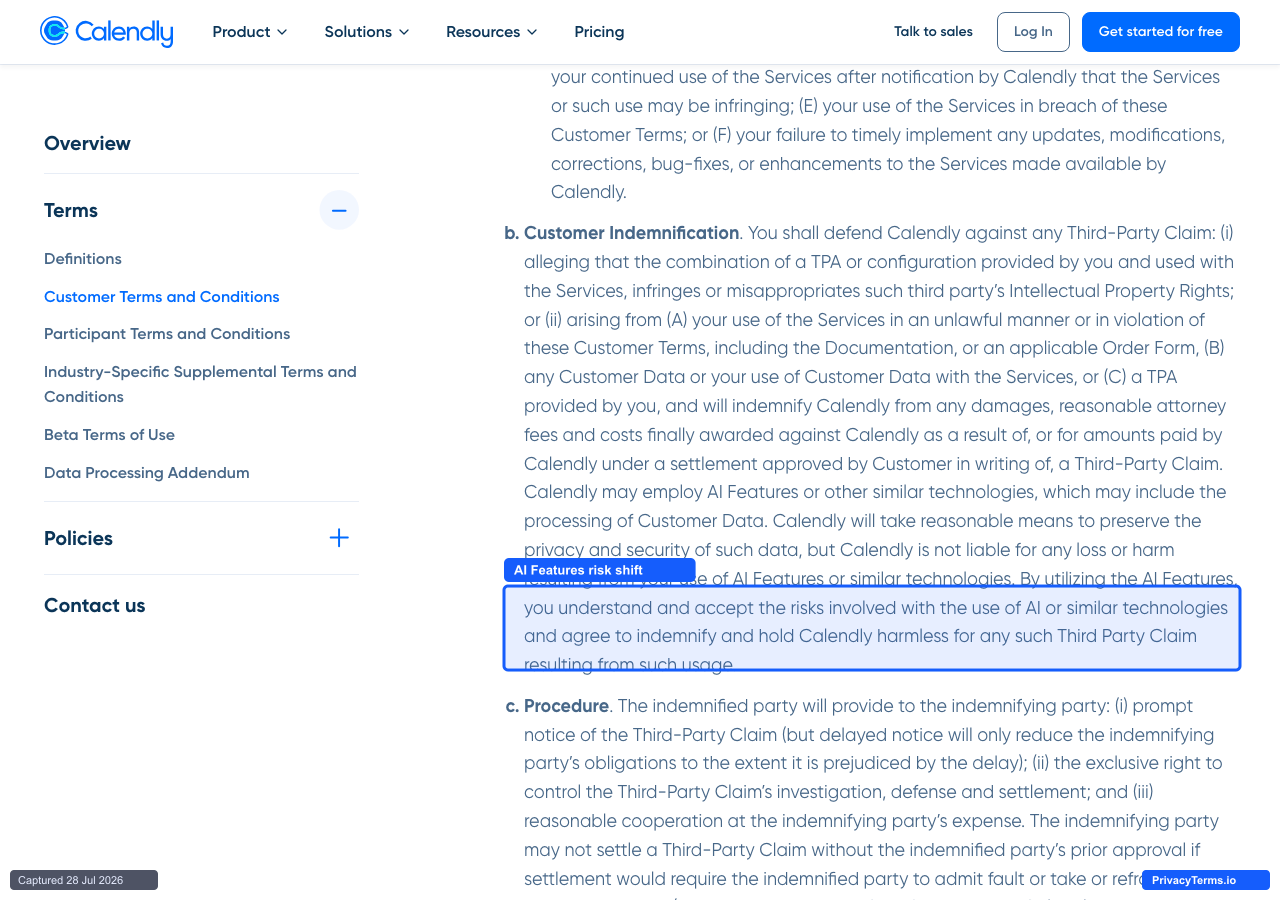
Calendly's Customer Terms and Conditions page showing its AI Features risk-shift clause
Calendly’s Customer Terms include a clause built for a scheduling product with an AI layer added on top: the customer indemnification section states that “Calendly may employ AI Features or other similar technologies, which may include the processing of Customer Data,” and that “by utilizing the AI Features, you understand and accept the risks involved with the use of AI or similar technologies and agree to indemnify and hold Calendly harmless for any such Third Party Claim resulting from such usage.” That is a meaningfully different allocation of risk than the rest of the document applies to ordinary scheduling features, and it sits inside the indemnification clause rather than a standalone AI addendum, so a customer who skims past the section heading could miss that using an AI scheduling assistant shifts liability for its output onto them specifically. The limitation worth flagging sits one sentence earlier, where Calendly disclaims “all liability with respect to any output, including but not limited to the accuracy, reliability, quality or completeness of the output,” language broad enough to cover a meeting summary an AI feature gets wrong as readily as a scheduling conflict it introduces, without distinguishing between the two in terms of consequence.
20. monday.com
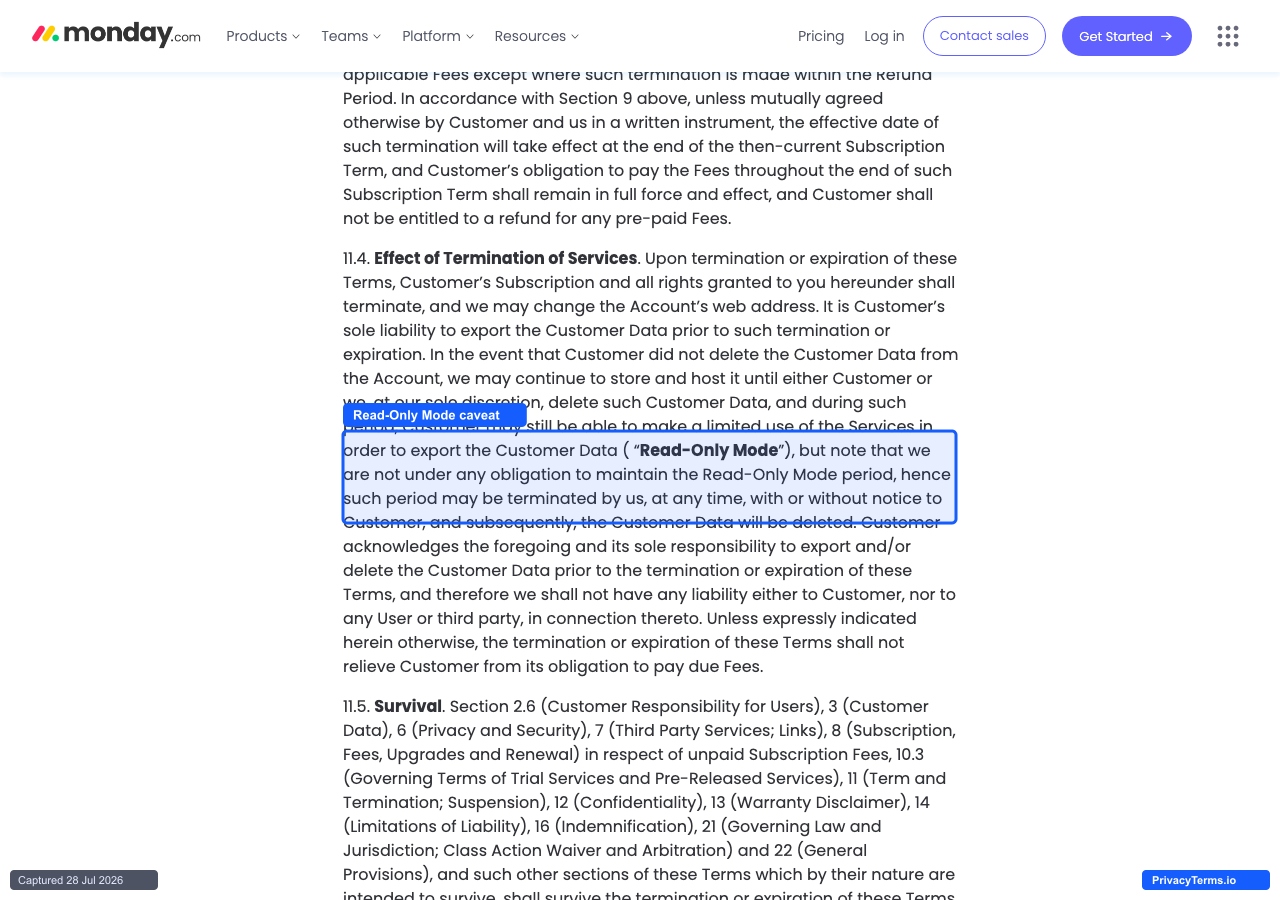
monday.com's Terms of Service showing its Read-Only Mode post-termination export clause
monday.com’s termination clause handles a problem specific to a work management platform holding years of boards, automations, and files: what happens to that data the moment a subscription ends. Section 11.4 states that after termination, the account can enter what the Terms call “Read-Only Mode,” during which the customer “may still be able to make a limited use of the Services in order to export the Customer Data,” rather than losing access the instant the contract lapses. Naming a specific post termination export state, instead of leaving customers to guess whether access simply continues or simply stops, is a genuinely more useful structure for a tool where a single board can represent months of a team’s operational history. The catch sits in the very next clause: monday.com states it is “not under any obligation to maintain the Read-Only Mode period, hence such period may be terminated by us, at any time, with or without notice to Customer,” after which the data is deleted. The export window is a real, named feature of how termination works, but it is not a guaranteed grace period a departing customer can plan around, and the Terms place that limitation in the same breath as the feature itself.
The Common Threads
Strip away the industry differences and a small set of structural habits explains almost every choice above: scope gets stated before obligations do, self-serve and enterprise customers get separated rather than squeezed into one document, dispute resolution and liability get their own visible heading instead of hiding in a miscellaneous section, and anything genuinely new to the product, an AI feature, a post-termination export window, a modular per-product agreement, gets its own named clause instead of being stretched to fit language written for an earlier version of the business. None of that requires more legal budget than a vague, generic terms page costs to draft; it requires deciding, before the document is written, exactly who it needs to speak to and what that reader is trying to find. If you are drafting or updating your own, start from that same question rather than a template built for a different kind of company, and a set of terms and conditions generated for your specific business makes it straightforward to state your own scope, tiers, and product-specific clauses clearly instead of reusing boilerplate that was never written with them in mind.
Frequently Asked Questions
Do self-serve and enterprise customers really need separate terms documents?
Not always, but it is worth considering once a company sells both a credit-card self-signup tier and a negotiated enterprise contract side by side. Several companies above, Figma and Miro among them, route Enterprise customers to a different agreement entirely rather than writing one contract loose enough to cover a solo user and a five-hundred-seat deployment equally well. A smaller SaaS with only one commercial tier does not need this split, but the moment a negotiated contract exists alongside a self-serve one, keeping them as separate documents avoids diluting either.
Is a third-party contract rating badge, like the TermScout seals above, actually meaningful?
It is a real, independently issued assessment rather than a made-up seal, and several of the companies above, HubSpot, Freshworks, and Atlassian among them, use it as a legible trust signal for buyers who will never read the full contract before signing up. The limitation is that the badge states a conclusion, not the reasoning behind it: it does not show which specific clauses earned a “Balanced” or “Customer Favorable” label, so a buyer who wants to verify the rating still has to read the underlying terms rather than take the seal as a substitute for doing so.
Where should an arbitration or class-action waiver clause sit on the page?
As visibly as the company is willing to make it. DocuSign puts its arbitration notice in bold capitals directly under the page headline, and Airtable names its class-action and jury-trial waiver in the table of contents heading itself rather than only inside the clause body. Neither placement changes what the clause actually does to a customer’s legal options, but a document that discloses an arbitration waiver plainly and early is giving a reader a fairer chance to notice it than one that leaves the same language for page nine.



![$3.31 Billion in Dark Pattern Fines: The Full Case List [2026]](/_astro/dark-pattern-fines-and-cases-2026.DzPrV2ck_Z9Uyfc.webp)