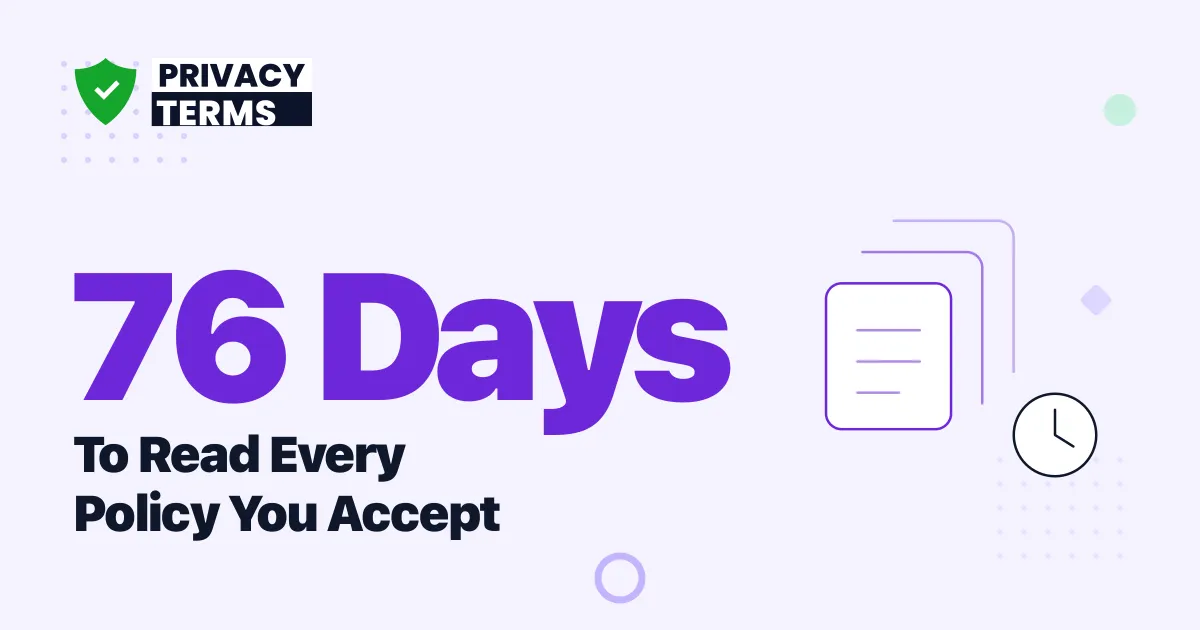
Reading every terms of service and privacy policy an average internet user agrees to in a year would take 76 work days, according to the foundational reading-cost study by Carnegie Mellon researchers Aleecia McDonald and Lorrie Faith Cranor. That figure has anchored two decades of research into how little anyone actually reads before clicking agree, and every newer survey on reading rates and document length confirms the same pattern: terms of service are long, dense, and almost never read start to finish.
How long would it take to read every terms of service you agree to?
76 work days a year, treating policy-reading as a full 8-hour-a-day job, is the headline number from McDonald and Cranor's 2008 study "The Cost of Reading Privacy Policies," published in A Journal of Law and Policy for the Information Society. The researchers measured the median length of privacy policies across the top 75 websites at 2,514 words, timed comprehension against 212 study participants, and combined that with an estimate that the average American visits about 1,462 unique websites a year.
At a 250 words-per-minute reading pace, each policy costs roughly 10 minutes, which multiplies out to about 244 hours, or slightly more than 30 working days, just for privacy policies. When the same methodology is extended to terms of service documents, which tend to run longer and read denser than privacy policies, later coverage of the study put the combined total at 76 work days a year. The study's authors calculated the national opportunity cost of that lost time at 781 billion dollars a year across the US internet-using population.
Figure 1: The combined reading burden of privacy policies and terms of service. Source: McDonald and Cranor, "The Cost of Reading Privacy Policies" (2008), Carnegie Mellon University.
That is not a one-off estimate that has since been debunked. It is the number every subsequent reading-time study either confirms or exceeds, because policies have only grown longer since 2008.
What percentage of people actually read terms of service?
Roughly 9% of people read terms and conditions in full before agreeing to them, according to a Deloitte 2017 Global Mobile Consumer Survey of 2,000 US adults, and that figure falls to just 3% among 18 to 34 year olds, the age group most likely to be signing up for new apps and services. The flip side of that statistic is stark: 91% of consumers accept legal terms without reading them, rising to 97% for the youngest respondents.
A separate, larger study from the Brookings Institution surveyed 2,006 US internet users and found a similar gap, though it split the middle ground differently. Asked how often they read terms of service before consenting, 32% said they never read the terms, 39% said they read them sometimes, and only 20% said they read them most of the time, with the remainder unsure.
Figure 2: Reading frequency reported by 2,006 US internet users. Source: Brookings Institution TechTank survey, published May 2019.
Both surveys point the same direction: fewer than one in five users can be relied on to have actually read what they agreed to, which is exactly why the wording, structure, and clarity of a terms of service document carries more weight than most site owners assume. Businesses that want the rare reader, and every regulator checking for fairness, to find clear terms can start from a terms of service generator built around plain-language sections rather than dense legal blocks.
Why don't people read terms of service?
Length is the single biggest reason people skip reading, and the data backs that up directly rather than just anecdotally. The combined terms of service and privacy policy across 70 digital services, spanning social media, ISPs, banks, and popular apps, averaged 34,064 words in the Biggest Lie on the Internet project's 2019 policy length analysis, a research effort backed by Canada's Office of the Privacy Commissioner. At a standard 250 to 280 words-per-minute adult reading pace, that works out to roughly 2.7 hours per service.
Figure 3: Why the reading rate is so low: length and time cost outpace user willingness. Source: Biggest Lie on the Internet project (2019), Deloitte Global Mobile Consumer Survey (2017).
Length is not evenly distributed across companies, either. Word-count comparisons of individual services show Microsoft's terms running to roughly 15,260 words, longer than the 7,591-word US Bill of Rights, while Spotify's terms run about 8,600 words. Twitter's combined policy documents, at the high end of the Biggest Lie on the Internet dataset, reportedly ran to 83,432 words, an estimated 6.7 hours to read in full.
Figure 4: Individual terms of service length compared to a familiar reference document. Source: Visual Capitalist, "Visualizing the Length of the Fine Print" (2020), based on public policy pages.
What reading level do terms of service documents require?
Most terms of service documents are written well above the reading level of the average adult. The Biggest Lie on the Internet project's companion complexity analysis scored the same 70 digital services using the Flesch-Kincaid Grade Level formula and found that 52 of 70 services required at least a grade 12 reading level for their terms of service, and 42 of 70 required grade 13 or higher, college-level reading. The single most complex terms of service in the dataset, J.P. Morgan Chase's, scored a grade 17.4 reading level.
That stands against general readability guidance, which recommends a 7th to 8th grade reading level for material aimed at a general adult audience. A document written at grade 17 assumes a reader with a graduate-level vocabulary and sentence-parsing ability, which most consumers do not bring to a sign-up flow they are trying to finish in under a minute.
| Reading level required | Terms of service (of 70) | Privacy policy (of 70) |
|---|---|---|
| Grade 12 or higher | 52 services | 50 services |
| Grade 13 or higher (college) | 42 services | 38 services |
| Recommended general-audience target | Grade 7 to 8 | Grade 7 to 8 |
| Most complex example scored | Grade 17.4 (J.P. Morgan Chase ToS) | Grade 9.2 (Snapchat, most accessible) |
Source: Biggest Lie on the Internet project, Policy Complexity Analysis for 70 Digital Services (2019).
Figure 5: The majority of terms of service documents exceed general-audience reading levels. Source: Biggest Lie on the Internet, Policy Complexity Analysis (2019).
How has terms of service length and reading time changed over time?
The reading-cost problem has been documented and re-documented for close to two decades without improving. McDonald and Cranor's original 2008 study set the baseline at roughly 244 hours a year for privacy policies alone. Coverage extending that methodology to combined terms of service and privacy policy reading put the total at 76 work days a year by the early 2010s, a figure still cited as the standard reference today. The Biggest Lie on the Internet project's 2019 dataset, built on a larger and more recent sample of 70 services, confirmed that combined policy length remains firmly in the multi-hour range per service rather than shrinking toward something a typical user could realistically read.
Figure 6: Two decades of research reaching the same conclusion. Source: McDonald and Cranor (2008), Deloitte (2017), Biggest Lie on the Internet project (2019).
None of this means length by itself is the enemy. A terms of service document has to cover liability, user conduct, and dispute resolution completely enough to hold up if it is ever tested. The gap the data points to is between necessary length and needless complexity, since a document can be thorough and still be written at a grade 8 to 10 level instead of grade 17.
The Bottom Line
The numbers agree with each other across sixteen years of independent research: terms of service documents are long enough that reading every one you agree to in a year would cost 76 work days, dense enough that most require a college-level education to parse, and as a direct result, read by somewhere between 3% and 20% of users depending on which survey you trust. That gap between what is written and what is actually read is a liability problem as much as a user-experience one, since a clause a court finds unconscionable does not become enforceable just because almost nobody read it. Site owners who want terms that are both complete and readable can generate a terms of service document built from plain-language sections instead of the grade-17 legal density that drives the reading rate toward zero.
Frequently Asked Questions
How long would it take to read every terms of service you agree to in a year? 76 work days, based on Carnegie Mellon researchers McDonald and Cranor's foundational reading-cost study, which found the average internet user would need about 244 hours a year, at 8 hours a day, to read the privacy policy and terms of service of every site visited.
What percentage of people actually read terms of service before agreeing? About 9% read terms and conditions in full, per a Deloitte 2017 survey of 2,000 US consumers, and the figure drops to 3% among users aged 18 to 34. A separate Brookings survey found 32% never read terms at all.
How long is the average terms of service document? 34,064 words on average across the combined terms of service and privacy policy for 70 digital services, per the Biggest Lie on the Internet project's 2019 policy length analysis, which would take roughly 2.7 hours to read at a 250 words-per-minute pace.
What reading level does the average terms of service require? Grade 12 or higher for 52 of 70 services studied, and grade 13 or higher, college level, for 42 of 70, according to the Biggest Lie on the Internet project's 2019 Flesch-Kincaid complexity analysis of terms of service documents.
Where the Numbers Come From
- McDonald, Aleecia M. and Cranor, Lorrie Faith. (2008). "The Cost of Reading Privacy Policies." A Journal of Law and Policy for the Information Society, 4, 543 to 568. Median policy length 2,514 words, 244 hours per year estimated reading cost, 781 billion dollar national opportunity cost.
- EE Journal, citing McDonald and Cranor's methodology. "You'd Need 76 Work Days to Read All Your Privacy Policies Each Year." Combined terms of service and privacy policy reading-time estimate.
- The Biggest Lie on the Internet project. (2019). "A Policy Length Analysis for 70 Digital Services." Average combined policy length 34,064 words, 250 to 280 words-per-minute reading speed assumption, research supported by the Office of the Privacy Commissioner of Canada.
- The Biggest Lie on the Internet project. (2019). "A Policy Complexity Analysis for 70 Digital Services." Flesch-Kincaid Grade Level scoring; 52 of 70 services require grade 12 or higher for terms of service, 42 of 70 require grade 13 or higher.
- Brookings Institution. (2019). "Brookings Survey Finds Three-Quarters of Online Users Rarely Read Business Terms of Service." Survey of 2,006 US internet users; 32% never read, 39% sometimes, 20% most of the time.
- Deloitte. (2017). "Global Mobile Consumer Survey." Survey of 2,000 US adults; 91% accept terms without reading, rising to 97% for ages 18 to 34.
- Visual Capitalist. "Visualizing the Length of the Fine Print, for 14 Popular Apps." Individual company word counts including Microsoft at approximately 15,260 words and Spotify at approximately 8,600 words.
Note: All figures verified as of July 2026. The McDonald and Cranor reading-cost study dates to 2008 and the Biggest Lie on the Internet project's length and complexity datasets date to 2019; both remain the most-cited primary sources in this space because no larger-scale replication has superseded them as of this writing. Figures are refreshed at least twice a year as newer studies become available.
![98% Click Agree Without Reading the Fine Print [2026]](/_astro/how-many-users-click-agree-without-reading.BovPsn2L_Z164p9W.webp)