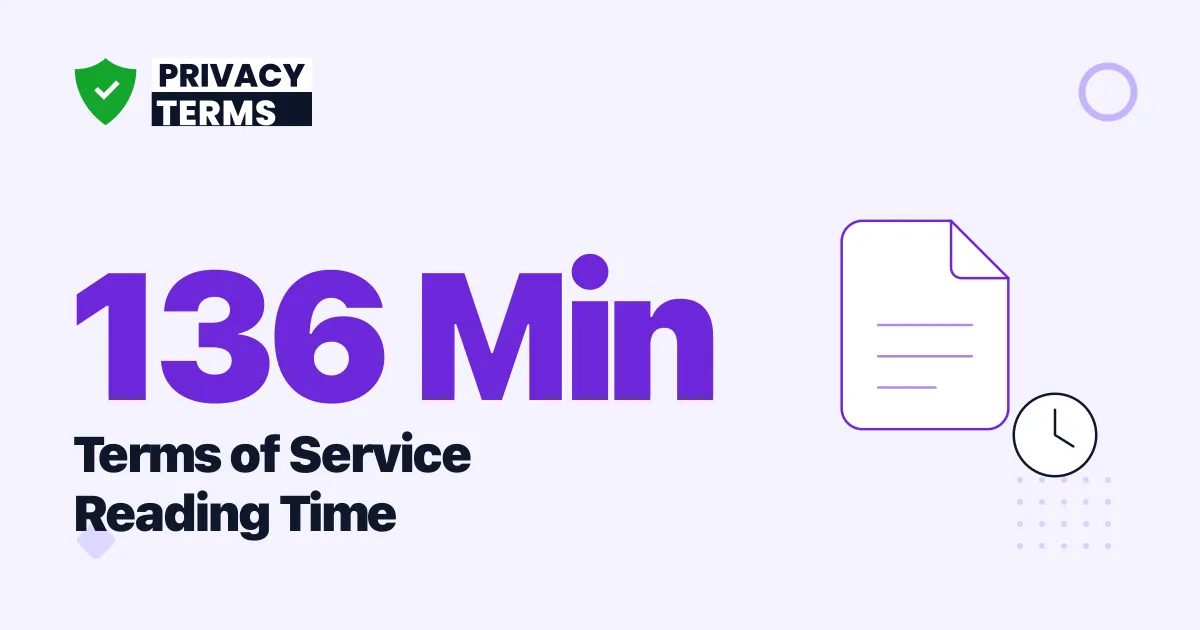
Reading a full terms of service and privacy policy bundle takes about 136 minutes, roughly 2 hours and 16 minutes, based on the Biggest Lie on the Internet project's 2019 analysis of 70 digital services, which found an average combined length of 34,064 words at a 250-words-per-minute reading pace. That is the time cost for one service. A single privacy policy alone runs shorter, and skimming instead of reading in full turns out to save far less time than most people assume.
How long does it take to read one terms of service document?
A single, median-length privacy policy takes about 10 minutes to read in full, according to Carnegie Mellon researchers Aleecia McDonald and Lorrie Faith Cranor's foundational 2008 study, "The Cost of Reading Privacy Policies." The researchers measured word counts across the 75 most popular websites, based on a list of the 30,000 most frequently clicked sites from AOL search data, and found lengths ranging from a low of 144 words to a high of 7,669 words. Applying a 250-words-per-minute reading rate, a pace the study attributes to a typical high-school-educated reader, gives a clean table of reading times by document length.
Figure 1: Reading time climbs directly with word count, as expected at a fixed reading pace. Source: McDonald and Cranor, "The Cost of Reading Privacy Policies" (2008), Carnegie Mellon University.
That math holds for a single policy read start to finish at a steady pace. It does not hold once a real reader starts searching a document for a specific answer, which is a different task with a different time cost, covered next.
Does skimming a terms of service actually save time?
Less than most people would guess. McDonald and Cranor's own online study asked 212 participants to skim one of six policies of varying length and answer a simple question, such as whether a service allowed email marketing or used cookies. The median time to skim a policy and answer just one question ranged from 18 to 26 minutes, longer in every case than the 8 to 12 minutes their word-count formula estimated for reading the same length of document in full.
Figure 2: Searching for one answer took longer in testing than the calculated time to read the whole document. Source: McDonald and Cranor (2008), online study of 212 participants.
The three policies closest to the study's typical 2,500-word length produced median skim times of 23 to 24 minutes, essentially the same regardless of exact length, because most of the time went to locating the relevant clause rather than reading word for word. The practical implication cuts against a common assumption: telling a user "just skim the important parts" does not reliably cut reading time in half, and for a short question buried in a long document, it can take longer than reading straight through would have.
How long does a modern terms of service and privacy policy bundle take?
Today's combined terms of service and privacy policy documents run far longer than the single policies McDonald and Cranor measured in 2008. The Biggest Lie on the Internet project's 2019 policy length analysis, research backed by the Office of the Privacy Commissioner of Canada, measured the combined terms of service and privacy policy across 70 digital services and found an average length of 34,064 words. At the same 250-words-per-minute reading pace, that works out to roughly 136 minutes, or 2 hours and 16 minutes, for one service's full set of legal documents.
Length varies sharply by company. Word counts compiled by Visual Capitalist for individual services put Spotify's terms at about 8,600 words and Microsoft's at about 15,260 words, longer than the 7,591-word US Bill of Rights. At the high end, Twitter's combined policy documents reportedly ran to 83,432 words, more than double the 70-service average.
| Document | Approximate word count | Reading time at 250 WPM |
|---|---|---|
| Spotify terms of service | 8,600 words | 34 minutes |
| Microsoft terms of service | 15,260 words | 61 minutes |
| Average combined bundle (70 services) | 34,064 words | 136 minutes |
| Twitter combined policy documents | 83,432 words | 5.6 hours |
Source: Visual Capitalist, "Visualizing the Length of the Fine Print" (company word counts); Biggest Lie on the Internet project, 2019 Policy Length Analysis (70-service average). Reading times calculated at 250 words per minute.
Figure 3: The gap between a short terms of service and a long one is measured in hours, not minutes. Source: Visual Capitalist, Biggest Lie on the Internet project (2019).
A business drafting its own terms does not need to land anywhere near the 83,432-word end of that range to be thorough. You can generate a terms of service document built from plain-language sections that cover liability, user conduct, and dispute resolution without stretching into multi-hour reading territory.
How should you estimate reading time before publishing your own terms?
A simple threshold-based estimate, built directly from the word counts and reading pace above, gives a workable rule of thumb for any document.
Figure 4: A word-count-based estimator for terms of service reading time, built from McDonald and Cranor's 250-words-per-minute formula. Source: McDonald and Cranor (2008), Biggest Lie on the Internet project (2019).
The flowchart's last step matters most for anyone designing a sign-up flow: even a short, plainly written document does not guarantee a fast skim, because users searching for one specific clause take longer than the raw word count suggests. Clear headings and a short summary at the top of a terms of service do more to cut real reading time than trimming a few hundred words from the body.
Why does almost no one finish reading before agreeing?
Reading time this long collides directly with how little time users actually spend before clicking agree. Deloitte's 2017 Global Mobile Consumer Survey of 2,000 US adults found that only 9% read terms and conditions in full before accepting them, while 91% accept without reading, a figure that rises to 97% among respondents aged 18 to 34. Set against a 10-minute-per-policy baseline and a 136-minute combined-bundle baseline, that gap is not surprising: few sign-up flows budget more than a few seconds for a screen most users are trying to get past.
Figure 5: Two decades of independent research reaching the same time-cost conclusion. Source: McDonald and Cranor (2008), Deloitte (2017), Biggest Lie on the Internet project (2019).
A related survey from the Brookings Institution, covering 2,006 US internet users, found 32% never read terms of service at all and only 20% read them most of the time. Neither survey measured reading time directly, but both explain why the 136-minute and 10-minute figures above describe time that documents demand rather than time users actually spend. For the full picture of how document length interacts with reading level and yearly reading burden, see Terms of Service reading, length, and trust statistics for 2026.
The Bottom Line
The reading-time math is consistent across seventeen years of independent research: a single policy costs about 10 minutes, a modern combined terms of service and privacy policy bundle costs about 136 minutes, and skimming instead of reading in full saves far less time than expected because locating one specific answer takes 18 to 26 minutes on its own. Set against a 9% full-read rate, the practical lesson for anyone publishing terms is that length is the lever within your control. A document that covers the same legal ground in 3,000 words instead of 15,000 cuts reading time from about an hour to about 12 minutes, without weakening what the document actually says.
Frequently Asked Questions
How long does it take to read a terms of service document? About 136 minutes, roughly 2 hours and 16 minutes, for a full terms of service and privacy policy bundle at the 34,064-word average across 70 digital services, reading at 250 words per minute. A single median-length privacy policy alone, at 2,514 words, takes about 10 minutes.
Does skimming a terms of service save much time? Less than expected. Carnegie Mellon researchers McDonald and Cranor measured a median of 18 to 26 minutes for participants to skim a single policy and answer one basic question, longer than the 8 to 12 minutes their own word-count formula estimated for reading the same document in full.
How much does reading time vary between companies? Widely. At a 250 words-per-minute pace, Spotify's terms run about 34 minutes, Microsoft's about 61 minutes, and Twitter's combined policy documents, reported at 83,432 words, run to roughly 5.6 hours, per word counts compiled by Visual Capitalist.
What percentage of people actually finish reading before agreeing? About 9%, according to Deloitte's 2017 Global Mobile Consumer Survey of 2,000 US adults, while 91% accept the terms without reading them at all.
Where the Numbers Come From
- McDonald, Aleecia M. and Cranor, Lorrie Faith. (2008). "The Cost of Reading Privacy Policies." A Journal of Law and Policy for the Information Society, 4, 543 to 568. Median policy length 2,514 words at 250 WPM equals 10 minutes; short and long quartiles 2,071 and 3,112 words equal 8 and 12 minutes; online study of 212 participants measured 18 to 26 minute median skim times.
- The Biggest Lie on the Internet project. (2019). "A Policy Length Analysis for 70 Digital Services." Average combined terms of service and privacy policy length 34,064 words, research supported by the Office of the Privacy Commissioner of Canada.
- Visual Capitalist. "Visualizing the Length of the Fine Print, for 14 Popular Apps." Individual company word counts including Microsoft at approximately 15,260 words, Spotify at approximately 8,600 words, and Twitter's combined policy documents at approximately 83,432 words.
- Deloitte. (2017). "Global Mobile Consumer Survey." Survey of 2,000 US adults; 9% read terms and conditions in full, 91% accept without reading, rising to 97% for ages 18 to 34.
- Brookings Institution. (2019). "Brookings Survey Finds Three-Quarters of Online Users Rarely Read Business Terms of Service." Survey of 2,006 US internet users conducted May 8 to 10, 2019; 32% never read, 39% sometimes, 20% most of the time, 9% unsure.
Note: All figures verified as of August 2026. The McDonald and Cranor reading-time formula dates to 2008 and the Biggest Lie on the Internet project's length dataset dates to 2019; both remain the most-cited primary sources on this topic because no larger-scale replication has superseded them as of this writing. Reading-time calculations in this post apply a consistent 250-words-per-minute rate to each source's published word count. Figures are refreshed at least twice a year as newer studies become available.
![98% Click Agree Without Reading the Fine Print [2026]](/_astro/how-many-users-click-agree-without-reading.BovPsn2L_Z164p9W.webp)