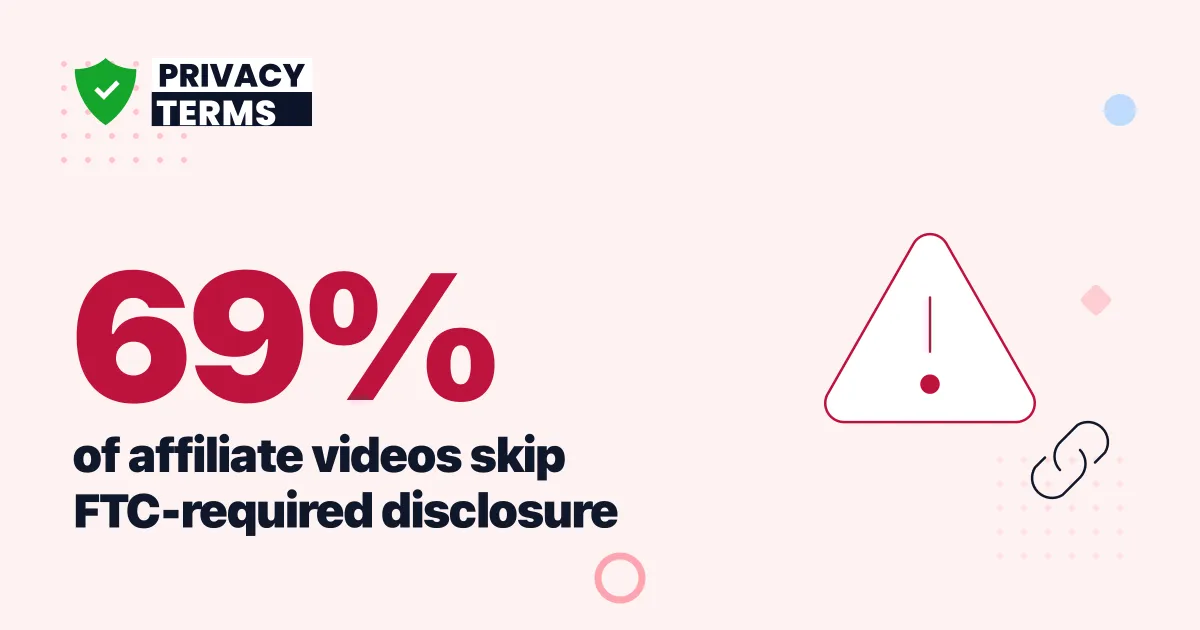
69.19% of YouTube videos with affiliate links fail to meet FTC disclosure standards, and more than half disclose nothing at all, according to a 2026 study by Sun, Vekaria, Shafiq, and Nithyanand published at ICWSM that analyzed 2 million videos spanning ten years. Compliance has improved since 2018, but most creators running affiliate links, paid placements, or sponsor deals across YouTube, Twitter/X, and other platforms still are not disclosing them the way the Federal Trade Commission requires.
The gap matters beyond social media. The same "material connection" disclosure rule that governs a sponsored YouTube video also governs a blog's affiliate links, a product review with a free sample, or any site earning commission from a link it recommends, which is exactly what a website disclaimer or affiliate disclosure page exists to satisfy. Below is what the largest available studies find, side by side, followed by the year-over-year trend, what actually improves compliance, and what the FTC changed in its own rules in 2023.
How many affiliate marketing videos actually disclose properly?
Only 12.20% of YouTube videos with at least one affiliate link carry disclosure language clear enough to meet FTC standards, per Sun, Vekaria, Shafiq, and Nithyanand's 2026 ICWSM study, "Turning Trust to Transactions: Tracking Affiliate Marketing and FTC Compliance in YouTube's Influencer Economy." Another 18.61% use language the researchers classify as "possibly compliant," meaning a disclosure exists but is ambiguous or hard to notice. The remaining 69.19% are non-compliant outright, and 54.19% of all affiliate-linked videos disclose nothing whatsoever.
Figure 1: Share of YouTube videos with at least one affiliate link, by FTC disclosure compliance category. Source: Sun, Vekaria, Shafiq and Nithyanand, ICWSM 2026.
The researchers built their dataset from 2 million YouTube videos published over ten years, finding 352,700 unique affiliate links across 146,800 of those videos (7.35% of everything sampled), averaging 5.28 affiliate links in every video that used them. Affiliate marketing is a growing, not shrinking, share of YouTube content, which is exactly why the low compliance rate carries real regulatory risk for creators and the brands whose products they link.
How has affiliate disclosure compliance changed since 2018?
Clear FTC-compliant disclosure on YouTube affiliate videos rose from 5.5% among videos published in 2015-2018 to 14.5% among videos published in 2018-2024, more than doubling. That period lines up with what the industry calls the "Adpocalypse," when YouTube's 2017-2018 advertiser boycotts pushed many creators toward affiliate and sponsorship revenue as a hedge against unstable ad income, and affiliate-link usage grew alongside it.
Figure 2: Affiliate link usage and clear disclosure compliance, before versus after 2018. Source: Sun, Vekaria, Shafiq and Nithyanand, ICWSM 2026.
Compliance more than doubling is real progress, but it still leaves the large majority of affiliate videos published in the 2018-2024 window outside the "clearly compliant" bucket. Sites publishing product reviews, roundups, or recommendation posts with commission links face the same underlying obligation, and closing that gap takes a fraction of the time an FTC inquiry does.
Does platform-provided disclosure tooling actually work?
Yes, and the difference is large. Videos that use YouTube's built-in Shopping tab, which automatically attaches a paid-promotion label to the video, reach 61.9% clear compliance. Videos relying on text-only disclosure written into the description or spoken in the video reach just 12.93% clear compliance, a gap of nearly 49 percentage points for the same underlying obligation.
Figure 3: Clear disclosure compliance among affiliate videos, by disclosure method. Source: Sun, Vekaria, Shafiq and Nithyanand, ICWSM 2026.
The finding backs up a simple pattern regulators have pointed to for years: disclosure that is structural, meaning built into the platform's own interface rather than left to a creator's memory or judgment, gets followed far more consistently than disclosure that depends on someone remembering to type it. A website's disclaimer page works the same way. A dedicated, linked disclaimer page that a reader can always find is a more reliable compliance layer than a one-time mention buried in a single post.
What about sponsored content beyond YouTube?
Disclosure gaps are not unique to YouTube or to affiliate links specifically. On Twitter/X, roughly 95% of posts a classifier identified as sponsored carried no disclosure hashtag at all, across a dataset of more than 100 million tweets from 268 major US brands studied between 2014 and 2021, according to Ershov, He, and Seiler's "Frontiers: How Much Influencer Marketing Is Undisclosed? Evidence from Twitter," published in Marketing Science in 2025. Non-disclosure fell from 98% of sponsored tweets in 2014 to 94% in 2021, and the median individual brand's non-disclosure rate fell from 99.7% to 97% over the same years, real improvement, but still leaving the overwhelming majority of sponsored posts unlabeled.
Figure 4: Key data points and regulatory milestones in disclosure compliance research, 2014 to 2026. Sources: Ershov, He and Seiler (Marketing Science, 2025); Sun, Vekaria, Shafiq and Nithyanand (ICWSM 2026); Influencer Advisory (2026); Federal Trade Commission (2023).
A live tracker maintained by Influencer Advisory, covering 260,527 sponsored YouTube deals across 45,615 brands and 29,555 creators since January 2024, finds a similarly low compliance rate as of its most recent update on May 20, 2026: only 3.0% of sponsor calls-to-action carry a disclosure phrase the FTC would read as adequate, and 15.8% have no call-to-action text on file at all. Compliance varies by niche, entertainment content leads at 7.0%, still under one in ten deals.
| Niche | Deals tracked | Disclosure rate |
|---|---|---|
| Entertainment | not stated | 7.0% |
| Lifestyle | 10,108 | 2.7% |
| Entrepreneurship | 3,380 | 2.2% |
| Fitness | 4,592 | 1.2% |
| All niches, overall | 260,527 | 3.0% |
Table 1: FTC-readable disclosure rate by content niche, live YouTube sponsor-deal tracker. Source: Influencer Advisory, updated May 20, 2026. This is a live, continuously updated dataset rather than a fixed-methodology academic sample, and figures may shift on future updates.
Why did the FTC rewrite its disclosure rules in 2023?
The Federal Trade Commission finalized an update to its Endorsement Guides on June 29, 2023, the first revision since 2009, approved by a unanimous 3-0 Commission vote. The update expanded the definition of an "endorsement" to explicitly cover fake reviews, virtual influencers, and tagged social media content, added a stricter standard for what counts as a "clear and conspicuous" disclosure, and clarified that platform tools alone (a checkbox or a built-in label) may not always be enough if the underlying disclosure itself is not obvious to an ordinary reader. The Commission simultaneously published an expanded FAQ document with 40 new questions covering how creators and site owners should disclose material connections across platforms.
Figure 5: A simplified compliance test based on the FTC's 2023 Endorsement Guides update. Source: Federal Trade Commission, June 2023 press release.
Source comparison: how the major disclosure studies stack up
| Source | Sample | Period | Non-compliant or non-disclosed |
|---|---|---|---|
| Sun, Vekaria, Shafiq & Nithyanand, ICWSM 2026 (YouTube affiliate links) | 146,800 videos with links (2M videos analyzed) | 2015-2024 | 69.19% non-compliant, 54.19% with no disclosure |
| Ershov, He & Seiler, Marketing Science 2025 (Twitter/X sponsored posts) | 100M-plus tweets, 268 brands | 2014-2021 | Roughly 95% no disclosure hashtag |
| Influencer Advisory live tracker (YouTube sponsor deals) | 260,527 deals, 45,615 brands, 29,555 creators | Jan 2024 to May 2026 | 97.0% of CTAs lack a readable disclosure phrase |
Table 2: Three independent measurements of disclosure compliance, spanning different platforms, methodologies and years, all pointing the same direction. Sources listed in full below.
The Bottom Line
Every large-scale study measured here, an academic analysis of 2 million YouTube videos, an academic analysis of 100 million-plus tweets, and a live tracker of a quarter-million sponsor deals, finds the same pattern: most affiliate links and sponsored content still are not disclosed the way the FTC requires, even though compliance has meaningfully improved since 2018. The practical takeaway for any site owner is that disclosure works best when it is structural rather than incidental. YouTube's own data shows built-in disclosure tooling lifting compliance to 61.9% against 12.93% for text-only mentions, and the same logic applies to a website: a dedicated, linked disclaimer page that covers every affiliate link, sponsored post, or paid placement on your site is a far more reliable compliance layer than a one-off mention inside a single article. If you publish reviews, recommend products, or run any kind of affiliate or sponsorship program, you can generate a website disclaimer that covers material-connection disclosure alongside the general liability language most sites also need.
Frequently Asked Questions
What percentage of YouTube videos with affiliate links properly disclose them? Only 12.20% carry clearly FTC-compliant disclosure language, while 69.19% are non-compliant and 54.19% disclose nothing at all, according to a 2026 ICWSM study that analyzed 2 million YouTube videos over ten years.
Has affiliate disclosure compliance improved over time? Yes. Clear FTC-compliant disclosure on YouTube affiliate videos rose from 5.5% in 2015-2018 to 14.5% in 2018-2024, more than doubling, though the majority of videos with affiliate links still fall short of the standard as of 2026.
Does YouTube's built-in disclosure tool improve compliance? Substantially. Videos using YouTube's Shopping tab, which auto-attaches a paid-promotion label, reach 61.9% clear compliance, versus 12.93% for creators relying on text-only disclosure in the description or video.
What percentage of sponsored social media posts go undisclosed? Around 95% of sponsored tweets carried no disclosure hashtag at all across more than 100 million tweets from 268 major US brands studied between 2014 and 2021, though the non-disclosure rate did fall from 98% to 94% over that period.
Where the Numbers Come From
- Sun, C., Vekaria, Y., Shafiq, Z., and Nithyanand, R. (2026). "Turning Trust to Transactions: Tracking Affiliate Marketing and FTC Compliance in YouTube's Influencer Economy." ICWSM 2026. 2 million videos analyzed over 10 years, 146,800 videos with affiliate links, 69.19% non-compliant with FTC disclosure standards.
- Ershov, D., He, Y., and Seiler, S. (2025). "Frontiers: How Much Influencer Marketing Is Undisclosed? Evidence from Twitter." Marketing Science, summarized via CEPR/VoxEU. Over 100 million tweets analyzed, 2014-2021, 268 major US brands, roughly 95% of sponsored posts undisclosed.
- Influencer Advisory. (2026). "FTC Influencer Marketing Enforcement." Live tracker of 260,527 sponsored YouTube deals across 45,615 brands and 29,555 creators, running since January 2024, published April 30, 2026 and updated May 20, 2026.
- Federal Trade Commission. (2023). "Federal Trade Commission Announces Updated Advertising Guides to Combat Deceptive Reviews and Endorsements." Press release, June 29, 2023, unanimous 3-0 vote, first Endorsement Guides update since 2009.
Note: All figures verified as of July 2026. The Influencer Advisory tracker is a live, continuously updated dataset rather than a fixed academic sample and may shift on future updates; treat its 3.0% figure as a snapshot dated May 2026 rather than a settled historical rate. Figures are refreshed at least twice a year to track new academic publications and tracker updates.