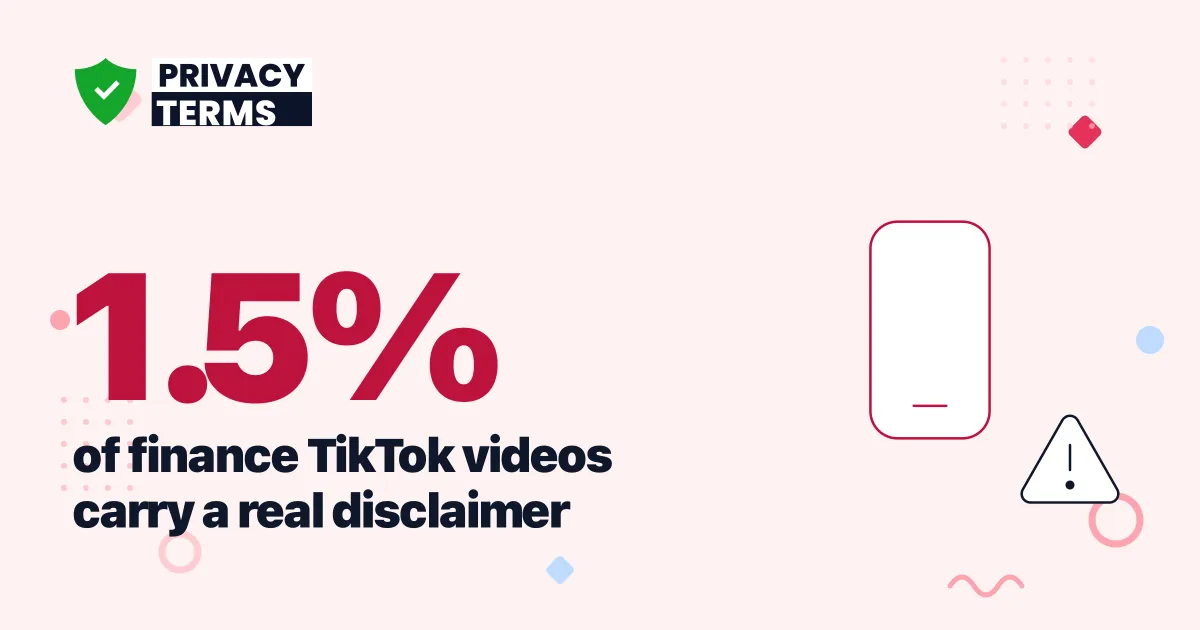
Just 1.5% of finance-focused TikTok videos posted by UK creators between October 2025 and March 2026, 64 of 4,200 finance-context videos, carried an explicit disclaimer stating the content was not financial advice, according to a July 2026 study by researchers at Newcastle University and the University of Birmingham. The gap was not new: across an earlier April-to-September 2024 window, only 215 of 13,215 videos carried any disclaimer-related language whatsoever.
No comparable large-scale crawl of disclaimer pages exists for websites the way it does for privacy policies, where a 2021 Princeton and KU Leuven study measured how many websites actually publish one. The closest recent, well-sourced measurement of disclaimer prevalence covers the platform where financial content now spreads fastest: TikTok. Below is what the 2026 study found, section by section, followed by how it compares to disclosure gaps documented on other platforms.
What percentage of finance TikTok videos actually include a disclaimer?
Ghadafi and Andriotis analyzed 13,215 UK finance-related TikTok videos posted between April and September 2024 by 71 accounts that met a minimum activity threshold, then repeated the measurement on the same creator cohort from October 2025 to March 2026 to see whether the pattern held. Across the primary period, only 215 videos, 1.6% of the total, contained any disclaimer-related language when the researchers checked video descriptions, spoken transcripts, and hashtags for disclaimer keywords.
Figure 1: Three-quarters of every disclaimer-carrying video came from active trading content. Source: Ghadafi and Andriotis, "UK Finfluencers on TikTok," arXiv, July 2026.
The researchers built a three-category framework: explicit disclaimers (statements like "not financial advice" or "do your own research"), weak disclaimers (responsibility-shifting language like "invest at your own risk" without an explicit denial of giving advice), and risk-only language (statements like "trading involves risk" that describe uncertainty without limiting liability). Explicit disclaimers were the rarest of the three, appearing in just 171 of 13,215 videos, 1.3%, during the primary observation window.
How many finance creators disclose at all, even once?
Looking at creators rather than individual videos tells a different part of the story. Of the 71 finfluencers in the primary dataset, 33 (46.5%) used disclaimer language in at least one video across the six-month window, meaning nearly half of all creators disclosed something at some point even though barely 1 in 60 of their videos actually carried one. That gap between "ever disclosed" and "consistently disclosed" is the pattern that matters for anyone judging a creator's compliance from a single video.
Profile-level disclosure was even thinner. Only 2 of the 71 accounts (2.8%) stated in their bio that their content was not financial advice, and just 3 accounts (4.2%) held a verified badge. One account in the original cohort was no longer accessible by the second observation period. A bio disclaimer covers every video a creator posts going forward without relying on any single caption or voiceover, which is exactly why the researchers flagged its rarity as a transparency gap rather than a labeling detail.
Which type of financial content is most likely to carry a disclaimer?
Disclaimer use was not spread evenly across content types. The study grouped videos into four thematic categories using topic modeling, then measured disclaimer prevalence within each.
| Content topic | Videos analyzed | Videos with disclaimer language | Disclaimer rate |
|---|---|---|---|
| Active trading (forex and crypto) | 3,458 | 162 | 4.68% |
| Property investing | 1,670 | 21 | 1.26% |
| Saving and budgeting | 1,640 | 8 | 0.49% |
| Entrepreneurship and side hustles | 6,447 | 24 | 0.37% |
Source: Ghadafi and Andriotis, "UK Finfluencers on TikTok," arXiv, July 2026, Tables 1 and 5.
Figure 2: Entrepreneurship content is the largest single category by volume and the least likely to carry a disclaimer. Source: Ghadafi and Andriotis, "UK Finfluencers on TikTok," arXiv, July 2026.
Entrepreneurship and side-hustle content is both the biggest category by volume, nearly half of every video in the dataset, and the category least likely to carry a disclaimer. The authors note that the concentration of disclaimer language in active trading content likely reflects recent guidance from the UK's Financial Conduct Authority, which has focused enforcement attention on trading and crypto promotions specifically.
Is disclaimer language becoming more common over time?
Explicit disclaimer use moved around from month to month rather than climbing in a straight line during the primary observation window.
Figure 3: Explicit disclaimer rates fluctuated between roughly half a percent and 2 percent from month to month. Source: Ghadafi and Andriotis, "UK Finfluencers on TikTok," arXiv, July 2026, Table 3.
The follow-up period tells a related but distinct story. Weak disclaimers and general risk language became noticeably more common in the October 2025 to March 2026 window, while explicit disclaimers stayed at roughly the same low level as before.
Figure 4: Risk language and weak disclaimers outpaced explicit disclosure in the most recent observation window. Source: Ghadafi and Andriotis, "UK Finfluencers on TikTok," arXiv, July 2026, Table 3.
Weak disclaimers rose from 4 videos out of 13,215 in the primary period to 78 out of 4,200 finance-context videos in the follow-up period, a real increase in raw share. The authors are careful to note that weak disclaimers and risk language are not the same as an explicit denial of giving financial advice, so a rising weak-disclaimer rate does not necessarily mean creators are becoming more transparent about their financial ties or credentials.
How were disclaimers actually classified?
The classification method matters because "disclaimer" covers a range of phrasing, from a clear legal denial down to a vague nod at risk.
Figure 5: The three-category test the researchers applied to every video's description, transcript, and hashtags. Source: Ghadafi and Andriotis, "UK Finfluencers on TikTok," arXiv, July 2026, Section 5.3.
The classification was rule-based, using keyword dictionaries and regular expressions rather than a language model, and validated with a manual review of a stratified sample of 100 videos from each month. The authors note that videos lacking a transcribed voiceover may still contain a disclaimer spoken aloud but not captured in text, so the measured rates are a floor rather than a precise ceiling on true disclosure.
How does this compare to disclosure gaps on other platforms?
Finance TikTok is not the only corner of the internet where disclosure lags the underlying activity. Sun, Vekaria, Shafiq, and Nithyanand's separate 2026 study of YouTube affiliate marketing found that 69.19% of videos with affiliate links failed to meet FTC disclosure standards, more than 45 times the finance TikTok explicit-disclaimer rate measured here. Full detail on that study, including the platform-tooling comparison and the FTC's 2023 rule update, is in our website disclaimer usage post.
| Source | Sample | Period | Disclosure or disclaimer rate |
|---|---|---|---|
| Ghadafi and Andriotis, 2026 (UK finance TikTok, explicit disclaimer) | 4,200 finance-context videos | Oct 2025 to Mar 2026 | 1.5% |
| Ghadafi and Andriotis, 2026 (UK finance TikTok, any disclaimer language) | 13,215 videos | Apr to Sep 2024 | 1.6% |
| Sun, Vekaria, Shafiq and Nithyanand, ICWSM 2026 (YouTube affiliate links, non-compliant) | 146,800 videos with links | 2015 to 2024 | 69.19% non-compliant |
| Ershov, He and Seiler, Marketing Science 2025 (Twitter/X sponsored posts, no disclosure) | 100M-plus tweets, 268 brands | 2014 to 2021 | roughly 95% no disclosure |
Table 1: Four independent measurements of disclosure compliance across platforms and content types, all pointing the same direction. Sources listed in full below.
The methodologies are not identical, one measures explicit financial disclaimers, the other measures FTC-style material-connection disclosure, but the shared pattern is that formal disclosure remains the exception rather than the norm across every large-sample study measured so far, regardless of platform or content type.
Why are regulators paying attention to this gap?
The FCA has been direct about why undisclosed financial content worries a regulator specifically. In consumer research the agency cites, 62% of 18-to-29-year-olds follow social media influencers, 74% of those followers say they trust the advice given, and 90% report that influencer content changed their financial behavior in some way. Against that backdrop, the FCA has interviewed 20 finfluencers under caution using its criminal powers and flagged 38 accounts for potential unlawful financial promotions, according to an FCA press release last updated in February 2026.
A site or creator publishing financial guidance, whether as a blog, a newsletter, or a TikTok script that later gets posted to a website, carries the same underlying obligation regardless of format: say clearly that the content is not personalized financial advice if that is the case. A disclaimer generator built for exactly this kind of liability language covers that base alongside the general no-warranty disclosure most publishing sites also need, without relying on a creator remembering to add it video by video.
The Bottom Line
The honest answer to how many finance content creators actually disclose is that almost none of them do it consistently, even though the practice of disclosing at least once is close to a coin flip. Only 1.5% of finance TikTok videos in the most recent observation window carried an explicit disclaimer, and profile-level disclosure sat at just 2.8% of accounts, despite 46.5% of creators having used disclaimer language somewhere in their back catalog. That gap between occasional and consistent disclosure is exactly what a standing disclaimer page or bio statement is built to close: set it once, on the account or the site, and it covers every piece of content published after, rather than depending on a single caption to carry the legal weight.
Frequently Asked Questions
What percentage of finance TikTok videos include a disclaimer? Just 1.5% (64 of 4,200 finance-context videos) carried an explicit not-financial-advice disclaimer between October 2025 and March 2026. In an earlier window, April to September 2024, only 215 of 13,215 videos (1.6%) carried any disclaimer-related language at all, per a 2026 study by researchers at Newcastle University and the University of Birmingham.
How many finance influencers ever post a disclaimer, even once? 33 of 71 UK finance TikTok creators (46.5%) used disclaimer language in at least one video during the study's April to September 2024 window, even though almost none of them did so consistently across their content.
Do finance influencers add disclaimers to their profile bio? Rarely. Only 2 of 71 finfluencers (2.8%) added a not-financial-advice disclaimer to their profile bio, and just 3 accounts (4.2%) were verified on the platform, according to the same 2026 study.
Which type of financial content is disclosed most often? Active trading content covering forex and crypto carried a disclaimer 4.68% of the time (162 of 3,458 videos), compared with just 0.37% for entrepreneurship and side-hustle content (24 of 6,447 videos), the widest gap of any content category measured.
Where the Numbers Come From
- Ghadafi, E., and Andriotis, P. (2026). "UK Finfluencers on TikTok: A Longitudinal Analysis of Content, Engagement, and Disclaimer Practices." arXiv, published July 6, 2026. 13,215 videos and 71 accounts analyzed for April to September 2024, plus a follow-up 8,565-video dataset for October 2025 to March 2026; 215 videos with any disclaimer language, 64 of 4,200 finance-context videos with an explicit disclaimer in the follow-up period.
- Financial Conduct Authority. Press release, published October 22, 2024, last updated February 20, 2026. 20 finfluencers interviewed under caution, 38 accounts flagged for potential unlawful financial promotions, and cited consumer research on influencer trust and behavior change among 18 to 29 year olds.
- Sun, C., Vekaria, Y., Shafiq, Z., and Nithyanand, R. (2026). "Turning Trust to Transactions: Tracking Affiliate Marketing and FTC Compliance in YouTube's Influencer Economy." ICWSM 2026. 146,800 videos with affiliate links out of 2 million analyzed, 69.19% non-compliant with FTC disclosure standards.
- Ershov, D., He, Y., and Seiler, S. (2025). "Frontiers: How Much Influencer Marketing Is Undisclosed? Evidence from Twitter." Marketing Science, summarized via CEPR/VoxEU. Over 100 million tweets analyzed, 2014 to 2021, roughly 95% of sponsored posts undisclosed.
Note: All figures verified as of September 2026. The Ghadafi and Andriotis dataset covers UK-based TikTok accounts identified through finance-related keywords and hashtags, so it may not generalize to other platforms, regions, or influencer categories, and rule-based keyword detection can miss a disclaimer spoken aloud but not transcribed. Figures are refreshed at least twice a year as newer studies become available.