Only 2% of Britons say they trust large companies “a lot” to keep their personal data safe from cyberattacks, according to a YouGov tracker of 6,315 GB adults published in May 2025. Another 17% say they have no trust at all, leaving the vast majority somewhere in a skeptical middle. That distrust sits alongside rising awareness of formal data rights and a near-doubling of complaints to the UK’s data protection regulator, a combination that suggests British consumers increasingly know what they are owed even as their confidence in who holds their data keeps falling, a pattern that shows up again in the broader global data privacy statistics and in Australia’s OAIC survey data.
How much do Britons trust companies with their data?
Trust in large companies to protect personal data is thin and polarized. YouGov’s May 2025 tracker found just 2% of respondents trust large companies “a lot” with data security, while 17% say they have no trust at all, with most of the rest spread across weaker degrees of trust rather than clustering near confidence. A separate YouGov tracker running from December 2024 through December 2025 found 59% of Britons are concerned about the sheer scale of data collected about them online, yet only 52% call limiting that access “very important,” a gap between worry and priority that shows up again in how people describe their own habits: 44% say they take only “moderate care” protecting their data online, and 38% say they no longer know how to protect it at all.
Figure 1: Trust in large companies with personal data, UK adults, 2025. Source: YouGov Daily Question tracker (n=6,315), 14 May 2025.
How many UK adults know and use their data rights?
Despite that thin trust, most Britons have already put their formal data rights to use. The ICO’s Public Attitudes Survey on Information Rights (PAIR) 2025, based on 8,019 respondents surveyed by Savanta between January and February 2025, found 76% of UK adults have exercised at least one information right, such as requesting access to their data or asking a company to delete it. Awareness of specific rights is climbing too: awareness of the right to erasure reached 49% in 2025, up from 46% the year before, and awareness of the right of access reached 45%, up sharply from 36%.
Figure 2: UK public awareness of the right to erasure and the right of access, 2024 vs 2025. Source: ICO Public Attitudes Survey on Information Rights (PAIR) 2025.
Understanding of the regulator itself lags behind rights awareness. The same PAIR 2025 survey found 57% of the UK public claim some awareness of the ICO, but only 26% say they clearly understand its role, a share the ICO itself describes as a substantial rise from 2024 despite still being a minority. If your site processes UK residents’ data, generate a privacy policy that covers UK GDPR disclosure requirements, including the access and erasure rights nearly half the country now recognizes by name.
How many complaints does the ICO receive, and about what?
Complaint volume to the ICO has surged. The regulator’s own Annual Report shows 76,743 data protection complaints received in the 2025/26 reporting year, nearly double the 42,315 logged in 2024/25, which was itself up 6.5% from 39,721 in 2023/24.
Figure 3: ICO data protection complaints received per reporting year. Source: ICO Annual Report, 2023/24 through 2025/26 editions.
Mishandled access requests drive most of that volume: the right of access was the single biggest complaint category in the ICO’s Q3 2025/26 quarterly data, accounting for 43% of completed cases (3,748 of 8,646). The regulator’s own ability to keep pace has fallen behind the surge. Only 30% of 2024/25 complaints were resolved within the ICO’s 90-day target, a collapse from 84.8% the year before, meaning 70% of cases missed the target compared with just 15.2% the prior year.
Figure 4: Share of ICO complaints resolved within the regulator’s own 90-day service target. Source: ICO Annual Report 2024/25, complaint-handling data.
People who have already experienced a data problem report the sharpest skepticism. The PAIR 2025 survey found people with a disability were more likely to say a data breach had affected them (77%) than those without (69%), and 76% of respondents with any vulnerability reported being affected by a breach, compared with 67% of those without one.
Do younger and older Britons see privacy differently?
Age is one of the clearest dividing lines in UK privacy attitudes. YouGov’s Data Privacy Day UK 2026 tracker found 63% of adults aged 55 and over say limiting how much of their data companies can access is very important, compared with just 36% of adults aged 18 to 34, a 27-point gap. The same tracker found 55% of 18-to-34s say they take only “moderate care” protecting their data online, versus 35% of adults over 55, meaning younger Britons are both less likely to call data limits a priority and more likely to describe their own protective habits as inconsistent.
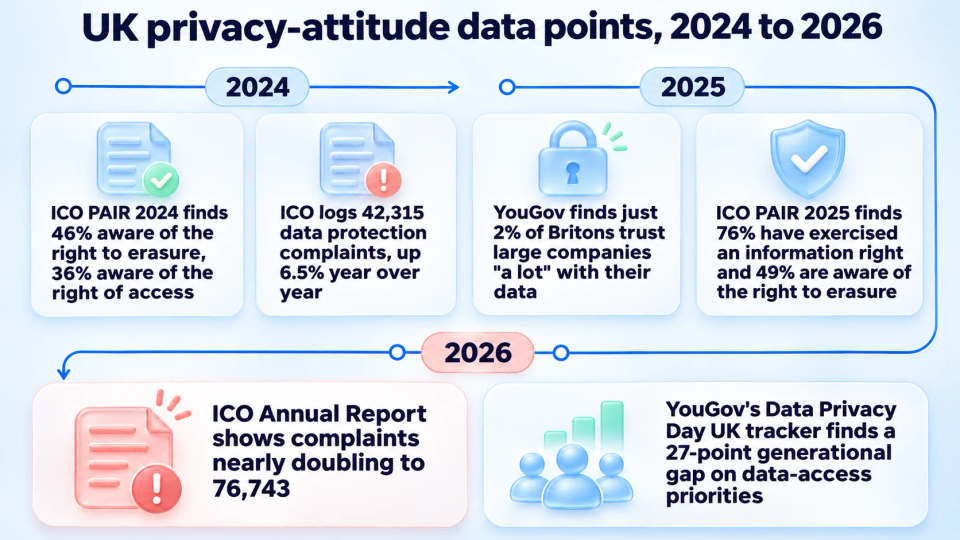
Figure 5: Key UK privacy-attitude findings by publication year. Source: ICO PAIR 2024 and 2025 reports; ICO Annual Reports; YouGov trackers.
| Metric | 2025/26 figure | Source |
|---|---|---|
| Trust large companies “a lot” with data | 2% | YouGov (May 2025) |
| Exercised at least one information right | 76% | ICO PAIR 2025 |
| ICO complaints received | 76,743 | ICO Annual Report 2025/26 |
| Adults 55+ who prioritize limiting data access | 63% | YouGov (2026 tracker) |
The Bottom Line
The UK numbers describe a public that trusts almost no one with its data yet increasingly knows how to act on the rights it has. Only 2% of Britons extend high trust to large companies, but 76% have already exercised a formal information right, and ICO complaint volume has nearly doubled in a single year as more people act on that awareness. The gap between generations matters here too: with just 36% of 18-to-34s calling data limits a priority against 63% of over-55s, the age group least likely to prioritize privacy today is the one that will be filing most rights requests within a decade. Any UK-facing site should treat rising rights awareness, not just headline trust numbers, as the metric that predicts how many access and erasure requests it will actually receive. That age divide is even sharper elsewhere: see how Gen Z and Baby Boomer attitudes toward privacy compare on reading habits and rights literacy.
Frequently Asked Questions
How many Britons trust large companies with their data? Only 2% of Britons say they trust large companies “a lot” to keep their personal data safe from cyberattacks, while 17% say they have no trust at all, according to YouGov’s tracker of 6,315 GB adults published in May 2025.
How many UK adults have exercised a data protection right? 76% of UK adults say they have exercised at least one information right, such as requesting access to or erasure of their data, according to the Information Commissioner’s Office’s Public Attitudes Survey on Information Rights (PAIR) 2025, based on 8,019 respondents surveyed by Savanta.
How many complaints does the ICO receive each year? The ICO received 76,743 data protection complaints in the 2025/26 reporting year, according to its own Annual Report, nearly double the 42,315 complaints logged the year before and up from 39,721 in 2023/24.
Do younger and older Britons view data privacy differently? Yes. 63% of UK adults aged 55 and over say limiting how much of their data companies can access is very important, compared with just 36% of adults aged 18 to 34, according to YouGov’s Data Privacy Day UK 2026 tracker.
Where the Numbers Come From
- YouGov. (2025). “Daily Question: Trust in Large Companies With Data Security.” Survey of 6,315 GB adults, published 14 May 2025.
- Information Commissioner’s Office. (2025). “Public Attitudes Survey on Information Rights (PAIR) 2025.” Conducted by Savanta, n=8,019, fieldwork 10 January to 21 February 2025.
- Information Commissioner’s Office. “ICO Annual Report 2025/26.” Reports 76,743 data protection complaints received in the reporting year.
- YouGov. (2026). “Data Privacy Day UK 2026: UK Attitudes Toward Online Data Protection.” Continuous tracker, fieldwork December 2024 to December 2025.
- GDPR Course UK. Compilation of the ICO’s published quarterly complaint-handling dataset, including the 90-day resolution rate and right-of-access complaint share.
Note: All figures verified as of November 2026. Complaint-handling and resolution-rate figures are drawn from the ICO’s own published datasets via a secondary compilation; readers requiring page-level citations should consult the ICO’s original quarterly releases directly. Figures are refreshed at least twice a year to track new PAIR and Annual Report editions.