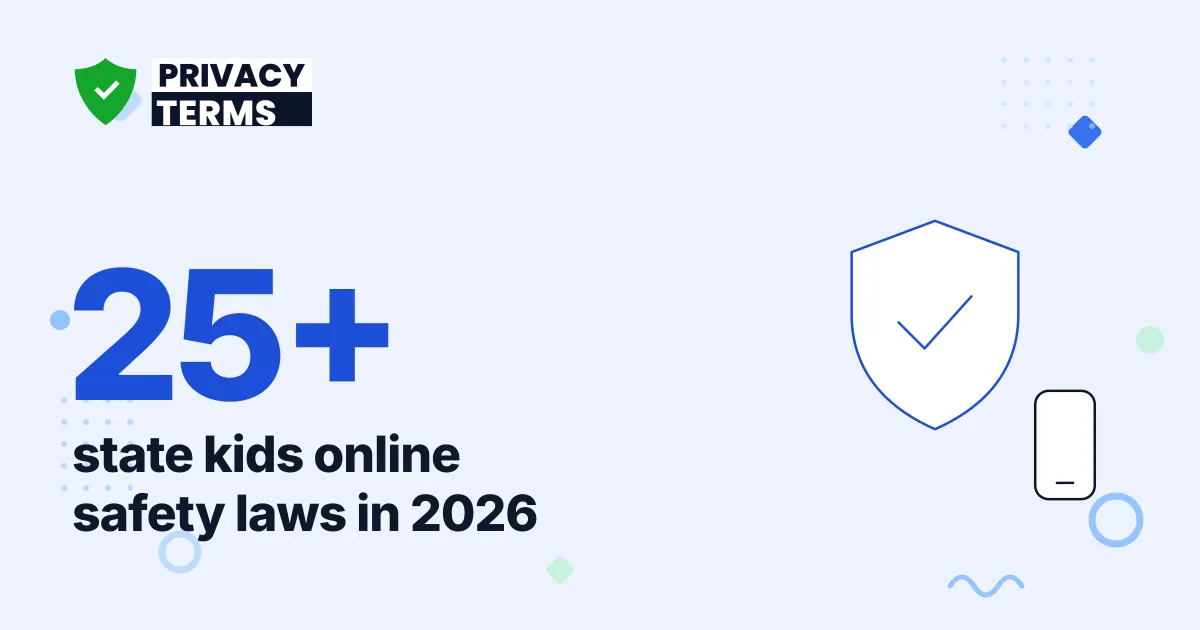
At least 25 US states had an enacted children’s online safety law by mid-2026, covering everything from app store age verification to design codes that limit addictive features for minors, according to a Loeb & Loeb tracker published in June 2026. Roughly 60% of those laws are tangled in litigation, sitting under an injunction, or waiting on a delayed effective date, which makes this one of the fastest-moving and least settled corners of US privacy law.
This tracker groups every enacted state law by type, flags which ones actually took effect versus which are stuck in court, and links to the full breakdown of children’s online privacy numbers this cluster builds on.
How many states have children’s online safety laws in 2026?
At least 25 states had an enacted law on the books as of mid-2026, spread across four distinct categories: App Store Accountability Acts, age-appropriate design codes, general children’s privacy statutes, and social media or interactive-service laws aimed specifically at minors. California passed the first modern version of this wave, its Age-Appropriate Design Code Act, back in 2022; by 2024 roughly 10 states had followed with some form of children’s online safety law, and that number has more than doubled again since.
Figure 1: State kids online safety laws grouped by category as of mid-2026. Source: Loeb & Loeb LLP tracker, June 2026.
Social media and interactive-service laws make up the largest single category, spanning states like California, Colorado, Florida, Georgia, Louisiana, Mississippi, Nebraska, New York, Ohio, Tennessee, Texas, and Utah, though several of those statutes remain under a preliminary injunction or stay as of this post’s freshness date.
What is an App Store Accountability Act, and which states have one?
An App Store Accountability Act shifts age-verification duty away from individual apps and onto the app stores themselves, requiring Apple’s App Store and Google Play to verify a user’s age at the account level and, for minors, obtain parental consent before an app download or in-app purchase. Utah passed the first version in 2024, and by mid-2026 four states, Utah, Texas, Louisiana, and Alabama, had enacted one.
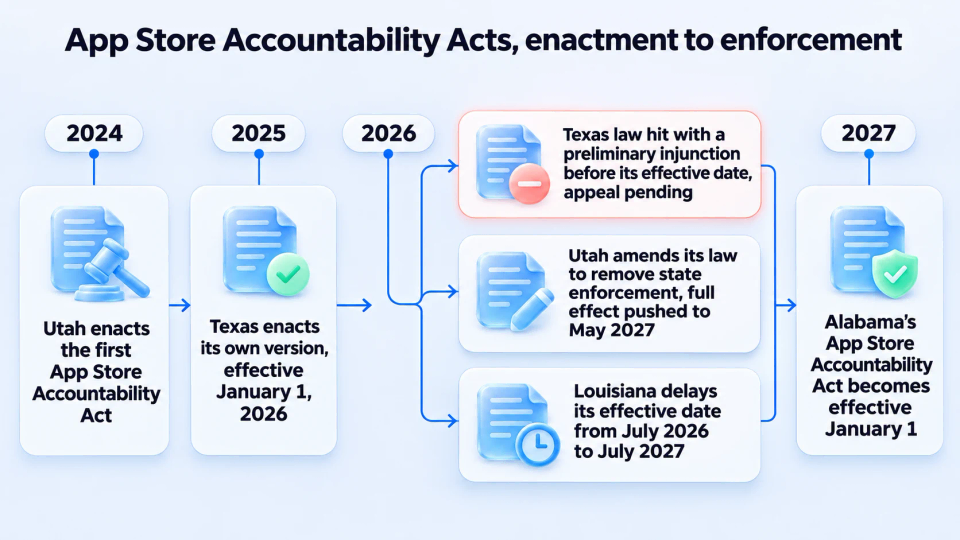
Figure 2: Timeline of the four enacted App Store Accountability Acts and their legal setbacks. Source: Loeb & Loeb LLP tracker, June 2026.
None of the four laws are cleanly in force and unchallenged today. Texas’s is enjoined pending appeal, Utah’s was amended to strip out state enforcement before its own effective date arrived, and Louisiana pushed its start date back a full year, a pattern that shows up across nearly every category on this list.
Which states have age-appropriate design codes?
An age-appropriate design code requires online services likely to be accessed by minors to default to privacy-protective settings, limit certain data uses, and complete a data protection impact assessment before launching features aimed at kids. At least 8 such laws are enacted across 7 states: California, Maryland, Colorado, Montana, South Carolina, Nebraska, Vermont, and Connecticut, which has passed two separate design-code statutes with different effective dates.
New Jersey became the newest state in this category. Governor Mikie Sherrill signed three children’s online safety measures on August 11, 2026, including the New Jersey Age-Appropriate Design Code, which imposes safety, privacy, data-use, and design requirements on covered online services starting September 1, 2027, according to Mayer Brown’s coverage of the signing.
Figure 3: Share of enacted state kids online safety laws that are challenged, enjoined, or delayed versus in force and unchallenged. Source: PrivacyTerms.io tally of Loeb & Loeb LLP’s June 2026 tracker.
California’s design code remains the highest-profile example of this legal pattern: it took effect July 1, 2024, but parts of it were preliminarily enjoined on First Amendment grounds and remain tied up in appellate litigation as of mid-2026.
Why are so many of these laws being blocked in court?
Most enacted laws in this tracker face a First Amendment challenge from tech industry trade groups, most commonly NetChoice, arguing that age-verification mandates and default-settings requirements restrict protected speech, compel speech through disclosure requirements, or burden adult access to lawful content the law never intended to reach. Courts have split on the outcome case by case, which is why the legal status column below matters as much as the enactment date.
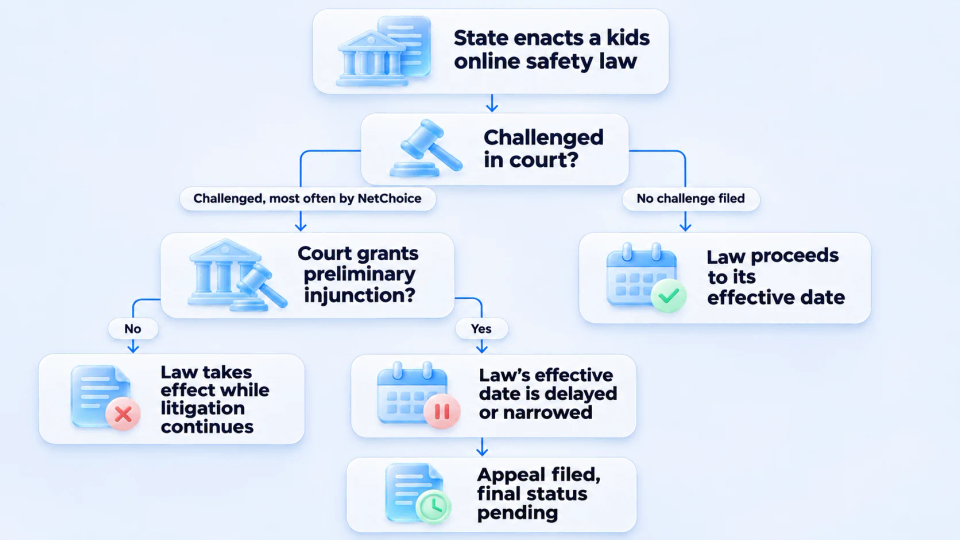
Figure 4: How an enacted state kids online safety law typically moves toward, or away from, taking effect. Source: PrivacyTerms.io synthesis of Loeb & Loeb LLP and Mayer Brown case tracking, 2026.
That litigation pattern is also why lawmakers keep introducing new bills rather than waiting for a single model law to hold up. State legislatures introduced roughly 300 children’s online safety bills in the 2026 session alone, according to MultiState’s April 2026 tracking, a volume that keeps this list growing even as individual laws get stalled.
A site that collects any data from users under the age of majority, including the population covered in our count of underage children on social media platforms, needs privacy-policy language that keeps pace with whichever of these laws actually applies to its user base, not just the ones that made headlines. Businesses building or updating that policy can generate a privacy policy that covers state-specific children’s data provisions alongside the federal COPPA baseline.
State Kids Online Safety Laws by Category
| Category | States | Example status |
|---|---|---|
| Social media / interactive services | California, Colorado, Florida, Georgia, Louisiana, Mississippi, Nebraska, New York, Ohio, Tennessee, Texas, Utah | Most under injunction, stay, or appeal |
| Age-appropriate design codes | California, Maryland, Connecticut (x2), Colorado, Montana, South Carolina, Nebraska, Vermont, New Jersey | Maryland in force unchallenged; California partially enjoined |
| App Store Accountability Acts | Texas, Utah, Louisiana, Alabama | Texas enjoined; Utah and Louisiana delayed to 2027 |
| General children’s privacy laws | New York, Arkansas | New York in force since June 2025 |
Source: Loeb & Loeb LLP tracker (June 2026) and Mayer Brown insights (January and August 2026). Counts reflect laws enacted as of mid-2026; several states appear in more than one category.
The Bottom Line
The headline number, 25-plus enacted state kids online safety laws, only tells half the story. With roughly 60% of them tied up in litigation, delayed, or amended before taking full effect, a business serving users across state lines cannot treat “enacted” and “enforceable” as the same thing. The practical answer is to build privacy and design practices around the strictest version of these rules that is actually in force in a given state, and to revisit that list regularly, since a new bill signing or appellate ruling can change the picture within weeks.
Frequently Asked Questions
How many US states have children’s online safety laws in 2026? At least 25 state laws covering app store age checks, age-appropriate design codes, general children’s privacy, or minors’ social media access were enacted as of mid-2026, according to a Loeb & Loeb tracker published in June 2026. That count spans laws already in force and laws signed but not yet effective.
What is an App Store Accountability Act? A state law requiring app stores such as Apple’s App Store and Google Play to verify a user’s age and, for minors, obtain parental consent before app downloads. Four states, Texas, Utah, Louisiana, and Alabama, have enacted one as of mid-2026, though Texas’s law is under a preliminary injunction and Utah’s and Louisiana’s effective dates have been pushed to 2027.
Why do so many kids online safety laws get blocked in court? Most face First Amendment challenges from tech industry groups, most often NetChoice, arguing that age-verification and design mandates restrict protected speech and burden adult access to lawful content. Roughly 60% of the 25-plus enacted laws tracked here carry an active lawsuit, injunction, or delayed effective date as of mid-2026.
Which state passed the newest kids online safety law? New Jersey, where Governor Mikie Sherrill signed three children’s online safety measures on August 11, 2026, including the New Jersey Age-Appropriate Design Code, which takes effect September 1, 2027, according to Mayer Brown’s coverage of the signing.
Where the Numbers Come From
- Loeb & Loeb LLP. (2026). “Children’s Online Privacy in 2026: More State App Store, Design Code and Social Media Laws Enacted, Then Delayed.” State-by-state tracker of enacted laws and their legal status, published June 2026.
- Mayer Brown. (2026). “New Jersey Enacts Children’s Online Safety Package, Including New Design Code Requirements.” Coverage of the August 11, 2026 signing and September 1, 2027 effective date.
- Mayer Brown. (2026). “Little Users, Big Rules: Tracking Children’s Privacy Legislation.” Baseline tracker of state children’s privacy bills, published January 2026.
- MultiState. (2026). “State Children’s Online Safety Laws Expand Beyond Social Media in 2026.” Legislative bill-count tracking, published April 30, 2026.
Note: All figures verified as of August 2026. State law counts and legal status change quickly as courts rule and legislatures reconvene; this page will be refreshed as the litigation landscape shifts.