Switzerland’s revised Federal Act on Data Protection can fine the person responsible for a violation up to CHF 250,000, not the company, a structure that sets it apart from GDPR’s revenue-based corporate fines. The law, known as the FADP or nFADP, took effect on 1 September 2023 and is enforced by the Federal Data Protection and Information Commissioner, the FDPIC. Below is what the FDPIC’s own annual reports say about how the law actually gets enforced, how the fine structure works, and whether Switzerland’s EU adequacy survived the rewrite.
What is Switzerland’s FADP and when did it take effect?
The Federal Act on Data Protection, referred to as the FADP (in German, the Datenschutzgesetz or DSG), is Switzerland’s national privacy law. The revised version, often called the nFADP or revFADP to distinguish it from the prior statute, entered into force on 1 September 2023 and replaced a data protection act dating to 1992, with no transition period for compliance.
The FDPIC, currently Adrian Lobsiger, is the federal regulator responsible for supervising both private companies and federal government bodies under the law. Unlike the EU’s network of national data protection authorities feeding into the European Data Protection Board, Switzerland has a single federal regulator with no state-level equivalents, and its 33 full-time staff positions dedicated to data protection have stayed flat since the FADP took effect, according to the FDPIC’s 32nd Annual Report.
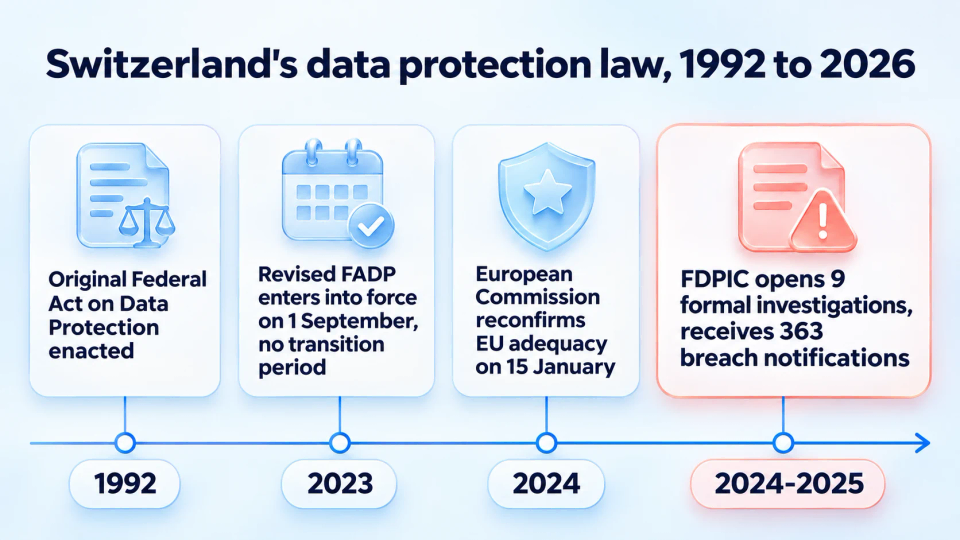
Figure 1: Milestones in the FADP’s development. Source: FDPIC 31st and 32nd Annual Reports, European Commission adequacy decision.
How does the FADP penalize violations differently than GDPR?
The FADP’s defining feature is who pays. Under Articles 60 and 61, a willful violation of specific duties, such as failing to provide required information, disclosing personal data abroad without safeguards, or neglecting minimum data security standards, can result in a criminal fine of up to CHF 250,000 against the individual responsible, usually a manager or the person who made the decision. Negligent violations carry no criminal penalty at all under these articles.
If prosecutors cannot reasonably identify the specific responsible individual, Article 64 allows the company itself to be fined instead, but the fallback amount is capped much lower at up to CHF 50,000. Cantonal prosecution authorities, not the FDPIC, bring these criminal cases, and the FDPIC has confirmed it has no independent right to file a criminal complaint, though it can act as a private plaintiff in proceedings.
| Feature | Switzerland FADP | EU GDPR |
|---|---|---|
| Who is fined | Responsible individual (company fallback capped lower) | The company |
| Maximum fine | CHF 250,000 for individuals; CHF 50,000 company fallback | EUR 20 million or 4% of global annual turnover |
| Fine basis | Flat cap, willful violations only | Percentage of turnover, negligence included |
| Who prosecutes | Cantonal criminal prosecution authorities | The national data protection authority |
Table 1: How Switzerland’s individual-liability model differs from GDPR’s corporate fines. Source: FADP Articles 60, 61, 64; GDPR Article 83.
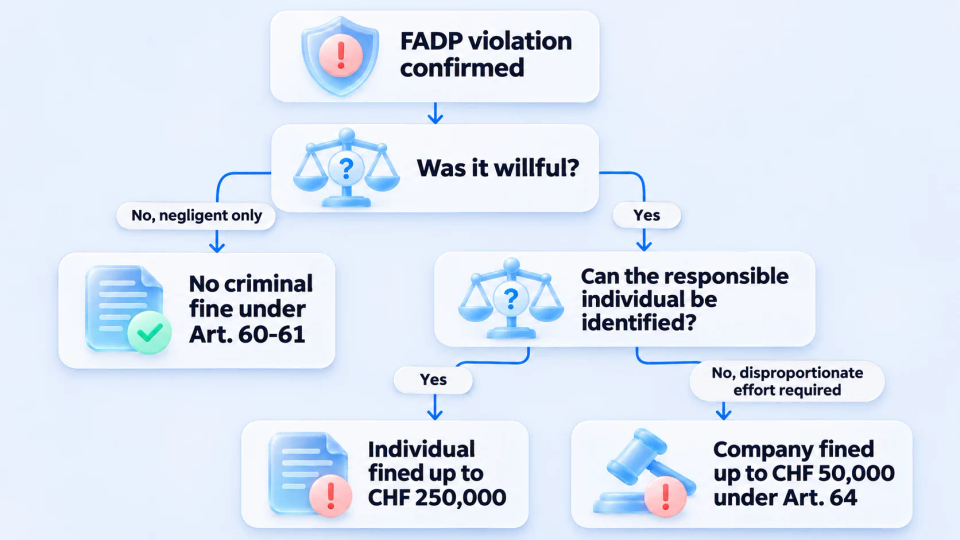
Figure 2: How Switzerland decides who pays a FADP fine. Source: FADP Articles 60, 61, and 64.
No confirmed criminal conviction under the CHF 250,000 provision has been publicly reported by the FDPIC as of this post’s research, since cantonal prosecutors handle these cases separately and outcomes are not centrally published in the FDPIC’s own annual reports. If you handle personal data of Swiss residents, you can generate a privacy policy that reflects the FADP’s information duties, since those duties, not the fine amount itself, are what triggers Article 60 liability in the first place.
How many investigations and complaints has the FDPIC handled?
The FDPIC’s Data Protection Directorate handled 1,053 complaints during the 2024/2025 reporting year, 1,023 of them against private entities and 30 against federal authorities, according to Table 9 of the 32nd Annual Report. Most complaints never become a formal investigation: the FDPIC resolved 108 cases through low-threshold interventions, with 90% of subjects complying voluntarily once contacted, before opening 20 preliminary investigations and 9 formal investigations.
Figure 3: Share of reported breaches that reached the FDPIC within 21 days. Source: FDPIC 32nd Annual Report, 2024/2025.
Of the 9 formal investigations opened in 2024/2025, 6 remained pending at the close of the reporting year and 3 concluded with administrative measures rather than a referral for prosecution. Two of those investigations, still ongoing, target controllers the FDPIC says failed to notify affected individuals about a data breach even after being told to do so.
Figure 4: Case volume drops sharply at each stage of FDPIC supervision. Source: FDPIC 32nd Annual Report, Table 9.
How many data breaches have been reported to the FDPIC?
The FDPIC received 363 data breach notifications in the 2024/2025 reporting year, up significantly from 245 in the prior period, which itself only covered the roughly ten months since the mandatory breach-reporting portal launched on 9 May 2023. Of the 363 notifications, 344 arrived through the FDPIC’s online DataBreach portal, 19 came through other channels such as email or post, and 26 were submitted voluntarily rather than because the breach met the high-risk notification threshold.
Figure 5: Breach notifications received by the FDPIC, by reporting year. Source: FDPIC 31st and 32nd Annual Reports.
The FDPIC also began tracking how quickly companies report once a breach is discovered. In the 2024/2025 year, around 40% of reported breaches reached the regulator within 6 days of occurring, and around 80% arrived within 21 days, figures the FDPIC published for the first time in its most recent report. The FADP’s notification threshold is stricter than GDPR’s in one respect: Switzerland only requires notification when a breach poses a high risk to the data subject’s rights, a narrower trigger than GDPR’s broader default reporting duty.
Does Switzerland still have EU adequacy status under the revised FADP?
Yes. The European Commission confirmed on 15 January 2024 that Switzerland’s revised data protection framework continues to meet EU adequacy requirements, meaning personal data can keep moving from the EU and EEA to Switzerland without additional contractual safeguards. Switzerland has held EU adequacy since 2000, originally under the precursor to GDPR, and the Commission’s 2024 report specifically credited the FADP revision with maintaining that status rather than putting it at risk.
Adequacy decisions are not permanent. The European Commission reviews Switzerland’s status roughly every four years, and a future finding that Swiss enforcement or legislation has drifted from GDPR-equivalent protection could change the outcome. For now, businesses transferring data between the EU and Switzerland can treat both jurisdictions as functionally aligned on cross-border transfer requirements, though the underlying fine structures, penalty targets, and notification thresholds still differ in the ways detailed above.
The Bottom Line
Switzerland’s revised FADP took a genuinely different enforcement path than GDPR: it fines the person, not the company, caps that fine at CHF 250,000, and routes prosecution through cantonal courts rather than the FDPIC itself. That individual-liability structure has not yet produced a publicly confirmed conviction, but the FDPIC’s own supervisory numbers, 1,053 complaints handled, 9 formal investigations opened, and 363 breach notifications received in 2024/2025 alone, show a regulator that has ramped up activity substantially since the law took effect in September 2023. Switzerland kept its EU adequacy status through the transition, so the practical compliance burden for most site owners is less about fine math and more about the FADP’s own information, security, and breach-notification duties, the same duties that trigger Article 60 liability for whoever is responsible when they are ignored.
Frequently Asked Questions
What is the maximum fine under Switzerland’s FADP? CHF 250,000, but it is billed to the responsible individual, not the company, and only applies to willful violations of specific duties such as failing to provide information or neglecting data security. If the responsible person cannot reasonably be identified, the company itself can be fined up to CHF 50,000 instead.
Does the FDPIC fine companies or individuals under the FADP? Individuals. Articles 60 and 61 of the FADP place criminal liability on the natural person who committed the willful violation, typically a manager or decision-maker, and cantonal prosecution authorities, not the FDPIC itself, bring the case. This is the opposite of GDPR, where fines land on the company.
When did the revised FADP take effect? 1 September 2023, replacing Switzerland’s 1992 data protection law without a transition period, according to the FDPIC’s own 31st Annual Report.
Does Switzerland still have EU adequacy status after the FADP revision? Yes. The European Commission confirmed on 15 January 2024 that the revised FADP still meets EU adequacy requirements, so personal data can keep flowing from the EU and EEA to Switzerland without extra safeguards. The decision is reviewed every four years.
Where the Numbers Come From
- Federal Data Protection and Information Commissioner (FDPIC). (2024). “31st Annual Report 2023/24.” Confirms the FADP entered into force 1 September 2023; reports 245 data breach notifications received since the portal launched 9 May 2023, covering the period through 31 March 2024.
- Federal Data Protection and Information Commissioner (FDPIC). (2025). “32nd Annual Report 2024/25.” Reports 363 total data breach notifications, 1,053 complaints handled, 108 low-threshold interventions, 20 preliminary investigations, and 9 formal investigations for the period 1 April 2024 to 31 March 2025, plus breach-reporting speed figures.
- Federal Data Protection and Information Commissioner (FDPIC). “EU adequacy decision regarding Switzerland.” Confirms the European Commission’s 15 January 2024 report reaffirming Swiss EU adequacy under the revised FADP.
- Fedlex, the official compilation of Swiss federal law. “Federal Act on Data Protection (FADP), SR 235.1.” Official English text of Articles 60, 61, and 64 governing criminal sanctions and the company fallback fine.
- Federal Data Protection and Information Commissioner (FDPIC). “Criminal law.” Confirms cantonal prosecution authorities, not the FDPIC, prosecute FADP criminal offenses, and that the FDPIC has no independent right to file a criminal complaint.
Note: All figures verified as of November 2026. Enforcement statistics are drawn from the FDPIC’s own annual reports, published roughly each July covering the prior April-to-March period; the next edition may update the investigation and breach-notification counts cited here. See also our Privacy Laws by Country 2026: The Global List for how the FADP compares globally, our South Korea PIPA enforcement statistics, and our Gulf States privacy law data for the UAE and Saudi Arabia.