South Korea’s Personal Information Protection Commission fined Coupang KRW 624.68 billion, roughly $409 million, on 10 June 2026, the largest privacy penalty ever issued under the Personal Information Protection Act. The fine covers a data breach that exposed roughly 37.55 million people’s information, close to two-thirds of the country’s population, plus a separate finding that Coupang misused browsing data collected through its Coupang Partners affiliate program.
PIPC is South Korea’s central data protection authority, and PIPA carries some of the steepest privacy penalties in the world by percentage of revenue. Below is how the record Coupang fine breaks down, how it compares to PIPC’s other major enforcement actions, what the statutory fine caps actually say after two amendments in three years, and where PIPC has focused its cross-border transfer enforcement.
What is the largest PIPC fine ever issued?
The Coupang fine of KRW 624.68 billion (about $409 million), confirmed on PIPC’s own site as a record penalty, is the largest since the commission was established in 2020. PIPC found that Coupang had an insufficient basic safety management system, including negligence in managing an authentication signing key and weak access controls, which let a former employee steal customer data.
The KRW 624.68 billion figure combines two separate findings: roughly $278 million tied to the November 2025 data breach itself, and roughly $132 million for the Coupang Partners program, which PIPC found had collected and cross-used members’ activity records from outside websites without adequate consent. A smaller additional fine of 248 million won was also issued against the Coupang Fulfillment Service subsidiary.
Figure 1: How the record Coupang penalty splits between the data breach and the Coupang Partners program. Source: PIPC, 11 June 2026 press release.
The breach itself involved a former Coupang engineer who had built the company’s alternative authentication system and later used a stolen signing key to access customer records after leaving the company. PIPC’s decision cited failures to notify affected users promptly, inadequate data destruction practices, and interference with the data protection officer’s independence.
How does the Coupang fine compare to PIPC’s other big cases?
Before Coupang, PIPC’s record fine was KRW 134.8 billion (about $97 million), issued against SK Telecom on 28 August 2025 for weak security and slow breach reporting after attackers stole SIM authentication data tied to 23.2 million LTE and 5G subscribers. SK Telecom has since filed suit to overturn that penalty.
Figure 2: The five largest confirmed PIPC fines by amount. Source: PIPC decisions and enforcement coverage, 2022 to 2026.
KT Corp was fined KRW 53.979 billion plus a 7.2 million won penalty (about $39 million) on 29 July 2026 after attackers used stolen digital certificates from illegal femtocells to access customer data over an 11-month span; PIPC also found KT had detected malware on its servers and failed to report the intrusion. Before these breach cases, PIPC’s biggest fines targeted consent failures rather than security lapses: Google was fined KRW 69.2 billion (about $50 million) and Meta KRW 30.8 billion (about $22 million) on 14 September 2022, a combined KRW 100 billion, for collecting behavioral tracking data across other websites without properly disclosed consent. You can build a PIPA-ready privacy policy that documents the consent basis and data-sharing disclosures PIPC checks first in an investigation.
| Company | Fine (KRW) | Fine (approx. USD) | Date | Violation |
|---|---|---|---|---|
| Coupang | 624.68 billion | $409 million | June 2026 | Data breach and unlawful tracking data use |
| SK Telecom | 134.8 billion | $97 million | August 2025 | USIM data breach, weak security |
| 69.2 billion | $50 million | September 2022 | Behavioral tracking without consent | |
| KT Corp | 53.979 billion | $39 million | July 2026 | Femtocell data breach, concealment |
| Meta | 30.8 billion | $22 million | September 2022 | Behavioral tracking without consent |
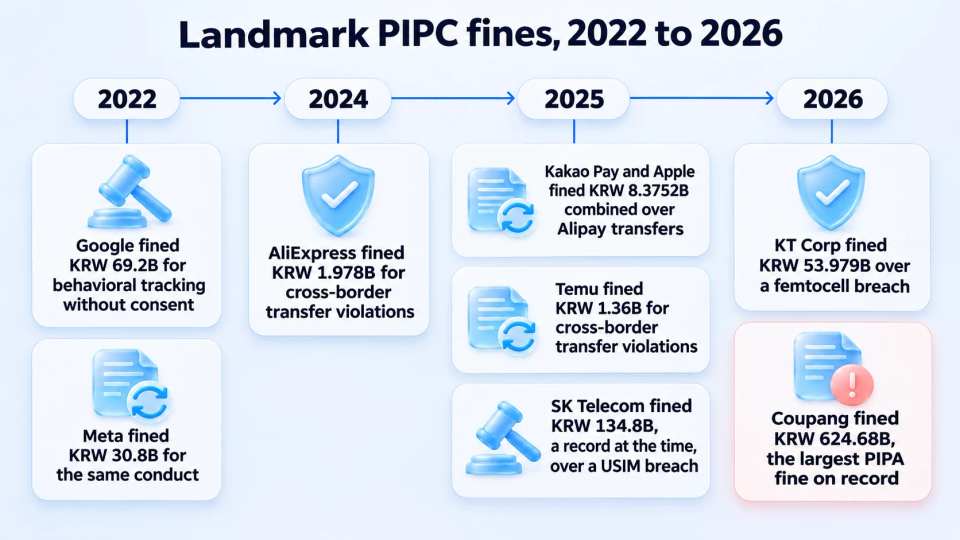
Figure 3: PIPC’s escalating fine history by year. Source: PIPC decisions as reported by DataGuidance, Korea Herald, and the Korea Times, 2022 to 2026.
What is the maximum fine under South Korea’s PIPA?
PIPA’s administrative fine ceiling has changed twice since 2023, and by this post’s publication both versions are in force. Since the amended PIPA took effect on 15 September 2023, the baseline cap is up to 3 percent of a company’s revenue tied to the violation, with the 2023 amendment broadening how that revenue base is calculated while still allowing companies to exclude clearly unrelated revenue streams.
A further amendment, passed by the National Assembly on 12 February 2026, signed on 10 March 2026, and effective from 11 September 2026, adds a second, punitive track: PIPC may seek fines of up to 10 percent of a company’s total revenue in the most severe cases. That higher cap applies only where a company intentionally or with gross negligence repeats a violation within three years, where intentional or grossly negligent conduct affects 10 million or more people, or where a breach occurs after the company ignored a PIPC corrective order. The same amendment names the business owner or representative the “ultimate responsible person” for data protection and requires board approval before certain companies can appoint or dismiss a chief privacy officer.
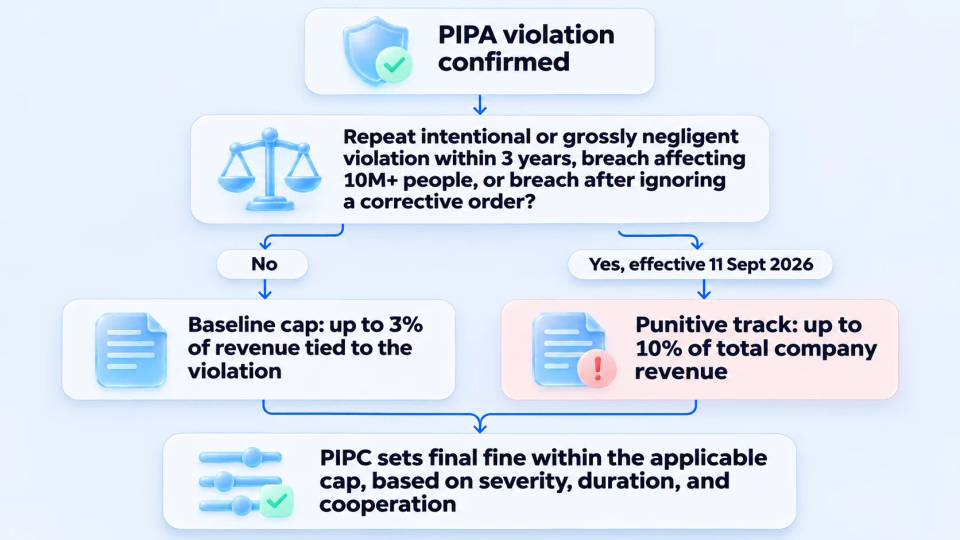
Figure 4: The two-track fine structure PIPC applies after the 2026 amendment takes effect. Source: PIPA amendment signed 10 March 2026, effective 11 September 2026, as summarized by IAPP and Hunton Andrews Kurth.
Because the 10 percent track requires proof of intent, gross negligence, or a corrective-order failure, most standard violations will still fall under the 3 percent baseline. But for a company the size of Coupang or SK Telecom, even the baseline cap reaches into the hundreds of millions of dollars, which is part of why South Korea’s per-violation ceiling is now cited alongside the EU’s as one of the world’s steepest.
How does PIPC enforce cross-border data transfer rules?
PIPA requires companies to disclose the recipient, destination country, purpose, and retention period before sending personal data outside South Korea, and PIPC has brought a steady run of fines against companies that skipped that disclosure. On 23 January 2025, PIPC fined Kakao Pay KRW 5.97 billion and Apple KRW 2.4 billion, a combined KRW 8.3752 billion (about $5.8 million), after finding the companies transferred about 40 million users’ data, including phone numbers and account balances, to China’s Alipay across three transfers between April and July 2018 without proper consent.
Figure 5: Personal data leak cases reported by South Korean public institutions, 2021 through the first half of 2026. Source: PIPC records compiled by Rep. Song Eon-seok, published by the Korea Herald, 16 August 2026.
Two Chinese e-commerce platforms followed the same pattern at smaller scale. AliExpress was fined KRW 1.978 billion (about $1.43 million) on 24 July 2024 after PIPC found it shared Korean users’ data with more than 180,000 Chinese sellers without the required disclosures. Temu was fined KRW 1.36 billion (about $982,000) on 15 May 2025 for transferring user data to China and Singapore without consent, including a pilot program that had collected photo ID scans and facial biometric video from local Korean sellers. Separately, South Korean public institutions are generating a fast-growing share of PIPC’s caseload: data leak cases there climbed from 22 in 2021 to 104 in 2024, 128 in 2025, and 164 in just the first half of 2026, with employee negligence behind roughly 68 percent of the cases PIPC has handled since 2022.
The Bottom Line
PIPC has moved from consent-disclosure cases against foreign platforms toward record-breaking penalties over security failures at Korea’s largest domestic companies, and the euro-scale fines that used to be a GDPR-only story now have a Korean equivalent: the Coupang penalty alone tops $400 million, more than four times PIPC’s previous record from less than a year earlier. With a second statutory track reaching 10 percent of total revenue now in force alongside the existing 3 percent baseline, and public institution breaches nearly tripling since 2021, any company handling Korean user data, foreign or domestic, is operating under one of the more aggressive enforcement regimes in the region. A current, accurate privacy policy that documents legal basis, retention, and any overseas transfer is the baseline PIPC checks first in every investigation on this list.
Frequently Asked Questions
What is the largest fine ever issued under South Korea’s PIPA? KRW 624.68 billion, roughly $409 million, issued against Coupang by the Personal Information Protection Commission on 10 June 2026 over a data breach affecting about 37.55 million people and unlawful use of browsing data through its Coupang Partners program. It is the largest privacy penalty in South Korean history, surpassing the KRW 134.8 billion fine against SK Telecom from August 2025.
What is the maximum fine under South Korea’s PIPA? Since the amended PIPA took effect on 15 September 2023, the baseline administrative fine cap is up to 3 percent of a company’s revenue tied to the violation. A further amendment signed on 10 March 2026 and effective from 11 September 2026 adds a punitive track of up to 10 percent of total company revenue for the most serious cases, such as repeated intentional violations or breaches affecting 10 million or more people.
How much did PIPC fine Google and Meta in South Korea? On 14 September 2022, PIPC fined Google KRW 69.2 billion (about $50 million) and Meta KRW 30.8 billion (about $22 million), a combined KRW 100 billion, for collecting user behavioral data for targeted ads without proper consent. At the time it was the largest privacy penalty PIPC had ever issued.
How does PIPC enforce cross-border data transfer rules? PIPC has fined several companies for moving Korean users’ data overseas without the disclosures PIPA requires, including a combined KRW 8.3752 billion against Kakao Pay and Apple in January 2025 for transferring about 40 million users’ data to Alipay, KRW 1.978 billion against AliExpress in July 2024, and KRW 1.36 billion against Temu in May 2025.
This is one entry in a broader look at how privacy enforcement varies by country: see Privacy Laws by Country 2026: The Global List for how PIPA fits into the wider global picture, and Switzerland FADP: Compliance Figures for 2026 for how a different, lower-fine enforcement model compares. New Zealand’s Privacy Act breach reporting regime, which relies on mandatory notification rather than PIPA-style revenue-based fines, is a useful contrast in enforcement philosophy, though it is not yet covered on this site with its own dedicated statistics page.
Where the Numbers Come From
- Personal Information Protection Commission (PIPC). (2026). Official enforcement notice confirming a record KRW 624.681 billion fine against Coupang, published 11 June 2026.
- BleepingComputer. (2026). “South Korea hits Coupang with record $409 million fine over data breach.” 11 June 2026, breach affected approximately 37.55 million people.
- The Korea Herald. (2025). “SK Telecom hit with record privacy fine after massive data leak.” KRW 134.8 billion fine, 28 August 2025.
- The Elec. (2026). “South Korea’s Privacy Regulator Fines KT 54 Billion Won Over Illegal Base Station Data Breach.” KRW 53.979 billion fine, resolved 29 July 2026.
- The Register. (2022). “Google and Meta fined over $70m for privacy violations in Korea.” Combined KRW 100 billion, 14 September 2022.
- DataGuidance. (2025). “South Korea: PIPC fines Kakao Pay and Apple KRW 8.37B.” 23 January 2025, transfers to Alipay.
- KED Global. (2024). “S.Korea fines AliExpress $1.4 mn for alleged privacy breach.” 24 July 2024.
- The Korea Times. (2025). “China’s Temu fined for transfer of South Korean users’ personal info.” KRW 1.36 billion, 15 May 2025.
- Hunton Andrews Kurth. (2026). “South Korea Amends Privacy Law to Authorize Fines of Up to 10% of Total Revenue.” Amendment signed 10 March 2026, effective 11 September 2026.
- IAPP. (2026). “South Korea overhauls PIPA and ties fines to CEO accountability.” Coverage of the 2026 PIPA amendment and CEO liability provisions.
- The Korea Herald. (2026). “Growing number of gov’t organizations hit by personal info leak: report.” Public institution data leak cases by year, published 16 August 2026, based on PIPC records compiled by Rep. Song Eon-seok.
Note: All figures verified as of August 2026. The SK Telecom fine is under legal challenge after the company filed suit to overturn it in early 2026; treat that figure as under active reconsideration. This post’s totals are refreshed at least twice a year to track new PIPC decisions.