The Federal Trade Commission gave final approval on June 5, 2026, to a modified order against Illuminate Education Inc., closing out a case built on a breach that exposed the personal records of 10.1 million students. The exposed data included students' email and mailing addresses, dates of birth, student records, and health-related information, according to the FTC's press release. The order requires the Wisconsin-based education technology vendor to build a data security program, delete personal information it does not reasonably need, and follow a public data retention schedule. Illuminate had been alerted to the vulnerabilities behind the breach by a third-party vendor almost two years before it happened, and the FTC says the company still failed to fix them in time.
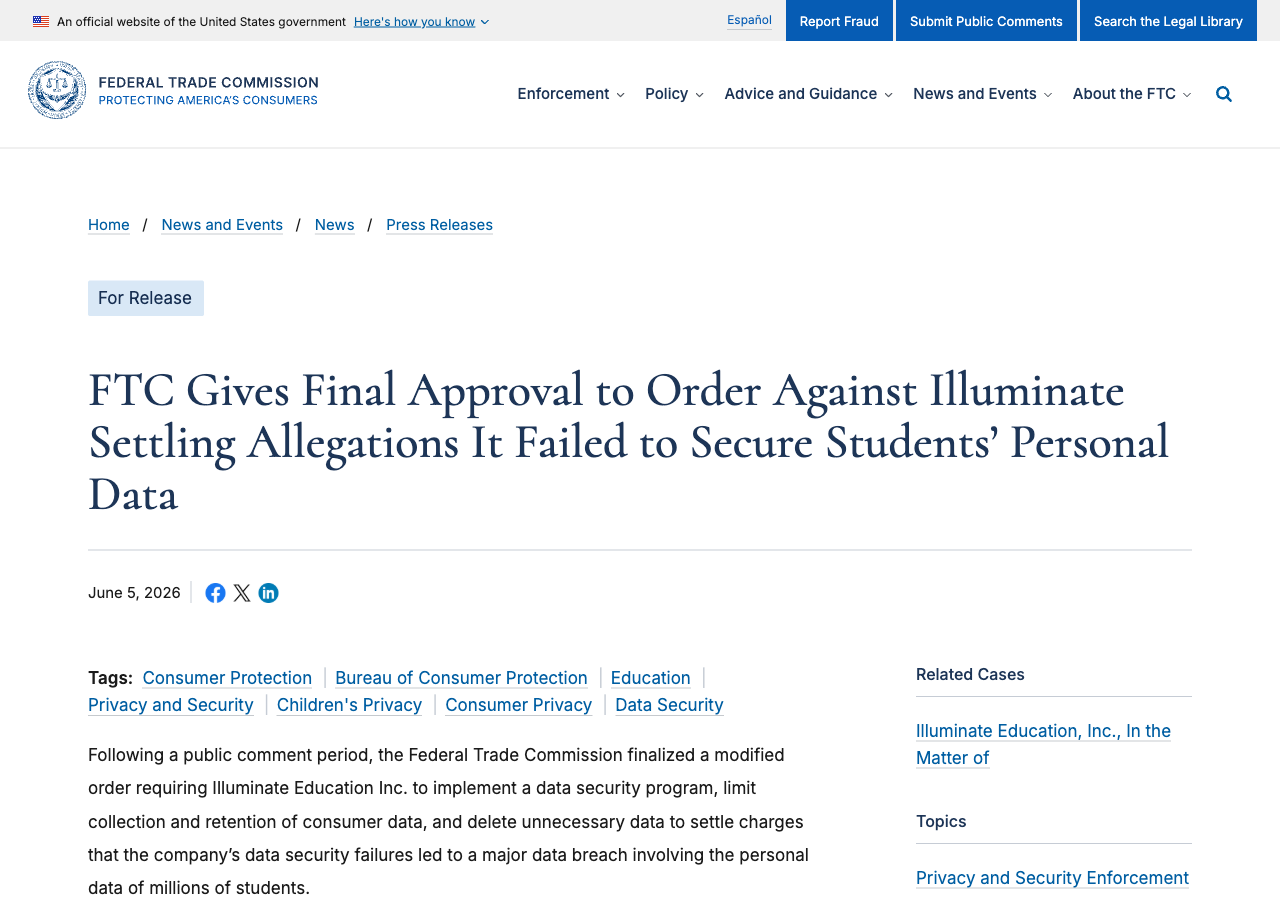
Source: Federal Trade Commission, "FTC Gives Final Approval to Order Against Illuminate Settling Allegations It Failed to Secure Students' Personal Data", captured August 8, 2026.
What the FTC's order actually requires
The Commission voted 2-0 to finalize the order after a public comment period and to send responses to three commenters. Under the terms, Illuminate is barred from misrepresenting its data security and privacy practices, including how fast it will notify school districts and students after a breach involving their personal data. Beyond that ban, the order pushes Illuminate toward a smaller, better-documented data footprint rather than just a stronger lock on the door: delete personal information not reasonably needed for the products or services it provides, stop collecting or keeping data it does not reasonably need in the first place, publish a data retention schedule that states why each category of information is collected and when it gets deleted, and stand up a comprehensive information security program covering the personal data it holds. Illuminate must also tell the FTC any time it alerts another federal, state, or local government body about a breach involving consumers' personal information.
How the breach happened, and how long Illuminate knew
According to the FTC's complaint, Illuminate told the schools and districts using its products that it protected the privacy and security of the student data it maintained, but did not deploy reasonable security measures to protect the information sitting in its cloud-based databases. Those failures let a hacker access the 10.1 million student records at the center of the case. The complaint says a third-party vendor had already flagged numerous security vulnerabilities on Illuminate's network almost two years before the breach occurred, and Illuminate did not adequately address them. The FTC also alleges Illuminate failed to notify affected schools about the breach as quickly as it had promised, a gap the final order now targets directly by banning misrepresentations about notification speed.
Part of a broader FTC enforcement pattern
This is not an isolated case. It lands in the middle of a run of privacy and data-security actions the FTC has brought through 2026, a pace we covered in our look at the FTC's H2 2026 enforcement surge. What sets the Illuminate order apart from a straightforward fine is the remedy: rather than resolving the case with a payment alone, the FTC is requiring an ongoing data minimization practice, a published retention schedule, and a documented security program, obligations a company has to keep meeting long after the settlement is signed.
Where this fits among student and children's privacy cases
Illuminate's case is tagged under the FTC's Children's Privacy and COPPA Safe Harbor Program topics, but the underlying complaint is a data security and misrepresentation case, not a COPPA violation. That distinguishes it from the FTC's COPPA-specific penalties, like the record $275 million fine against Epic Games covered in our roundup of COPPA fines and settlements. It also sits alongside the wider consent and disclosure problems tracked in our children's online privacy statistics for 2026, where verifiable parental consent failures are the dominant issue. Illuminate's order shows regulators reaching student data through a data security angle even when a COPPA theory is not the one being charged.
What the order requires, mapped to the usual policy gap
| Order requirement | What Illuminate must do | Gap it targets |
|---|---|---|
| Data minimization | Delete data not reasonably needed for the product; stop collecting more than necessary | Treats "we collected it because we could" as its own problem, not just a bigger breach if it leaks |
| Retention schedule | Publish a schedule stating why each data category is kept and when it is deleted | Most privacy policies promise data is kept "as long as necessary" without naming a timeframe |
| Security program | Build and run a comprehensive information security program covering the data it holds | The FTC's now-standard remedy in data security cases: a documented, ongoing program, not a one-time patch |
| Notification accuracy | Stop promising faster breach notification than it actually delivers | Illuminate is accused of missing its own promised notification timeline to schools |
The Bottom Line
Illuminate's case did not turn on a novel legal theory. It turned on a gap between what the company told schools about its data practices and what it actually did with the data those schools were required to hand over. That gap is exactly what an accurate, current privacy policy is supposed to close: naming the categories of personal data actually collected, stating a real retention timeframe instead of a vague promise, and describing security and breach-notification practices a business can actually stand behind. Our Privacy Policy Generator builds those disclosures around what a business genuinely collects, retains, and secures, so the published policy matches practice rather than describing a version of the business that would not survive the kind of scrutiny the FTC applied here. The broader pattern of open breach litigation, including the 59 data breach class action settlements currently open in 2026, makes an outdated retention promise a live liability well beyond a single regulator's order.
The information in this article is for informational purposes only and should not be construed as legal advice on any matter, and does not create a lawyer-client relationship.