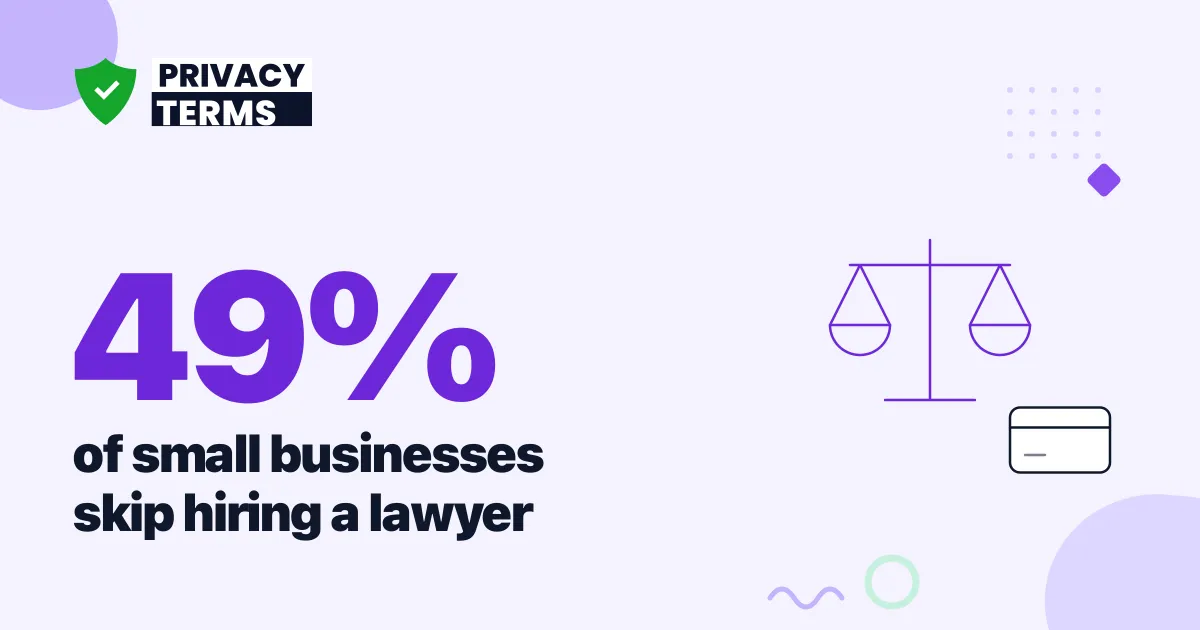
49% of small business owners who choose not to use a lawyer for a legal document say the reason is simple: they cannot afford one, according to Rocket Lawyer's 2025 SMB Legal Concerns Survey of 1,224 US small business owners fielded between February and March 2025. That affordability gap is exactly why free templates and paid document generators both exist, and why treating "free" and "paid" as interchangeable choices, or assuming price alone determines whether a document holds up, misses what the data actually shows.
Why do small businesses skip hiring a lawyer for legal documents?
Cost dominates every other reason. In Rocket Lawyer's 2025 survey, 49% of small business owners who avoid lawyers cite affordability directly, 18% say a lawyer would not understand their business as well as they do, and 11% believe they can handle the legal issue better themselves. Zoomed out further, 67% of all surveyed owners identify cost as the primary barrier to getting legal help of any kind, and the report notes a single hour with a traditional attorney can run $250 or more.
Figure 1: Affordability is not a close second, it is the reason. Source: Rocket Lawyer, SMB Legal Concerns: A 2025 Survey of the Small Business Landscape.
This is not a small subgroup shrugging off legal risk. The same survey found 39% of small businesses manage more than 10 new contracts a year and 75% of owners are personally involved in creating those contracts, meaning the people deciding between a free template and a paid option are usually the same people who will live with the consequences of that document.
What does a free legal template actually cost you?
Nothing upfront, and that is precisely the trade-off. A free terms and conditions template has no drafting fee, no hourly rate, and no subscription, but it also has no jurisdiction-specific customization, no built-in update when a law changes, and no one checking whether the acceptance flow around it will hold up if a user disputes it later. Rocket Lawyer's data shows why that gap matters: 72% of small business owners say it is important to keep up with changing licensing rules and 56% worry about tax law changes, yet a static, unmodified template does not track either automatically.
The dollar comparison is stark on its own. A lawyer-drafted terms and conditions page averages $980 across 107 recent marketplace projects on ContractsCounsel, current as of July 30, 2026, against $0 for a free template. Paid document generators sit in between: a flat-rate annual membership from a provider like Rocket Lawyer or LegalZoom typically runs in the low hundreds of dollars a year, well under a single lawyer hour, while still including guided customization and periodic updates that a static free template does not.
| Option | Typical cost | Who customizes it | Updates when laws change |
|---|---|---|---|
| Free template | $0 | You, manually | Never automatically |
| Paid document generator | Low hundreds of dollars a year (subscription) | Guided wizard plus you | Often, as part of the subscription |
| Attorney-drafted | $980 average to draft | Attorney | Only with a new paid review |
A free template is not worthless, and a paid one is not automatically safe. What each option buys is different, and the price tag alone does not tell you which one.
How many small businesses actually pay for a legal document service?
More than the "everyone uses free templates" assumption suggests. LegalZoom, one provider among several, reported roughly 1.9 million subscription units outstanding as of December 31, 2025, in its Form 10-K filed with the SEC on February 23, 2026, with subscriptions accounting for 65% of its 2025 revenue. That is one company's paying customer base, not an industry-wide count, so the true number of small businesses paying for some form of legal document help across all providers is almost certainly higher.
Figure 2: Two-thirds of LegalZoom's revenue now comes from recurring subscriptions rather than one-time transactions. Source: LegalZoom.com, Inc. Form 10-K, filed February 23, 2026.
The shift toward subscriptions is deliberate. Providers are betting that small business owners will pay an ongoing fee for a document that updates itself rather than pay once for a static file and hope it still applies next year. Whether that bet pays off for a given business depends on how often its legal documents actually need to change, which for most growing companies is more often than owners expect.
Does it matter in court whether your terms were free or paid?
Not directly, no. What matters is how the document was presented and accepted, not what it cost. Courts evaluate three types of online agreements: clickwrap, where a user affirmatively clicks "I agree"; sign-in-wrap, where clicking a button to sign in or register doubles as acceptance; and browsewrap, where terms sit in a footer link with no required action at all. Ironclad's Clickwrap Litigation Trends report, covering court decisions through 2020, found clickwrap agreements succeeded in court 97% of the time in 2018, falling to 80% in 2019 and 70% in 2020 as courts began demanding stronger back-end evidence of acceptance. Sign-in-wrap agreements succeeded less consistently, at 60% in 2018, 65% in 2019, and 64% in 2020. The report describes browsewrap agreements, the weakest form, as rarely enforced at all because no affirmative action ties a specific user to a specific acceptance event.
Figure 3: The most recent published breakdown, from Ironclad's 2021 Clickwrap Litigation Trends report covering 2020 case data. A newer year-by-year breakdown has not been publicly published since.
A free template presented through a clear clickwrap flow can outperform an expensive attorney-drafted document buried in a browsewrap footer link. The acceptance mechanism, not the price tag, is what a judge actually evaluates.
Figure 4: Source selection matters less than acceptance design. Source: Rocket Lawyer 2025 survey (cost thresholds), ContractsCounsel (attorney pricing), Ironclad Clickwrap Litigation Trends report (enforceability factors).
How has the free-vs-paid legal document landscape evolved?
The market has moved from a binary choice, hire a lawyer or write it yourself, toward a three-way split between free templates, paid generators, and traditional attorneys, with AI now layered on top of all three.
Figure 5: Twenty-five years of free-to-paid legal document tooling, condensed. Sources: company histories, Ironclad Clickwrap Litigation Trends report, LegalZoom Form 10-K.
80% of small business owners say they would consider an AI-powered legal assistant to review and summarize contracts, per Rocket Lawyer's 2025 survey, and that share climbs to 85 to 87% among owners already worried about compliance, non-payment, or financial liability. AI has not replaced the free-vs-paid decision. It has attached itself to both sides of it, with free AI trials sitting alongside free templates and paid AI features sitting alongside paid subscriptions.
The Bottom Line
The free-vs-paid decision is not really about which option is better in the abstract. It is about what $0 does not buy you: an acceptance flow designed to survive a court challenge, clauses updated for your specific jurisdiction, and a document that changes when the underlying law does. A free template with a well-designed clickwrap acceptance screen can be just as enforceable as a $980 attorney draft with a sloppy one, which is exactly what the clickwrap-versus-browsewrap enforcement gap shows. For most small businesses producing standard terms and conditions, a terms and conditions generator closes that gap at a fraction of the $980 average lawyer fee, pairing template speed with the kind of guided customization and update cadence that a static free file cannot offer on its own. Businesses with complex commerce, subscription billing, or heavier liability exposure still get the most value from at least one paid attorney review layered on top.
Frequently Asked Questions
Is a free terms and conditions template legally binding? Yes, if it is presented and accepted the right way. Courts upheld clickwrap agreements, where a user actively clicks "I agree," 70% of the time in 2020, down from 97% in 2018, according to Ironclad's Clickwrap Litigation Trends report. A free template's enforceability depends far more on how it is presented than on whether it cost anything.
How much does it cost to have a lawyer draft terms and conditions? $980 on average, based on 107 recent projects tracked on ContractsCounsel's marketplace and last updated July 30, 2026. Individual bids vary with complexity, and a straight review without new drafting typically costs less than a full draft.
Why do most small businesses avoid hiring a lawyer? 49% of small business owners who skip a lawyer say they cannot afford one or the specialists they would need, according to Rocket Lawyer's 2025 SMB Legal Concerns Survey of 1,224 US small business owners. Another 18% say a lawyer would not understand their business as well as they do, and 11% believe they can handle the issue better themselves.
How many businesses pay for a legal document service instead of using a free template? LegalZoom alone reported roughly 1.9 million subscription units outstanding as of December 31, 2025, according to its SEC Form 10-K filed February 23, 2026. That figure covers one provider only, so it understates the total number of small businesses paying for legal document help across the industry.
Where the Numbers Come From
- Rocket Lawyer. (2025). "SMB Legal Concerns: A 2025 Survey of the Small Business Landscape." 1,224 unweighted responses from US small business owners, fielded February 7 to March 3, 2025, plus a 1,022-response follow-up fielded May 7 to 14, 2025.
- ContractsCounsel. "Terms and Conditions Cost: How Much Does It Cost? (2026)." Average drafting cost $980 based on 107 recent marketplace projects, last updated July 30, 2026.
- LegalZoom.com, Inc.. (2026). "Form 10-K, Fiscal Year 2025." Filed with the SEC February 23, 2026. Approximately 1.9 million subscription units outstanding at December 31, 2025, 65% of 2025 revenue from subscriptions.
- Ironclad. (2021). "Clickwrap Litigation Trends Report." Clickwrap court success rate 97% (2018), 80% (2019), 70% (2020); sign-in-wrap 60% (2018), 65% (2019), 64% (2020), based on analysis of US court decisions on online agreement disputes.
Note: All figures verified as of July 2026. The Ironclad enforcement-rate breakdown is the most recent one publicly published as of this writing; a newer year-by-year update has not been released. Cost and subscription figures are refreshed at least twice a year to track new ContractsCounsel marketplace data and LegalZoom SEC filings.