
How does a privacy policy meet the requirements for Google AdSense?
If you want to use Google AdSense on your website, you need to comply with Google’s privacy and security requirements for publishers.
What Is Google AdSense?
Google AdSense is a cost-per-click program that lets website owners run ads targeted to their site’s content and audience. Each time someone clicks an ad, the site earns a small commission: currently the website owner earns 68% of the revenue for that click, with Google receiving the remaining 32%.

When you sign up for AdSense, you agree to Google’s program policies, which require that at all times you use the service, your site has a clearly labelled and easily accessible privacy policy providing users with clear, comprehensive information about cookies, device-specific information, location data, and other information collected via the service, including, where relevant, how users can manage cookie preferences. Google also requires publishers to make reasonable efforts to obtain user consent for cookies and similar tracking where required by law.
What Does This Mean for You?
Your website needs a privacy policy that includes:
- A cookie policy
- Instructions for opting out of cookie tracking
- The specific disclosures AdSense requires, including that third-party vendors (including Google) use cookies to serve ads based on prior visits, and that users can opt out of personalised advertising via Google’s Ads Settings or a general opt-out service like aboutads.info
Google also requires that you obtain consent from your users for the use of cookies.
Privacy Policy
A privacy policy is a legal document that informs your users what information you collect, why, how and where you store it, and how you keep it secure. It also tells them their rights and how to opt out of data collection, including cookies.
There are international laws to comply with too: the major ones being GDPR, CalOPPA, and CCPA.
Cookie Policy
Your cookie policy can be part of your privacy policy, and should cover:
- Definition of a cookie: a text file placed in a user’s browser, stored so the site can remember them between pages or sessions.
- What cookies your website uses: common types include functionality cookies, session cookies, and persistent cookies.
- Why you use them: your purpose for using cookies.
- How to opt out: details on opting out, and how the service may be affected if a user does.
A well-structured cookie policy clearly defines what a cookie is, lists the cookies used, and explains how to opt out, that structure alone (regardless of which specific company demonstrates it) is the standard to aim for.
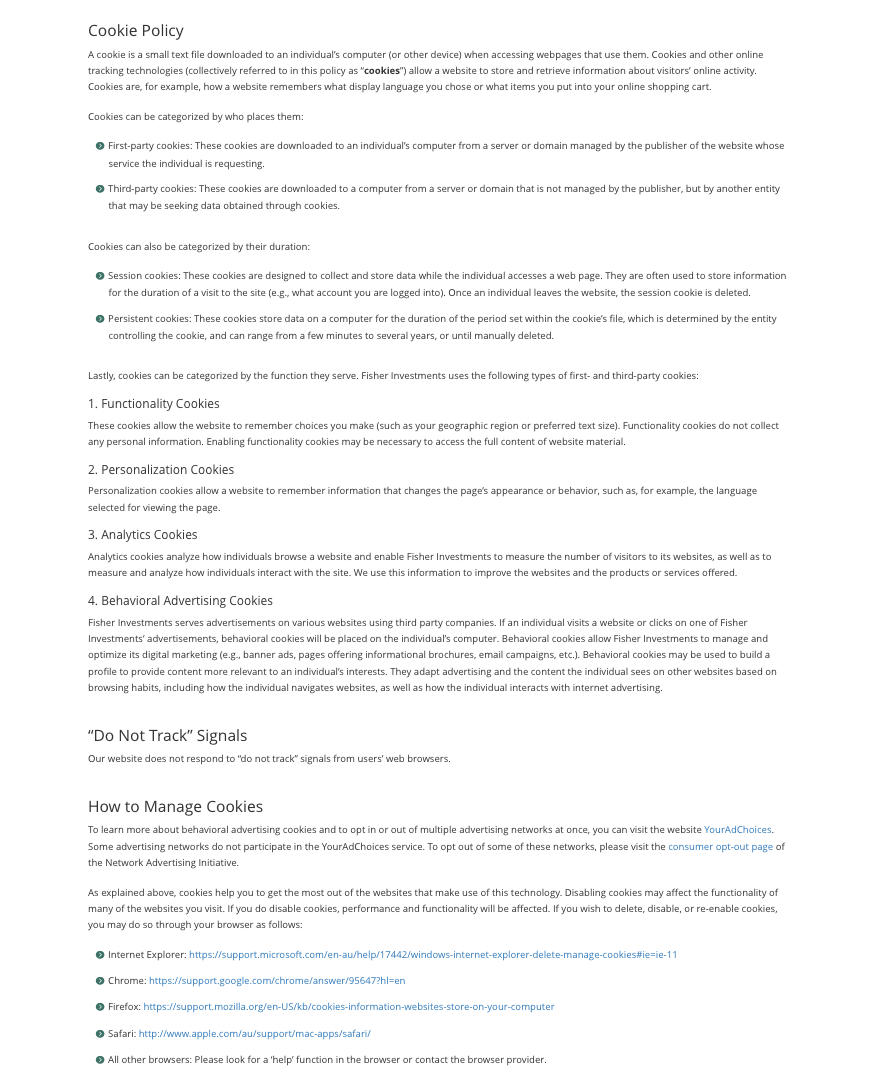 fisherinvestments.com Cookie Policy in their Privacy policy
Opting Out of Cookie Tracking
Your privacy policy needs to explain how users can opt out of cookie tracking if they wish, including a list of the third-party cookies you use (common ones include Facebook and Google Analytics) and how to opt out of each.
Specific Clauses Required by Google
As part of AdSense’s program policies, the cookie and advertising disclosures described above need to be included in your privacy policy. Make sure your policy also tells users how they can opt out of ads if they wish.
Special Requirements for EU Residents
The requirements above apply to any website or business, regardless of location. For EU residents specifically, there are additional GDPR requirements:
- Users must be informed, as soon as they access your site, that it uses cookies.
- Disclose the type of cookies you use, and the type used by third-party sites.
- Explain where cookies are placed and why your site uses them.
- Obtain consent for cookie use, either actively (a checkbox users click) or passively (informing users that continued use of the site means consent).
Create Your Privacy Policy
Creating your privacy policy is easy with our privacy policy generator. Our professional privacy policy covers AdSense requirements as well as a comprehensive cookie policy, and is compliant with GDPR, CalOPPA, CCPA, and COPPA, with 100+ options to customise it to your site.
The information in this article is for informational purposes only and should not be construed as legal advice on any matter, and does not create a lawyer-client relationship.


![Biggest GDPR Fines of All Time: Top 50 Ranked [2026]](/_astro/gdpr-compliance-badge.BVq2lnz4_Z1bs8mH.webp)