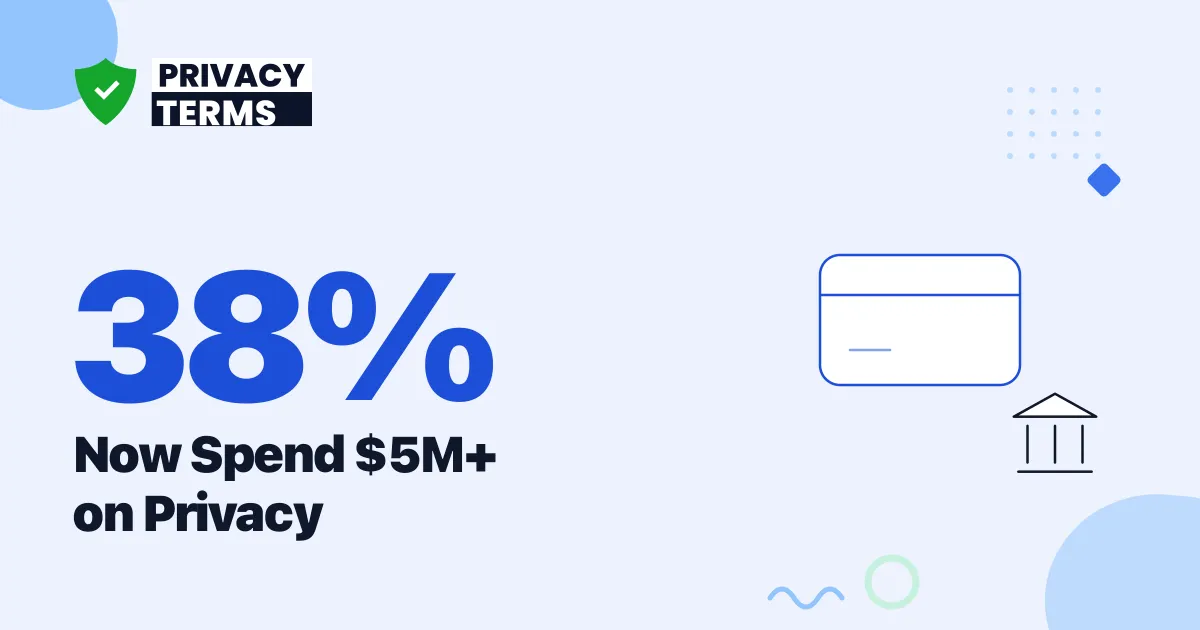
38% of organizations now spend $5 million or more a year on privacy programs, up from just 14% a year earlier, according to Cisco's 2026 Data and Privacy Benchmark Study, published in 2026 from a survey of more than 5,200 IT, technology, security, and privacy professionals across 12 markets. Privacy budgets nearly tripled in a single year for a meaningful share of large organizations, and the driver is not a mystery: AI governance has been bolted onto existing privacy programs almost overnight.
Compliance spending is not one number. It ranges from a few hundred dollars a year for a solo site owner buying a policy generator subscription to eight figures at a multinational running a dedicated privacy team. Below is what the budget looks like at each tier, what the money buys, and what happens to a company that spends nothing at all. For a closer breakdown of how these budgets split by company size, see our privacy budget benchmarks by company size.
How much do large organizations spend on privacy compliance?
Large organizations are now the biggest spenders privacy has ever seen, and the increase happened in a single reporting cycle. Cisco's 2026 study found average annual privacy budgets at larger organizations now exceed EUR 2.5 million, and the share of organizations spending $5 million or more annually on privacy jumped from 14% in early 2025 to 38% by the survey's September 2025 fieldwork window. That is close to a tripling of the top spending tier in twelve months.
Figure 1: Growth in the top privacy-spending tier in one year. Source: Cisco 2026 Data and Privacy Benchmark Study.
The study, independently analyzed by Sandpiper Research & Insights and reported accurate to within plus-or-minus 1 percentage point at a 95% confidence level, also found 43% of organizations increased privacy spending over the past year and 93% plan to allocate more resources to at least one privacy or data-governance area over the next two years, though that 93% figure looks different once you ask what percentage of firms actually expect their own budget to grow rather than the field in general. Budget growth at this scale is unusual for a compliance function that, a decade ago, was still treated by many companies as a subset of general legal spend rather than its own line item.
Why are 2026 privacy budgets rising so fast?
AI is the single biggest driver Cisco identifies. 90% of surveyed organizations said their privacy program expanded because of AI, with 47% describing that expansion as significant and another 43% as moderate. New AI systems create new categories of data-governance work: model training data provenance, output monitoring, vendor contract review for AI tools, and new disclosure requirements, all of which land on the same teams that already own privacy compliance.
Figure 2: Share of organizations reporting privacy program expansion attributable to AI. Source: Cisco 2026 Data and Privacy Benchmark Study.
Cisco also reports that organizations are seeing a return on that spending rather than treating it as a pure cost center: 99% report at least one measurable benefit from privacy investment, and 96% specifically credit privacy investment with supporting business agility and innovation rather than slowing it down. That framing matters for budget planning, since a spending category executives view as producing returns is far less likely to get cut in a downturn than one viewed as pure overhead. If your current policies have not been reviewed since before this budget surge, you can generate an updated privacy policy that reflects current disclosure practices without hiring outside counsel for the whole rewrite.
What does a small business actually pay for compliance?
Enterprise figures do not tell a five-person startup what it will pay. The clearest small-business benchmark still on record is California's 2019 economic impact assessment, prepared for the state Department of Justice by the independent research firm Berkeley Economic Advising and Research, ahead of the original CCPA's effective date. It estimated initial compliance costs by employee-count tier, and those tiers remain the most detailed publicly available breakdown by company size, even though the underlying law has since been amended by the CPRA and the figures have not been formally re-estimated since.
| Company size | Estimated initial compliance cost |
|---|---|
| Fewer than 20 employees | About $50,000 |
| 20 to 100 employees | About $100,000 |
| 100 to 500 employees | About $450,000 |
| 500 or more employees | About $2,000,000 average |
Table 1: Initial CCPA compliance cost estimates by company size. Source: California Department of Justice economic impact assessment, prepared by Berkeley Economic Advising and Research (2019).
Statewide, the same assessment projected roughly $55 billion in aggregate initial compliance costs for the roughly 75% of California businesses the original law covered, equivalent to about 1.8% of California's 2018 gross state product at the time of publication. Treat the statewide total and the per-tier estimates as directional rather than current: they are more than six years old, predate the CPRA amendments that took effect in 2023, and no comparably detailed state-commissioned re-estimate has been published since. A small business today, using a template-based generator rather than custom outside counsel, typically spends far less than the 2019 figures suggest, since the estimate assumed bespoke legal drafting rather than standardized compliance tooling.
What does a privacy team actually cost in salary?
Headcount, not software, is the largest recurring line in most privacy budgets, and salaries vary sharply by how broad the role is. The IAPP Salary and Jobs Report 2025-26, based on more than 1,600 responses from over 60 countries collected between March and April 2025, found professionals working a single privacy-focused role reported a median salary below $123,000. Professionals whose role spans both privacy and AI governance reported a meaningfully higher median above $169,700, and legal or compliance roles specifically inside technology companies reported a median of $205,000.
Figure 3: Median compensation widens as role scope expands to include AI governance. Source: IAPP Salary and Jobs Report 2025-26.
The gap between a single-scope privacy role and a combined privacy-plus-AI-governance role, roughly $47,000 at the median, is itself a budget signal: as Cisco's data shows AI work absorbing more of the privacy function's time, companies are paying a premium to hire people who can cover both rather than staffing two separate roles. IAPP also found almost 7 in 10 professionals received a bonus in the reporting period, with North American respondents reporting bonuses slightly more often than European respondents, at 72% versus 67%. A salary line only shows up in the budget at all once a company has a dedicated role to pay for, and how many companies actually employ a DPO turns out to be a smaller share than designation counts alone suggest.
How has privacy budget growth tracked over time?
Privacy spending has moved from a niche legal cost to a mainstream budget line over roughly a decade, tracking each major wave of regulation and, most recently, AI oversight requirements.
Figure 4: Regulatory milestones that expanded privacy compliance budgets. Source: Cisco 2026 Data and Privacy Benchmark Study, California Department of Justice economic impact assessment (2019).
Is spending more on privacy compliance worth it?
Cisco's 2026 data suggests organizations that invest in privacy see it pay back rather than sit as a sunk cost. 95% of surveyed organizations cited reduced sales friction tied to privacy concerns, 95% cited breach-mitigation benefits, and 95% cited operational efficiency gains directly linked to privacy investment. A further 94% said stronger privacy practices improved how investors viewed the company.
Figure 5: Reported benefits organizations attribute to privacy investment. Source: Cisco 2026 Data and Privacy Benchmark Study.
None of these figures isolate privacy spending as the sole cause of the reported benefit, since Cisco's methodology is a perception survey of privacy professionals rather than a controlled before-and-after cost study. Read them as evidence that people who manage privacy budgets believe the spending pays off, not as independently audited return-on-investment figures.
The Bottom Line
Privacy compliance costs now range from roughly $50,000 for the smallest companies to multi-million-dollar annual budgets at the largest ones, and the gap between those two ends widened again in 2025 as AI governance work got folded into existing privacy programs. The 38% of organizations now spending $5 million-plus a year are mostly large enterprises with dedicated teams, in-house counsel, and enterprise privacy-management software, none of which a small business needs to replicate. What every site still needs, regardless of size, is a current, accurate privacy policy that actually describes what data it collects and why: that is the one compliance cost every business faces, and it does not require a five-figure legal engagement to get right. You can generate a privacy policy covering the disclosures regulators and privacy-conscious visitors both check first.
Frequently Asked Questions
How much does privacy compliance cost in 2026? 38% of organizations now spend $5 million or more a year on privacy programs, up from 14% a year earlier, according to Cisco's 2026 Data and Privacy Benchmark Study of 5,200-plus professionals. Average annual privacy budgets at larger organizations now exceed EUR 2.5 million. Smaller companies spend far less: California's 2019 state-commissioned economic impact assessment estimated initial CCPA compliance at roughly $50,000 for firms under 20 employees.
What is the average salary for a Data Protection Officer or privacy professional? Privacy professionals working a single privacy-focused role reported a median salary below $123,000 in 2025, per the IAPP Salary and Jobs Report 2025-26. Professionals who combine privacy and AI governance responsibilities reported a higher median above $169,700, and legal or compliance roles inside technology companies reported a median of $205,000.
Why did privacy budgets increase so sharply in 2025? 43% of organizations increased privacy spending over the past year and 93% plan to allocate more resources over the next two years, per Cisco's 2026 study. Cisco attributes much of the jump to AI governance: 90% of surveyed organizations said their privacy program expanded because of AI, and 47% called that expansion significant.
How much does CCPA compliance cost a small business? California's 2019 state-commissioned economic impact assessment, prepared by Berkeley Economic Advising and Research for the state Department of Justice, estimated initial CCPA compliance at roughly $50,000 for companies with fewer than 20 employees, $100,000 for firms with 20 to 100 employees, and about $450,000 for firms with 100 to 500 employees. Statewide initial compliance costs were projected at roughly $55 billion, though the figure predates the 2023 CPRA amendments and has not been re-estimated since.
Where the Numbers Come From
- Cisco. (2026). "2026 Data and Privacy Benchmark Study." Survey of 5,200-plus IT, technology, security, and privacy professionals across 12 markets, fielded September 2025, independently analyzed by Sandpiper Research & Insights, accurate to within plus-or-minus 1 percentage point at a 95% confidence level.
- IAPP. (2025). "Salary and Jobs Report 2025-26: Privacy, AI Governance and Digital Responsibility." Survey of 1,600-plus respondents from over 60 countries, fielded March to April 2025.
- CNBC, reporting on the California Department of Justice's economic impact assessment prepared by Berkeley Economic Advising and Research. (2019). "California's New Privacy Law Could Cost Companies a Total of $55 Billion to Get in Compliance." Published October 2019.
- Compliance Week. (2019). "CCPA Compliance Costs Projected to Reach $55B." Corroborating detail on per-employee-tier cost estimates from the same 2019 state-commissioned assessment.
Note: All figures verified as of July 2026. The California CCPA cost figures are from a 2019 state-commissioned assessment and predate the 2023 CPRA amendments; no comparably detailed statewide re-estimate has been published since. Cisco and IAPP figures are current as of their respective 2025 fieldwork windows and are refreshed at least twice a year to track new study editions.