Most “EULA examples” lists online recycle the same three or four screenshots and stop at “here’s what a EULA looks like.” That’s not particularly useful if you’re actually trying to write one, because the interesting differences between real EULAs aren’t cosmetic, they’re structural: how the license is scoped, what happens at the free-to-paid boundary, how a company handles data protection obligations that didn’t exist when EULAs were invented, and what happens when a product reaches end of life. The 14 EULAs below were pulled directly from live company sites and grouped by the pattern they use, not ranked against each other, so the choice in front of you is “which pattern fits my product,” not “which single example do I copy.”
What Makes a EULA Worth Studying in 2026
A handful of things separate a EULA that’s actually doing its job from one that’s just legal boilerplate copied from a template a decade ago:
- It’s scoped to what’s actually installed. A EULA that tries to cover a desktop app, a mobile companion, and a web dashboard in one undifferentiated document usually gets at least one of those wrong.
- It handles the free-to-paid transition explicitly, not just “contact sales,” since trial periods, freemium tiers, and per-seat subscriptions all create different obligations.
- It addresses modern realities a 1990s shrinkwrap license never had to: AI-powered features, SaaS delivery of what used to be a pure desktop install, and GDPR-style data processing obligations.
- It says what happens at the end, not just how the license starts: termination, end-of-life, and what a licensee can still do with a copy they already have.
Keep those four in mind while reading through the examples below. Where an agreement handles one of them unusually well, or skips it entirely, the entry says so.
Platform-Level License Hubs
These four aren’t single documents at all. Each company ships dozens or hundreds of products under one brand, so instead of one EULA, they publish a hub: a selector, chart, or repository that routes you to the specific terms for the specific product you’re actually using.
1. Microsoft
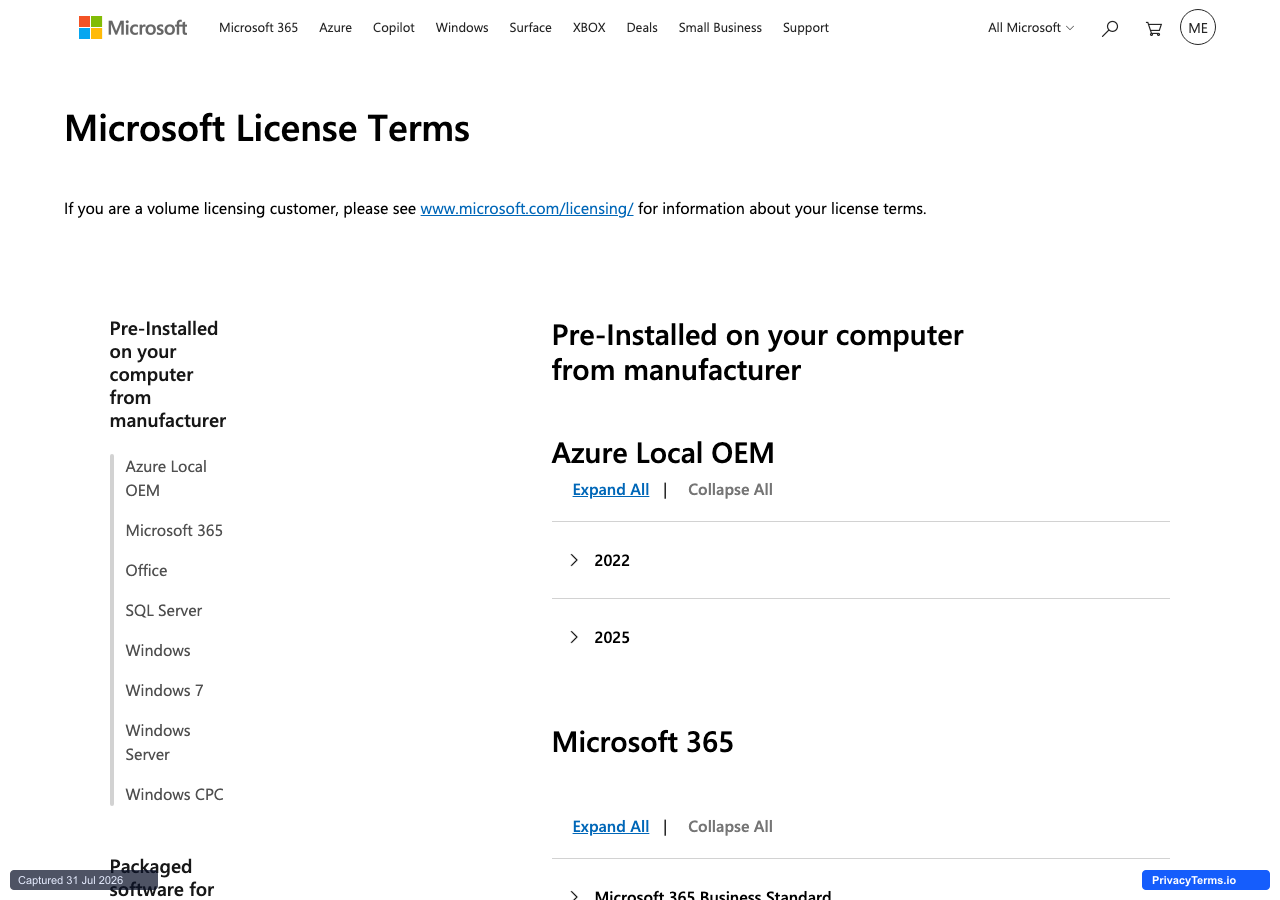
Microsoft License Terms: a sidebar of product categories next to expandable sections for each product family, Expand All and Collapse All included.
Microsoft’s license terms hub isn’t a EULA you read top to bottom, it’s a product picker. A left-hand sidebar sorts everything into a handful of real-world categories (“Pre-Installed on your computer from manufacturer,” “Packaged software for” retail purchases), and the main panel groups products by family, Azure Local OEM, Microsoft 365, Office, SQL Server, Windows, each with its own Expand All and Collapse All controls. Drill into a specific edition and the page hands you a direct link, often in twenty or more languages for that one product. What it gets right is treating “which EULA even applies to me” as the actual first question a visitor has, rather than assuming one document can cover a company that ships this many distinct retail, OEM, and volume-licensed products at once.
2. Apple
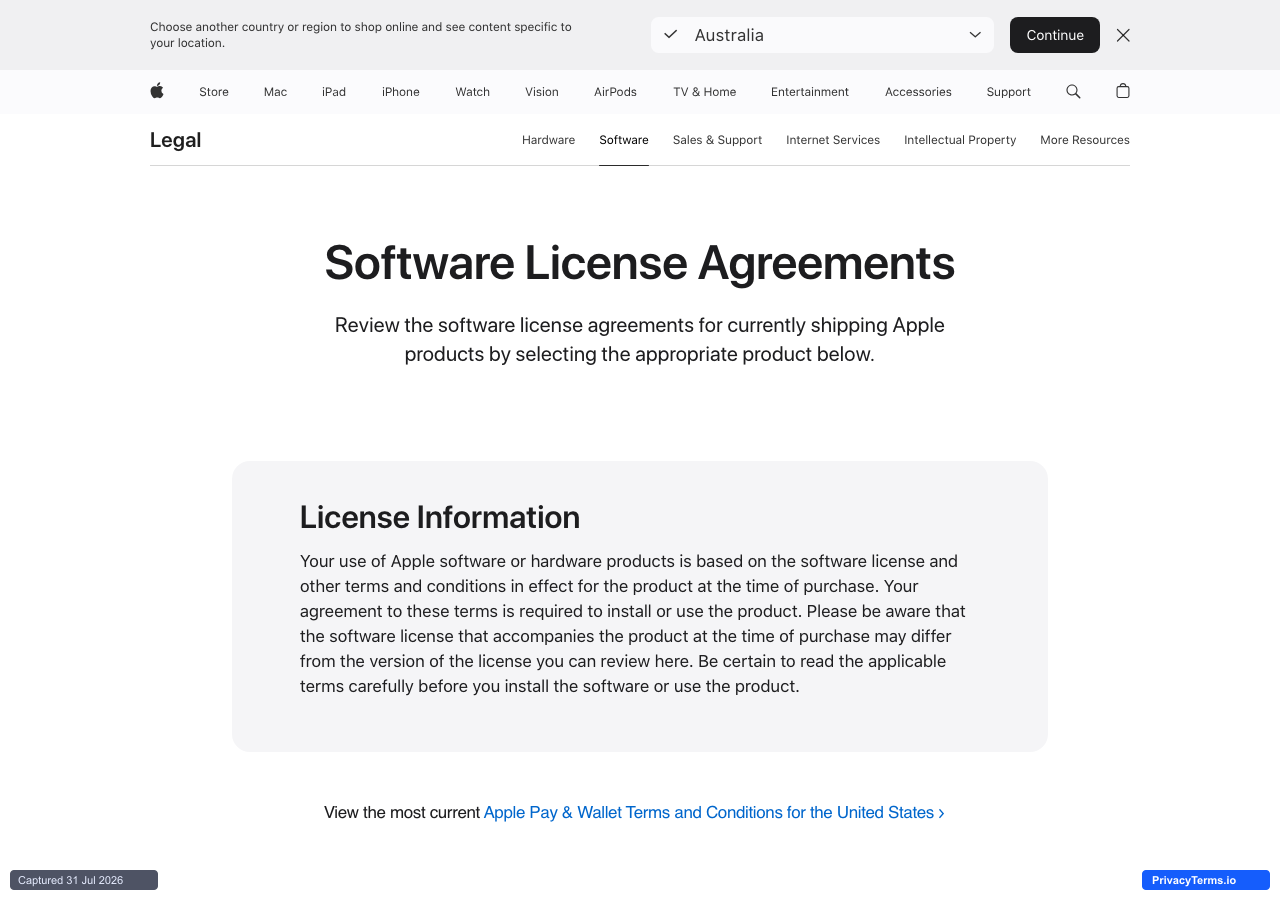
Apple's Software License Agreements page, leading with a plain warning about version drift before the product list even loads.
Apple’s Software License Agreements page is a similar product-selector pattern, but it adds something Microsoft’s doesn’t: an explicit, upfront warning that “the software license that accompanies the product at the time of purchase may differ from the version of the license you can review here.” That’s an honest disclosure most companies leave implicit. Apple is telling you directly that this page is a reference copy, not necessarily the exact terms you agreed to, and that you should check what actually shipped with your purchase.
3. VMware (Broadcom)
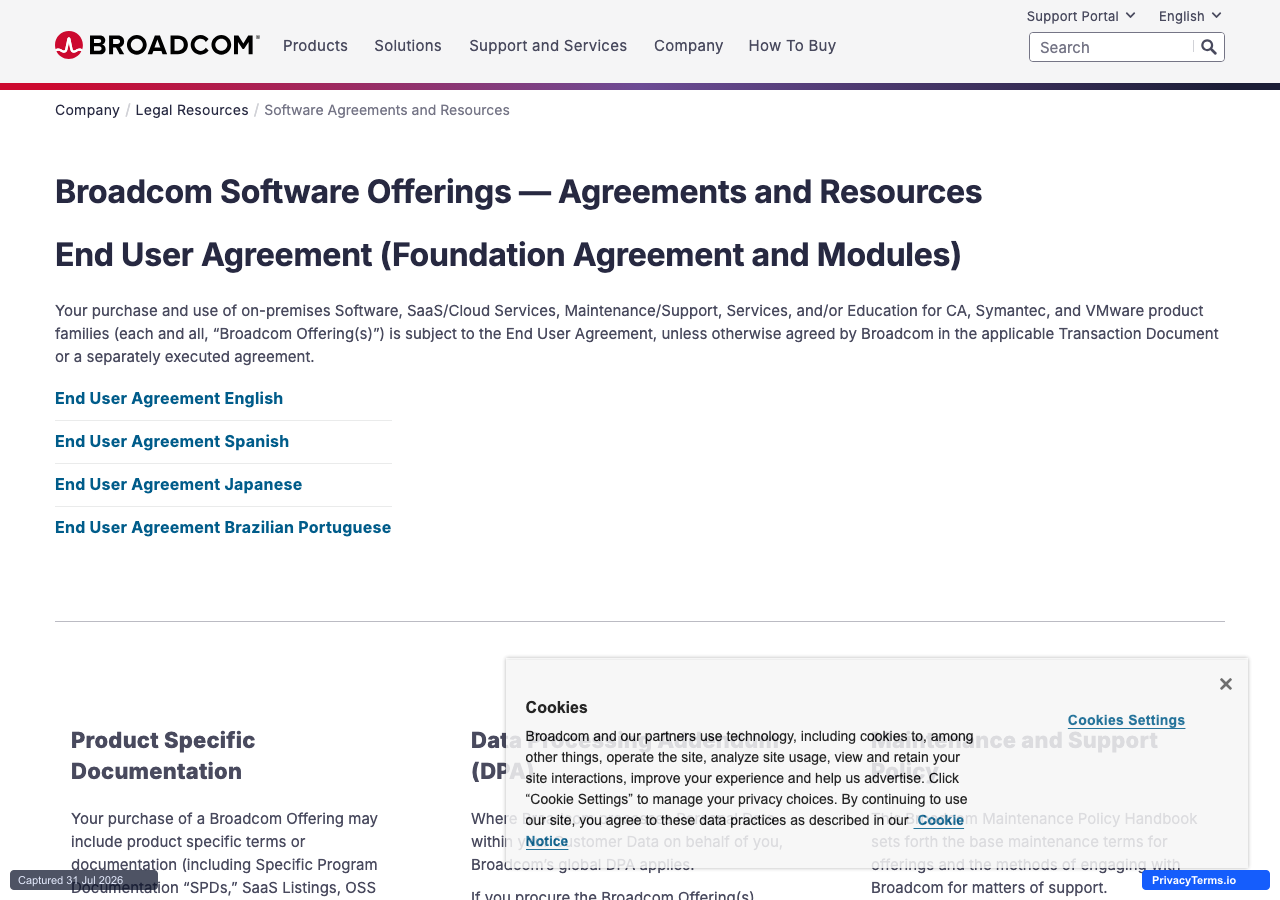
VMware's old EULA link now resolves to Broadcom's combined agreement hub, covering CA, Symantec, and VMware under one End User Agreement.
VMware’s own EULA link is the clearest evidence in this list of what an acquisition does to a license page: it now redirects straight to Broadcom’s “Software Offerings, Agreements and Resources” hub, titled “End User Agreement (Foundation Agreement and Modules),” and covering three formerly separate companies, CA, Symantec, and VMware, under one shared agreement rather than three. What it gets right is saying so plainly in the first paragraph: purchase and use of any CA, Symantec, or VMware offering is subject to this one End User Agreement unless a specific transaction document says otherwise. For any company that grows by acquisition, that’s the honest way to handle it, one current agreement that says what it now covers, rather than three stale pages quietly pointing at whichever entity used to own them.
4. Bitdefender
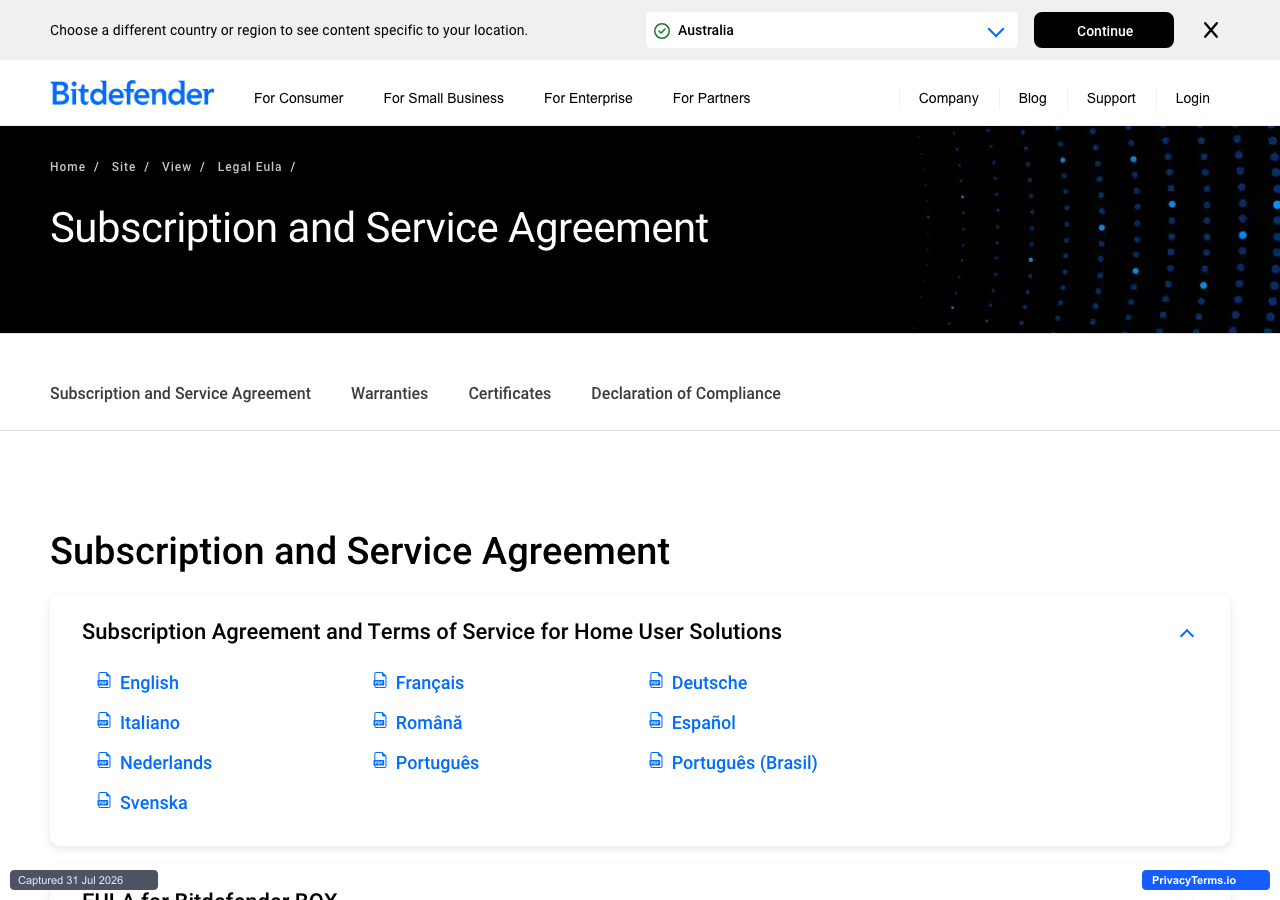
Bitdefender's Subscription and Service Agreement, with the Home User Solutions terms offered in ten languages and adjacent tabs for Warranties, Certificates, and Compliance.
Bitdefender nests its structure one level deeper than a flat chart: the main “Subscription and Service Agreement” page sits alongside tabs for Warranties, Certificates, and a Declaration of Compliance, so licensing terms and the compliance paperwork a business customer actually needs for procurement live in the same place instead of scattered across the site. Inside the agreement itself, the Home User Solutions terms are offered in ten languages, and a separate EULA for Bitdefender’s BOX hardware is linked from further down the same hub rather than mixed into the software terms. Splitting a hardware EULA out from the software subscription terms, while still keeping both reachable from one starting page, is the right call for a company selling a physical device and a software subscription under the same brand.
Developer and Creative Tools
Four EULAs built for people building things with the software, where the license itself has to answer real product questions: what happens when a trial ends, what an AI feature actually does with your input, and what happens when a product is discontinued.
5. JetBrains
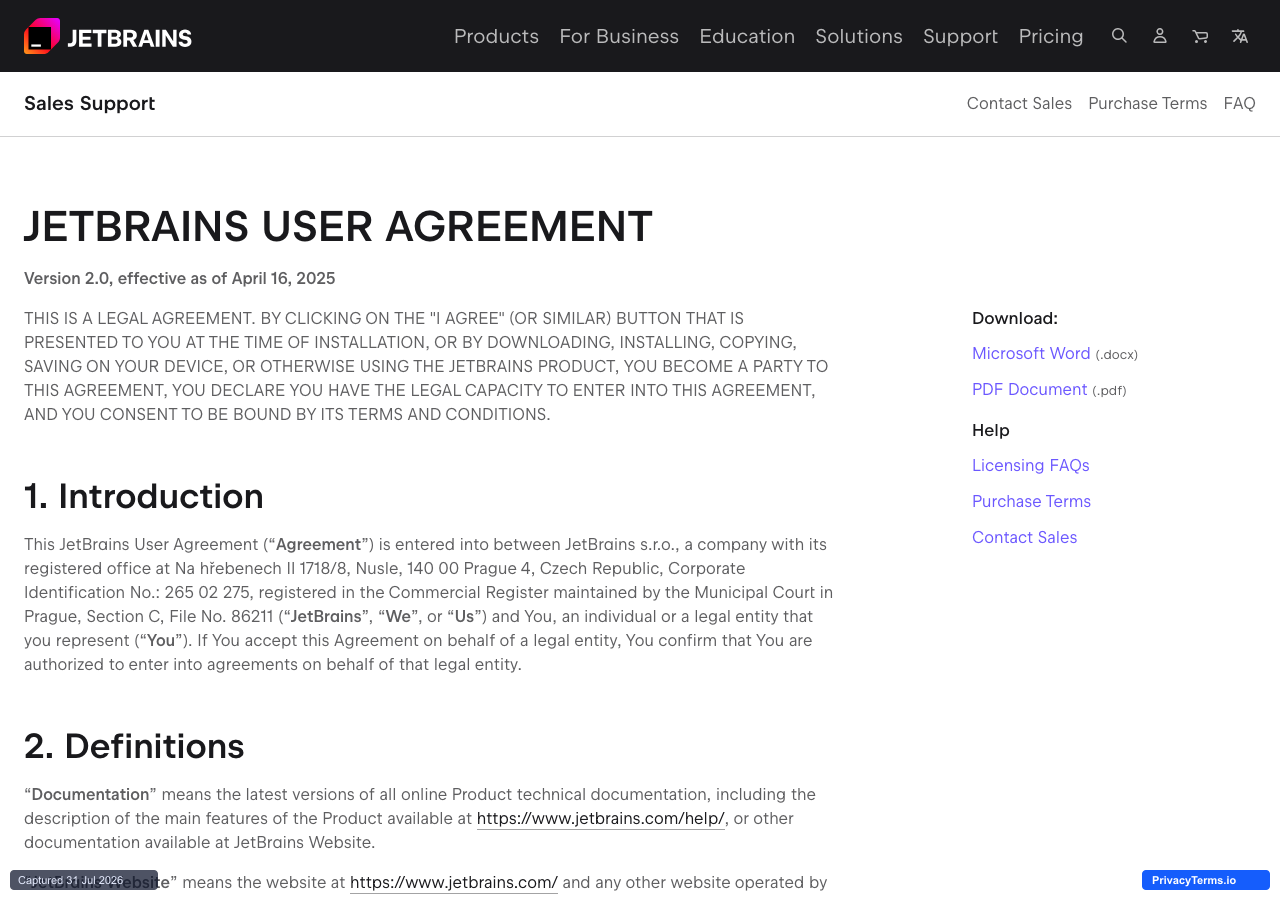
The JetBrains User Agreement opens with a plain acceptance statement before Introduction and Definitions, plus a sidebar offering the whole document as a Word or PDF download.
JetBrains’ User Agreement opens with the acceptance statement almost every EULA needs, clicking “I Agree,” or simply downloading and using the product, makes you a party to the agreement, but puts it in a normal paragraph rather than a wall of capitalized legal text, ahead of numbered Introduction and Definitions sections that read more like documentation than a contract. A persistent sidebar offers the full agreement as a Word or PDF download alongside links to Licensing FAQs and Purchase Terms, useful for a developer tool whose buyers are often procurement or legal teams wanting an offline copy to review. Further into the agreement, the license grant section separates free trial use, freemium use, and paid subscription use into distinct, plainly labeled cases rather than one blanket license clause, and a dedicated AI Features section addresses IDE features built on AI models directly, rather than leaving them to a separate policy a reader would have to go find.
6. Docker
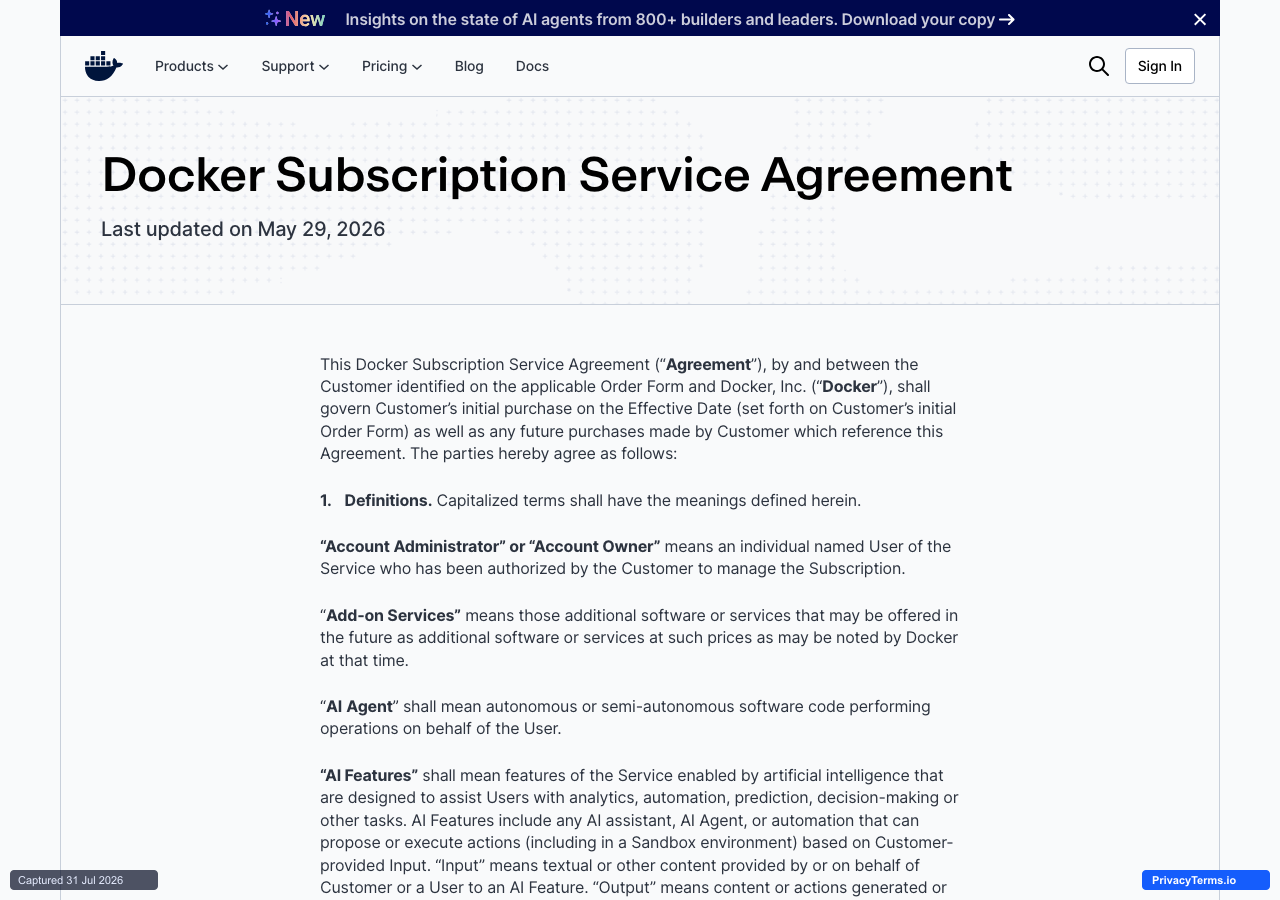
Docker's Definitions section names AI Agent and AI Features as first-class terms, alongside the standard Account Administrator and Add-on Services definitions.
Docker’s Definitions section is worth reading closely for how far it’s already been rewritten around AI-driven tooling: “AI Agent” is defined as autonomous or semi-autonomous software code performing operations on behalf of a user, and “AI Features” covers anything from an AI assistant to an automation that can propose or execute actions, with Input and Output defined as their own terms underneath it. Further into the agreement, standalone unpaid use of Docker Desktop is gated by a precise, numeric rule, restricted to non-commercial open source projects, or commercial use only inside companies with fewer than 250 employees and under 10 million dollars in revenue, rather than a vague “for personal use only” line. That specificity exists because Docker Desktop’s licensing became a genuinely contested business question once large enterprises started using the free version at scale.
7. Sublime Text
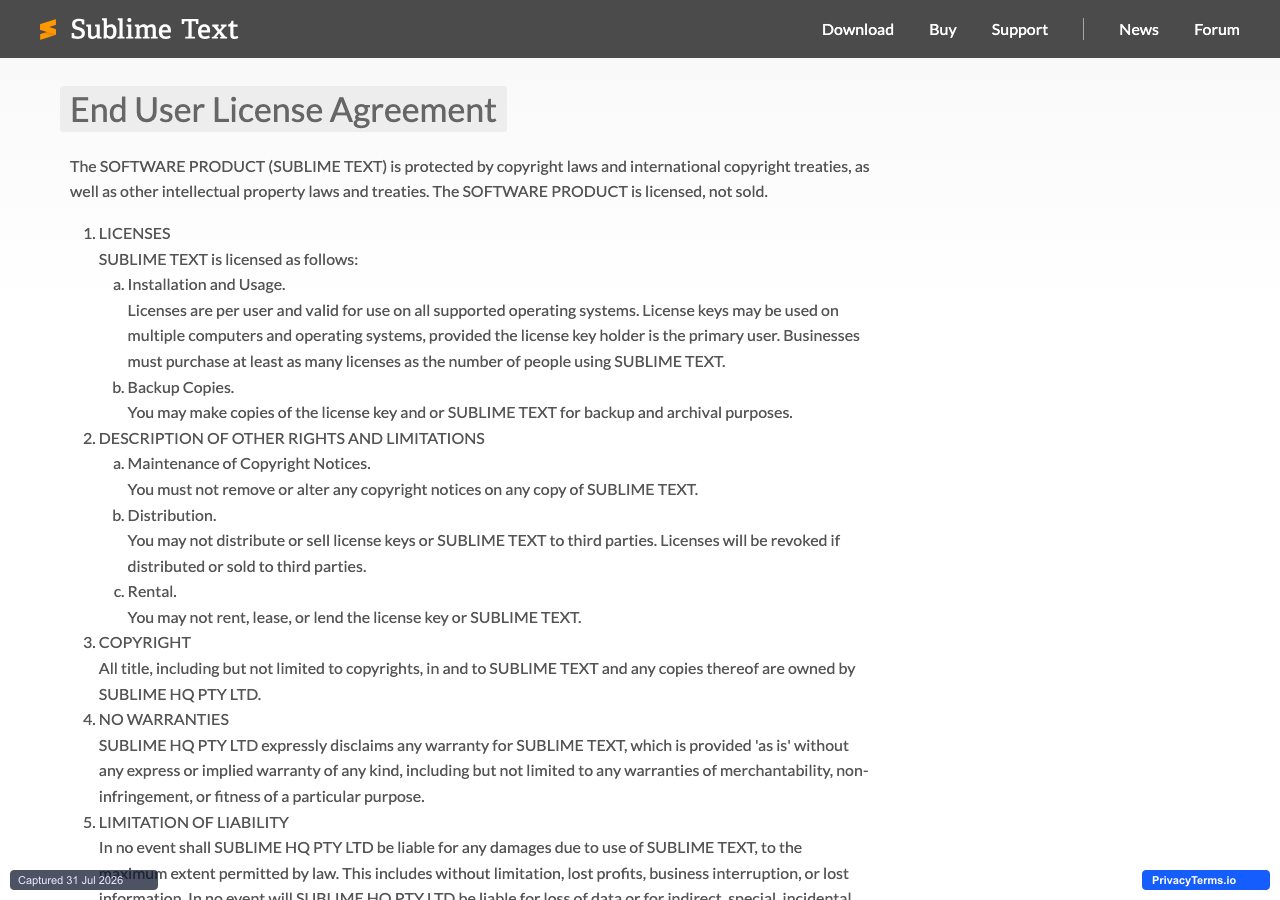
Sublime Text's entire EULA fits on one screen: licenses, backup copies, distribution and rental limits, copyright, and warranty disclaimer.
Sublime Text’s EULA is the shortest, plainest document in this list, and that’s the point worth copying, not a shortcoming. Five short numbered sections cover licensing (per user, valid across every supported OS, one key usable on multiple machines by the same primary user), backup copies, distribution and rental restrictions, copyright ownership, and a standard “as is” warranty disclaimer. There’s no AI clause, no SaaS delivery language, no multi-product routing table, because the product doesn’t need any of that. A EULA scoped exactly to what the software actually does, and nothing more, is easier for a buyer to actually read than a longer one padded with clauses that don’t apply.
8. Balsamiq
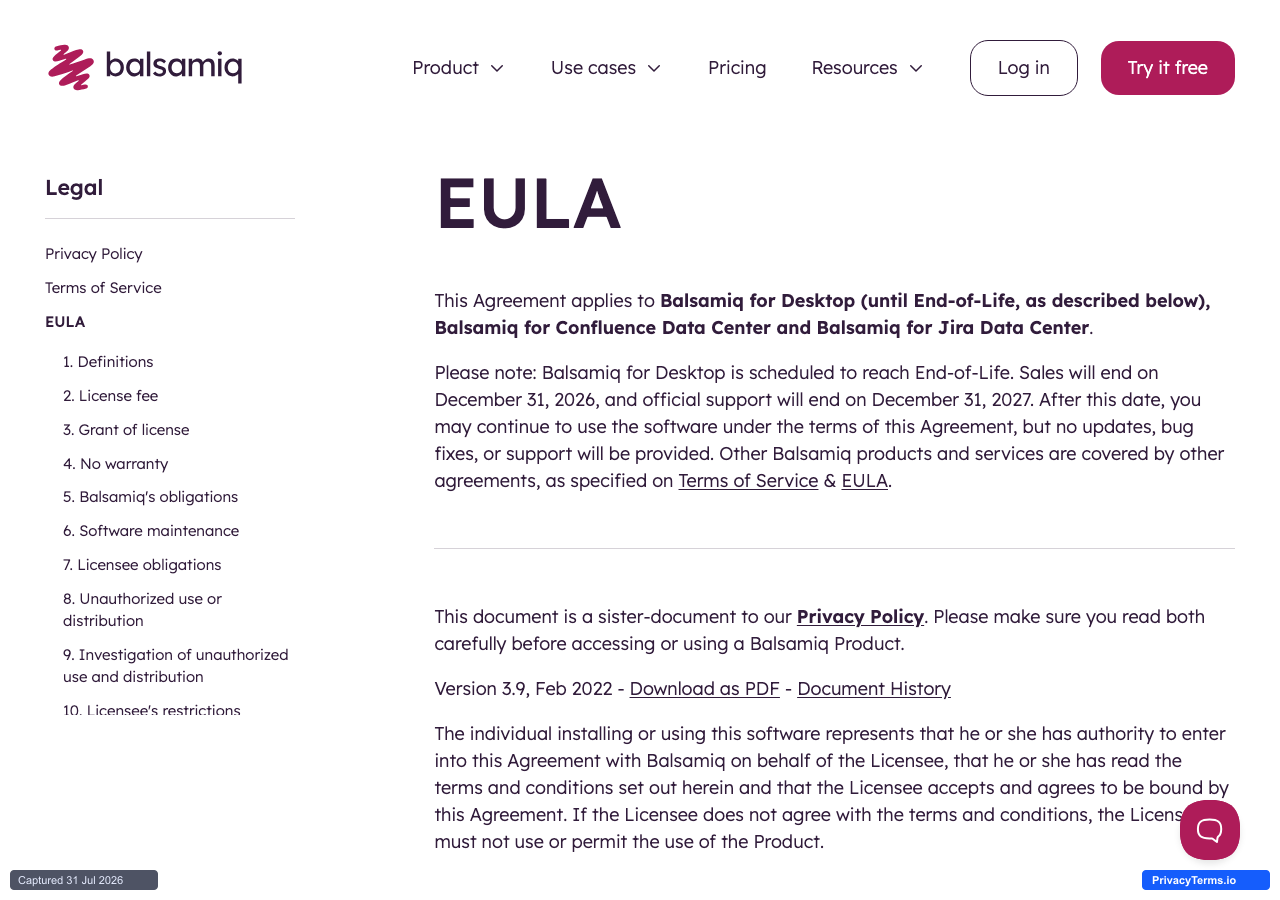
Balsamiq's EULA states exact End-of-Life dates for Balsamiq for Desktop right below the title, not buried in a termination clause.
Balsamiq’s EULA does something almost no other agreement on this list does: it states, in plain language right below the title, that Balsamiq for Desktop is scheduled to reach end of life, with exact dates, sales ending December 31, 2026, support ending December 31, 2027, and what a licensee can still do with the software after that point (keep using it, with no further updates or support). Further down, the termination section backs this up with a real commitment: if Balsamiq discontinues a product, it will announce an end-of-life date at least twelve months out and honor the agreement’s terms until then. Very few EULAs say anything about what happens when the company decides to stop selling the product at all; Balsamiq answers it directly, with specific dates attached, and even offers the current version, 3.9, as a dated PDF download with a linked document history.
Games and Real-Time Platforms
Two EULAs where the underlying business, subscriptions and digital distribution for one, monetized user-generated content for the other, shapes the license far more than a typical desktop software agreement has to account for.
9. Steam
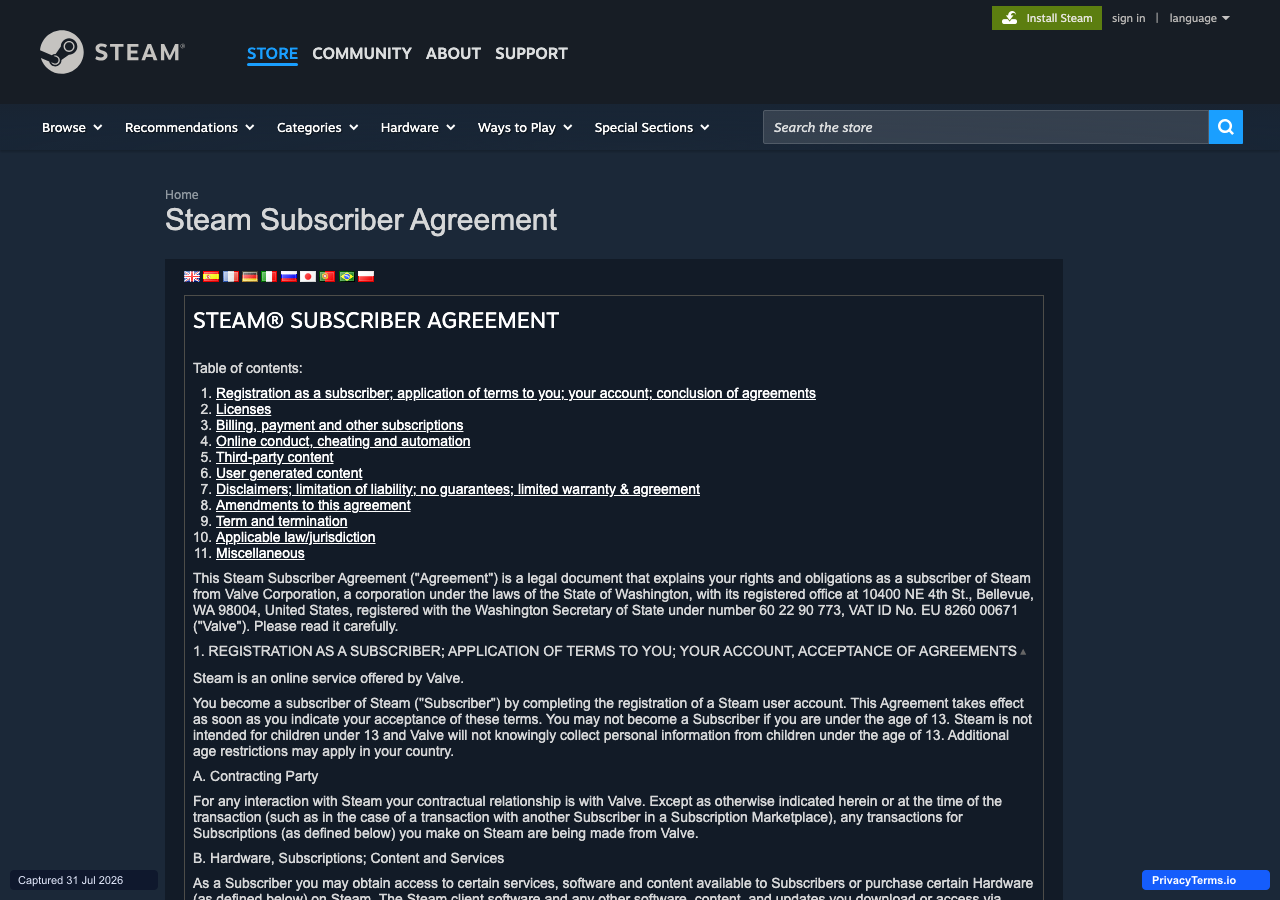
Steam's Subscriber Agreement opens with an eleven-item table of contents and Valve's full registered address and VAT ID before any substantive clause.
Valve’s Steam Subscriber Agreement opens with an actual table of contents, eleven numbered sections with jump links, before a single clause of substantive text. For a document covering account registration, licensing, billing, user-generated content, and dispute resolution all at once, that’s a genuinely useful piece of structure most EULAs skip in favor of a wall of unbroken legal prose. The agreement also states its governing entity’s full registered address and VAT ID directly in the first section, and sets a minimum age of 13 to become a Subscriber, both details written in specifically rather than left to a generic “you must be of legal age” line.
10. Unreal Engine
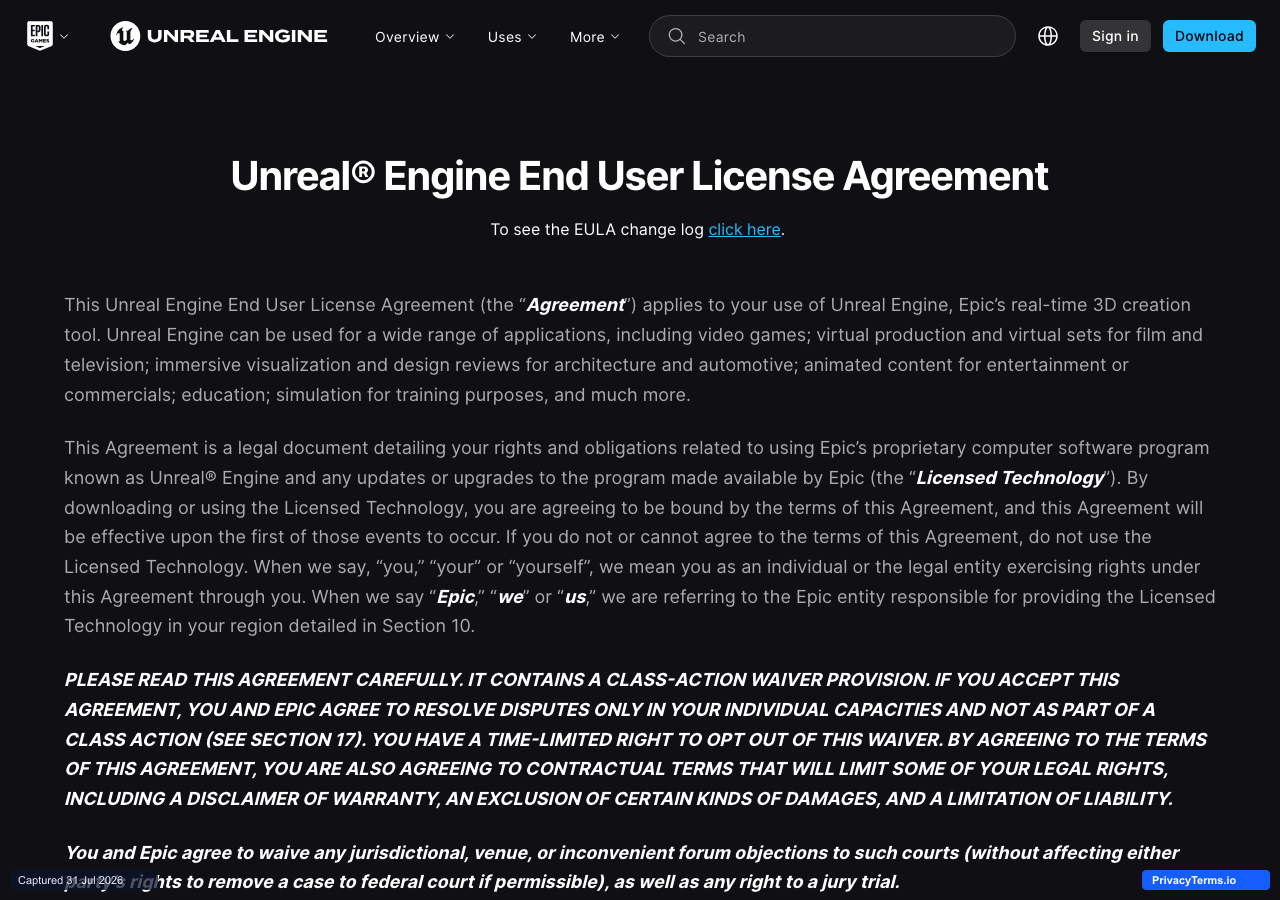
Unreal Engine's EULA links to its own versioned change log directly under the title, ahead of the bolded class-action waiver notice.
Epic’s Unreal Engine EULA opens with a small, easy-to-miss detail worth copying: a link straight to a versioned change log, letting a reader see exactly what’s changed between revisions, a level of transparency almost no other agreement on this list offers up front. Further into the agreement, the license is built around a distinction most software licenses never need: what you built with the tool determines what you owe. Rendered video files and standalone asset files that don’t embed the engine’s code are royalty-free to distribute, even if you’re monetizing them, while products that do embed engine code become subject to a Release Form requirement, submitted to Epic before the product starts generating revenue. It’s a EULA written around a real revenue-sharing business model rather than a flat license fee.
Remote Access and Security Software
Two EULAs for the category of software with the most to lose from getting data handling and dispute resolution wrong: tools that run with elevated system access and often process another company’s data directly.
11. TeamViewer
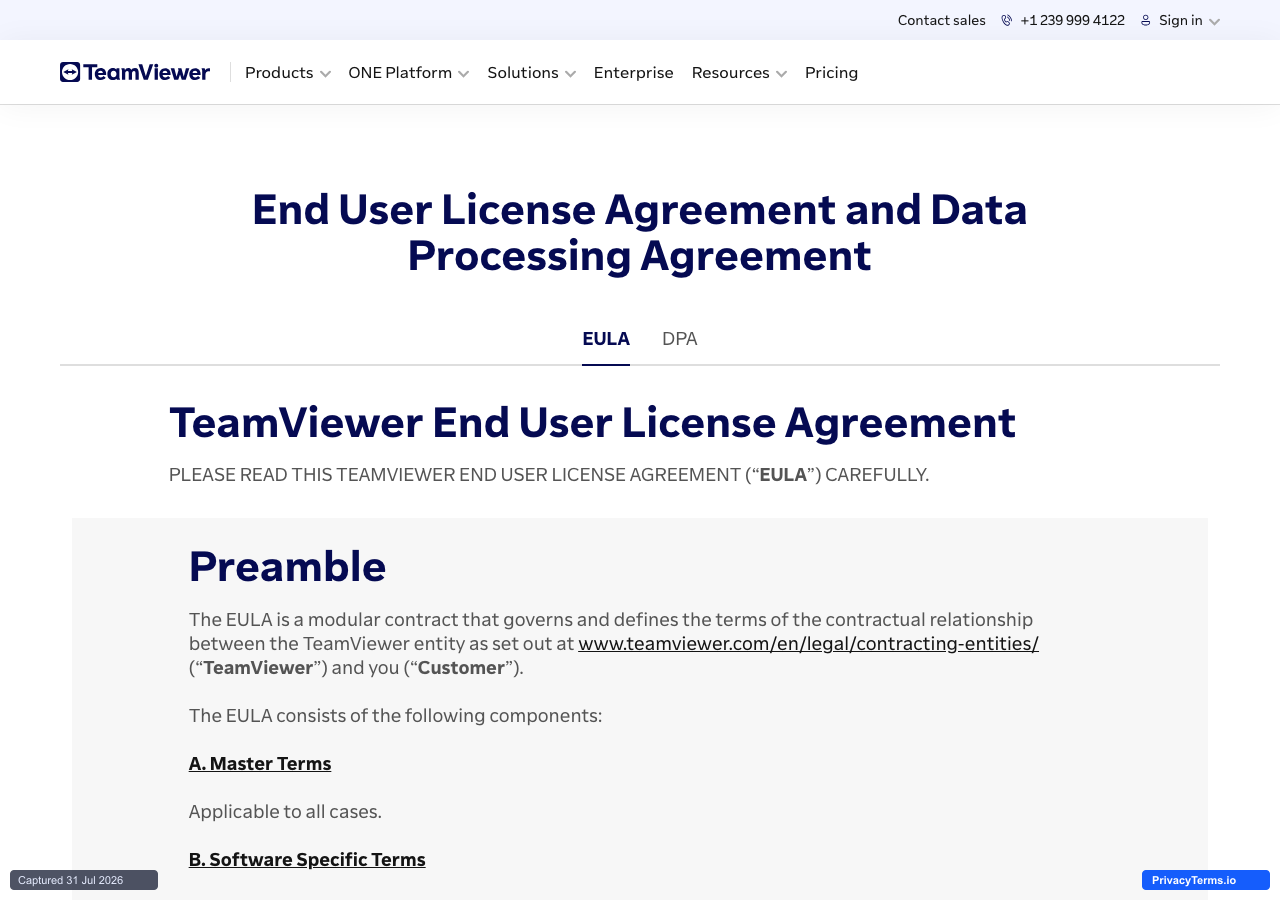
TeamViewer's EULA and DPA share one page behind two tabs, with a Preamble explaining the agreement's modular Master Terms and Software Specific Terms structure.
TeamViewer publishes its EULA and its GDPR Data Processing Agreement behind two tabs on the same page rather than as two separate documents, and its Preamble is unusually upfront about the agreement’s own structure: a modular contract made up of Master Terms that apply to all cases plus Software Specific Terms layered on top. Elsewhere in the combined document, an explicit rule governs how the EULA and DPA interact, the DPA supplements the EULA, and where the two conflict on data protection specifically, the DPA takes precedence, with an exception carved out for a customer who is a natural person using the software for purely personal or family purposes. For remote access software, where the whole product exists to move data and control between two parties, folding the DPA into the same document as the license itself is a genuinely practical choice rather than making a customer hunt for a separate agreement.
12. Malwarebytes
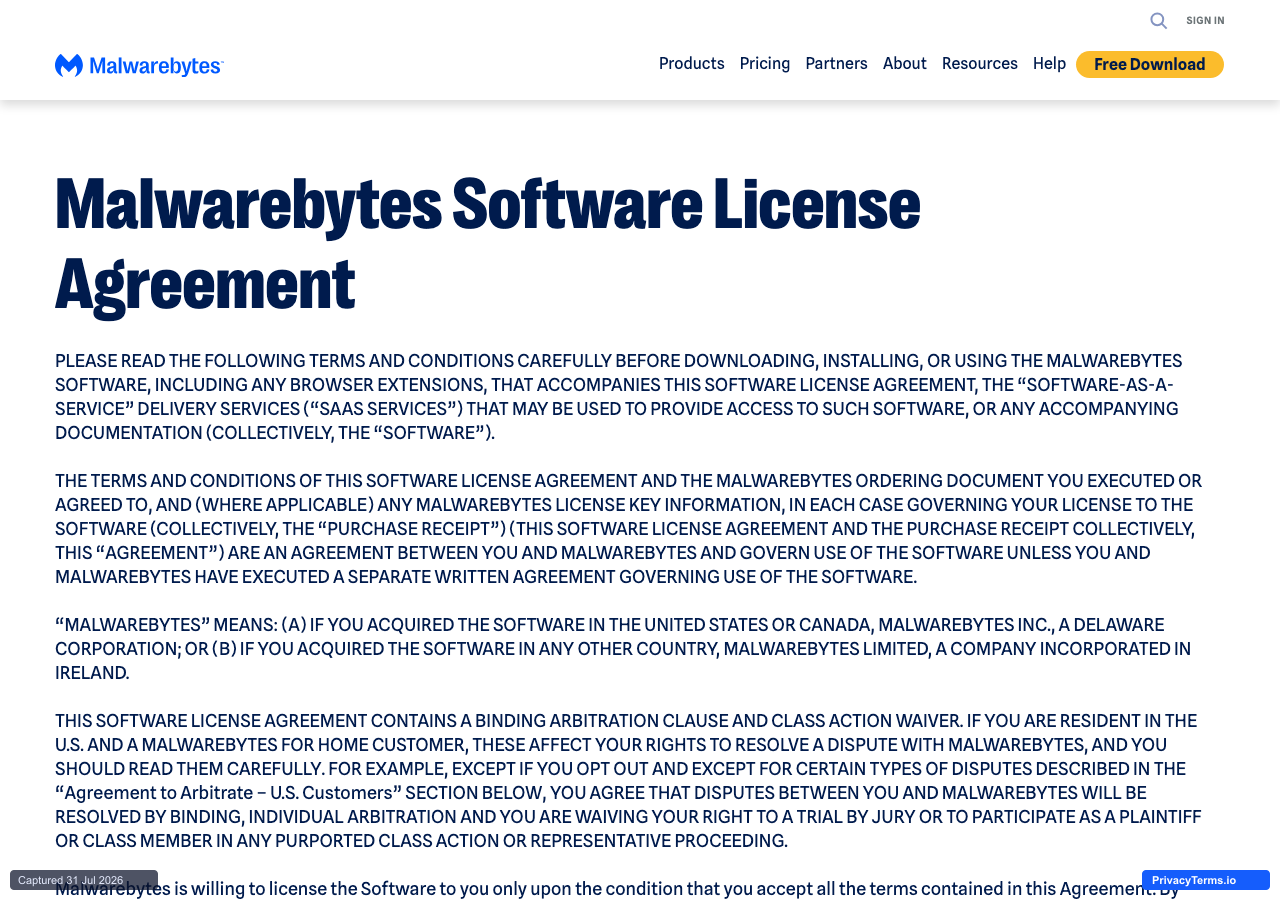
Malwarebytes folds browser extensions and SaaS delivery into one Software definition, then discloses its binding arbitration clause in bold before any substantive term.
Malwarebytes’ agreement opens by folding its browser extensions and its SaaS delivery services into the same definition of “Software” as the installed application, so one license covers the full product surface rather than needing separate terms per delivery method. Immediately after that, in bold capital letters before any substantive clause, it discloses that the agreement contains a binding arbitration clause and class action waiver specifically for U.S. resident “Malwarebytes for Home” customers. Putting that disclosure in bold, ahead of the actual license terms, rather than buried in a dispute-resolution section near the end, is the kind of upfront honesty a security company selling trust as its core product should probably lead with.
Utilities
Two compression and creative-suite EULAs from companies whose products have existed, largely unchanged in purpose, for decades, and whose licenses reflect a shareware and multi-product-portfolio history most modern SaaS EULAs don’t have to deal with.
13. WinRAR
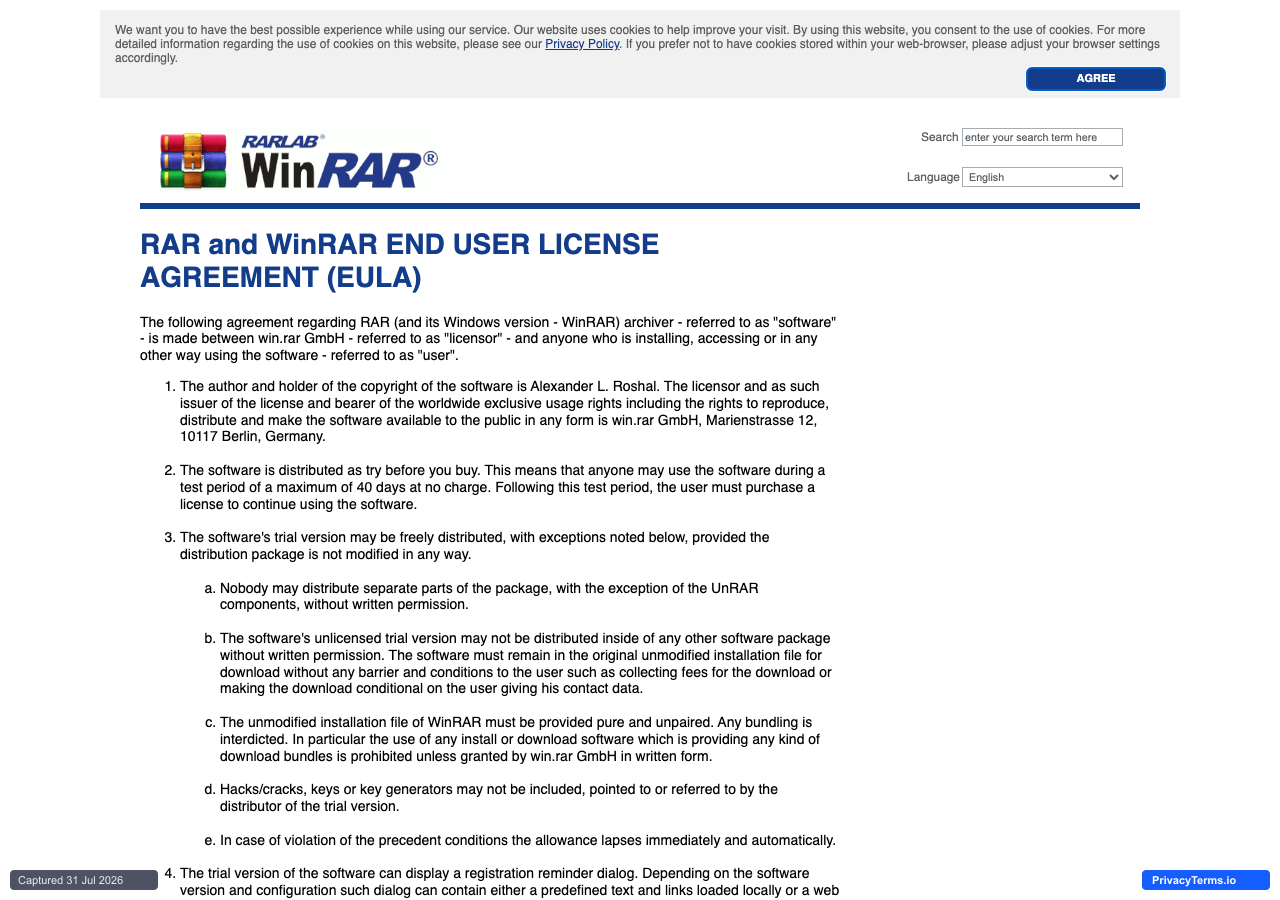
WinRAR's EULA states the 40-day trial period plainly, then spells out anti-bundling distribution rules in unusual detail.
WinRAR’s EULA is upfront about the detail every longtime Windows user already half-knows: the software is distributed as try-before-you-buy, with a stated 40-day test period, but it says nothing about what happens technically after that period ends, which is exactly why WinRAR’s famous “your trial has expired” nag screen, rather than a hard lockout, has become a running joke online. What the EULA does spell out in unusual detail is anti-bundling: the unmodified trial installer can’t be wrapped in third-party download managers, paired with unrelated software offers, or gated behind a fee or a data-collection form, a direct response to the download-bundling practices that plagued freeware distribution for years.
14. WinZip (Corel)
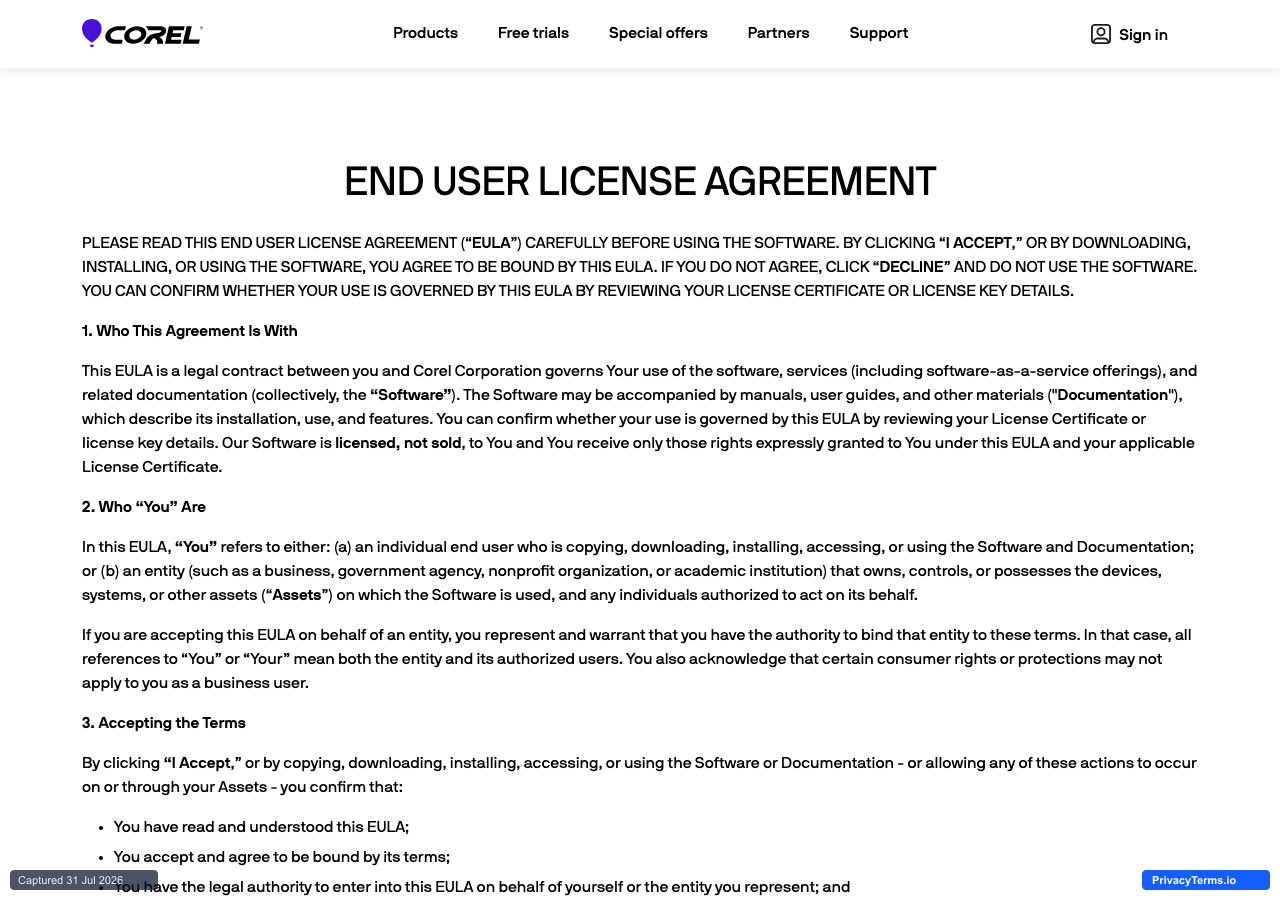
WinZip's EULA opens as a shared Corel agreement, with Who This Agreement Is With and Who You Are sections written to cover Corel's entire product portfolio at once.
WinZip’s EULA is actually one entry point into a much larger shared Corel agreement covering an entire portfolio of otherwise unrelated products, CorelDRAW, Painter, WordPerfect, MindManager, and Roxio’s disc and video tools among them, each routed to its own product-specific terms through a table embedded further into the general EULA. It’s the same hub pattern the platform-level companies at the top of this list use, just applied to a mid-sized software company whose product line grew through acquisition rather than internal development. The general EULA’s third-party software section is also worth a look: it explicitly disclaims granting any rights to third-party components bundled into the software beyond what’s needed to run it alongside Corel’s own product, pointing users to each vendor’s own terms instead of trying to absorb them.
What These 14 Add Up To
Read together, these fourteen EULAs aren’t fourteen variations on one template, they’re five genuinely different shapes: a routing hub for a multi-product portfolio, a scoped license for a single focused tool, a revenue-sharing agreement for monetized output, a combined license-and-data-processing document, and a shareware trial with explicit anti-bundling rules. The right shape for your own EULA depends on which of those five situations actually describes your product, not on which company’s document happens to rank first in a search result.
If your product includes a desktop app, browser extension, CLI tool, or any other installable component, our EULA Generator builds a license scoped to exactly what you’re distributing, without the multi-product routing tables or portfolio-wide clauses that make sense for a company like Microsoft or Corel but would just be noise for a single product. For the question of whether you need a standalone EULA at all versus folding license language into your Terms of Service, see our guide on EULAs for web apps and SaaS products.
The information in this article is for informational purposes only and should not be construed as legal advice on any matter, and does not create a lawyer-client relationship.