A chargeback almost never starts as a chargeback. It starts as a customer who could not find a straight answer to “can I get my money back,” gave up looking, and called their bank instead. The refund policy pages below all avoid that outcome, but they do it in noticeably different ways: some promise no questions asked with no stated deadline at all, some trade a shorter window for tighter, clearer conditions, and a couple hand the money back onto a store credit rather than the original card once enough time has passed. None of that is accidental. Every choice below is a deliberate trade between how generous the policy reads and how exposed the merchant is to abuse, and the pages that get it right say so in plain language instead of burying the trade in a legal wall of text.
That is the actual lever against chargebacks: a cardholder disputes a charge with their bank when the merchant’s own return path looks slower, vaguer, or more adversarial than just asking Visa or Mastercard to claw the money back. A refund policy that states the timeframe, the condition requirements, and the refund method up front, in the first screen a shopper sees, removes the ambiguity that sends people to their bank instead of to “start a return.”
What Makes a Refund Policy Cut Down Disputes
A handful of traits repeat across the pages below, independent of how generous or strict the underlying policy is:
- The timeframe is a number, or an explicit “no deadline,” not a vibe. “30 days,” “365 days,” or “no time limit” stated once, near the top, not scattered across three different pages that each imply a different window.
- Condition requirements are explicit before the shopper starts a return, not discovered after an item is shipped back and rejected: original packaging, tags attached, unworn, receipt or order number.
- The refund method is named up front, original payment method, store credit, or a mix depending on how long it has been, so a customer knows what they are actually getting back before they commit to the return.
- Starting a return does not require a phone call or email ticket for the common case, an online form or account-linked flow handles it, which is also what keeps a shopper from defaulting to a chargeback out of sheer friction.
- Exceptions are named specifically, final sale, activation-required electronics, opened software, rather than a vague “some items may not be eligible” that a shopper only discovers after ordering.
Keep those five in mind while reading through the examples. Where a page skips one anyway and still works, the entry below explains why.
No Time Limit / Lifetime-Style Guarantees
These three do not put a number on the return window at all: the guarantee is framed around ongoing satisfaction with the product rather than a countdown from the purchase date. That is a stronger claim than it looks, and it only holds up because each backs it with tight, specific conditions on what actually qualifies.
1. Costco
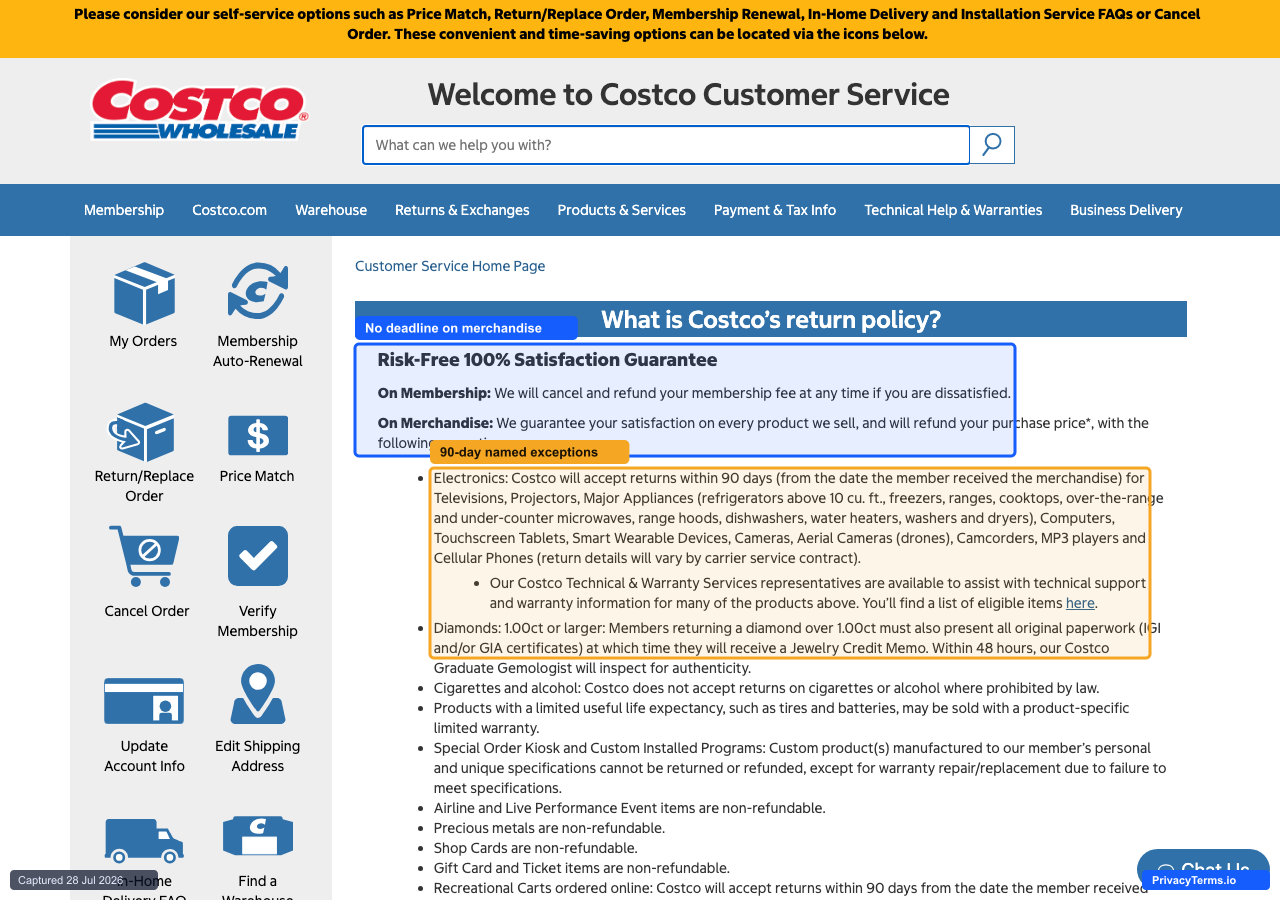
Costco's Membership Risk-Free 100% Satisfaction Guarantee page
Costco’s page splits its guarantee into two tiers rather than one blanket number: general merchandise gets a 100% satisfaction guarantee with no stated cutoff at all, while a short, explicitly named list, electronics, appliances, diamonds over a certain size, gets a specific 90-day window instead. Naming the exceptions individually rather than lumping them into “some restrictions apply” is the detail worth copying: a customer checking whether their laptop qualifies finds a direct answer instead of a policy that reads generously right up until their specific item turns out not to be covered.
2. Patagonia
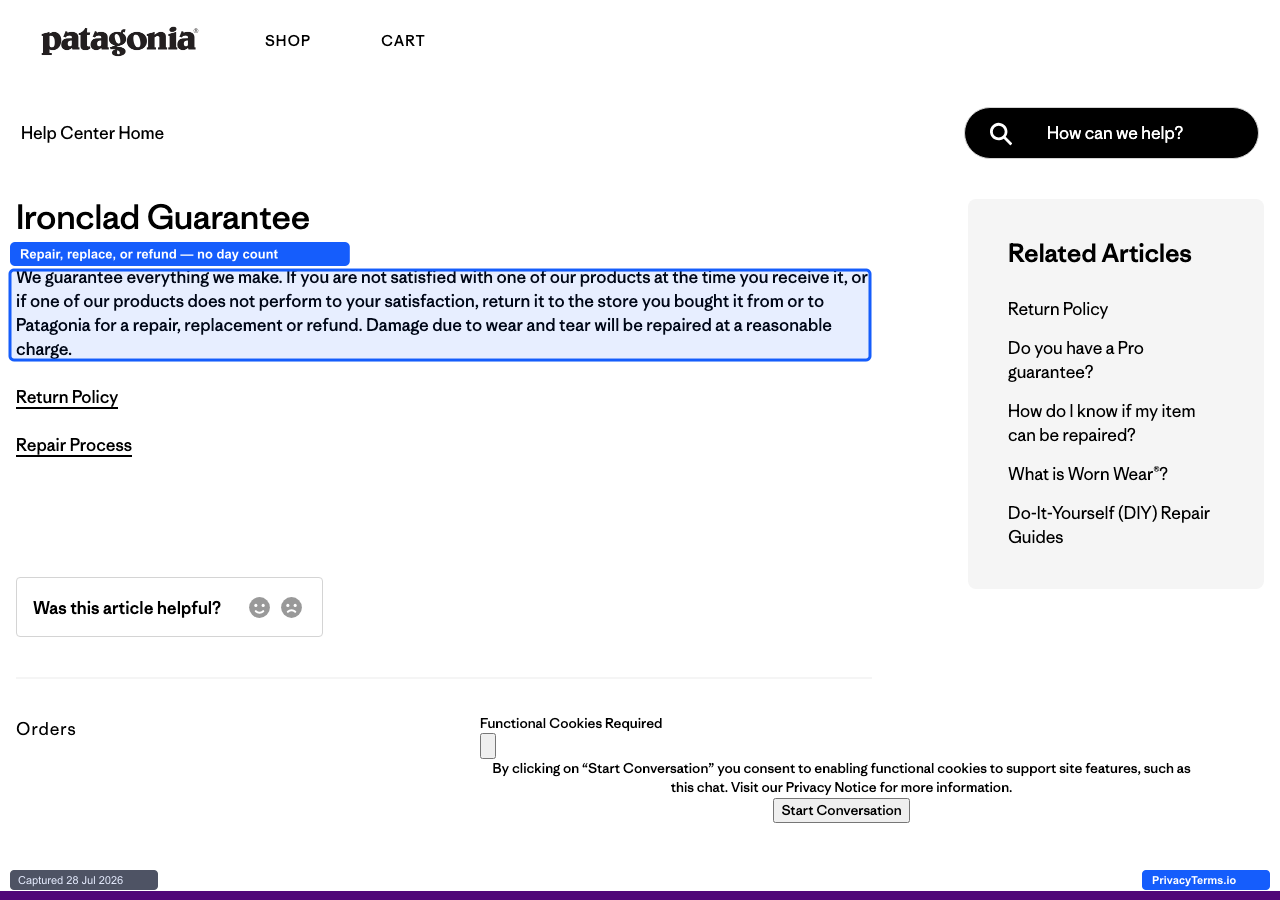
Patagonia's Ironclad Guarantee page describing repair-first, refund-second handling
Patagonia’s Ironclad Guarantee states plainly that “if you are not satisfied with one of our products at the time you receive it, or if one of our products does not perform to your satisfaction, return it to the store you bought it from or to Patagonia for a repair, replacement or refund,” with no day count anywhere in that sentence. What keeps the open-ended promise from reading as a blank check is a second, equally direct line: damage from ordinary wear and tear is repaired at a reasonable charge, not covered free. Naming the boundary, normal wear versus a genuine defect, in the same breath as the guarantee itself is what lets an unlimited-sounding policy avoid being read as unlimited in practice.
3. Bath & Body Works
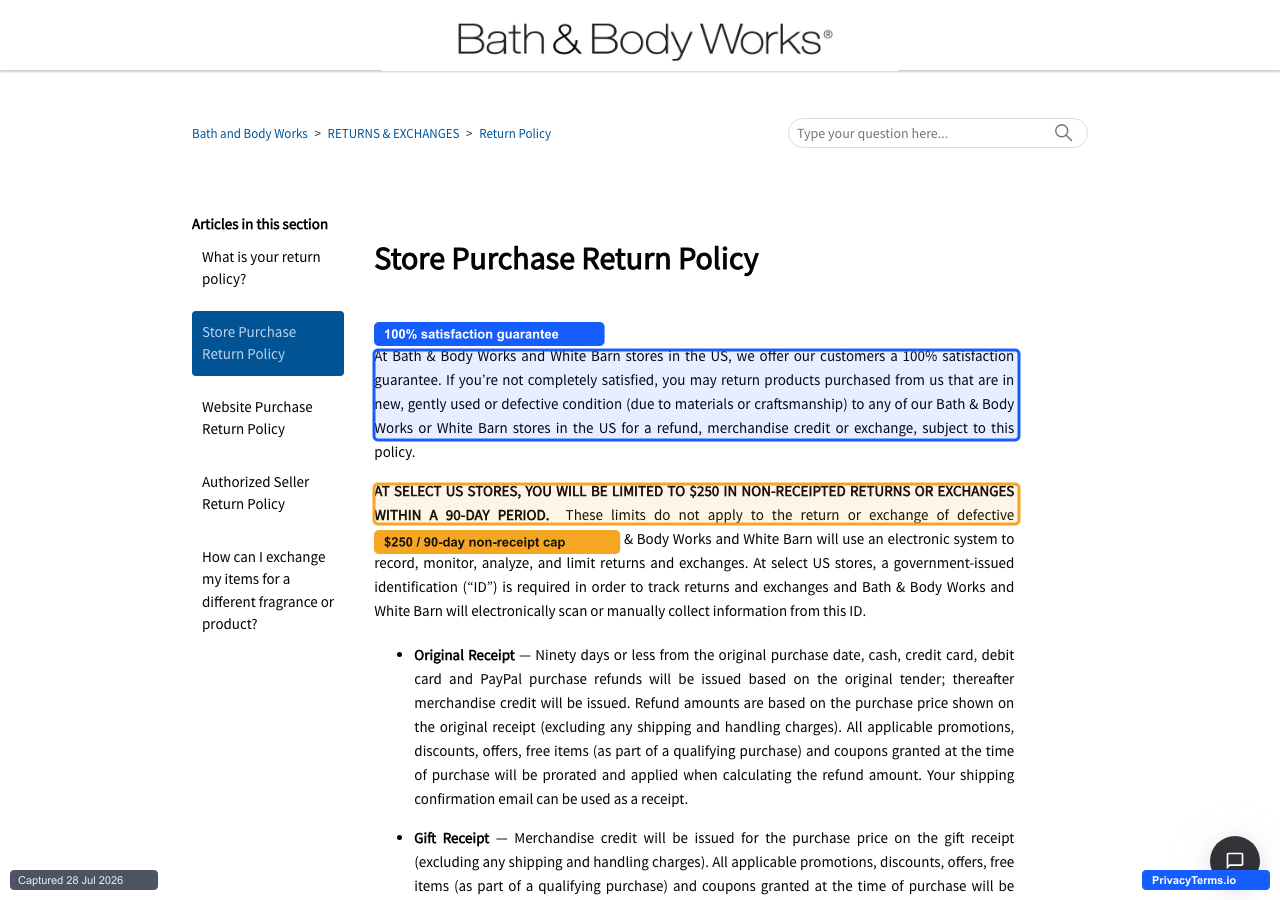
Bath & Body Works' 100% satisfaction guarantee return policy page
Bath & Body Works backs its 100% satisfaction guarantee with a specific, disclosed limit rather than leaving it fully open: returns or exchanges made without a receipt are capped at $250 within a 90-day period at participating stores, and government-issued ID is required to track them. That cap does not apply to defective merchandise, which the page states separately, so a customer with a real product failure is not measured against the same ceiling as someone doing an undocumented return. Stating a specific dollar figure and time window for the unreceipted case, rather than a vague “management discretion,” is what turns a policy that could otherwise invite abuse into one a store can actually enforce consistently.
365-Day / 1-Year Windows
A full calendar year removes almost all “did I miss the deadline” disputes, without going as open-ended as the guarantees above. These three all land on 365 days, with the fine print underneath that headline number doing the real work.
4. IKEA
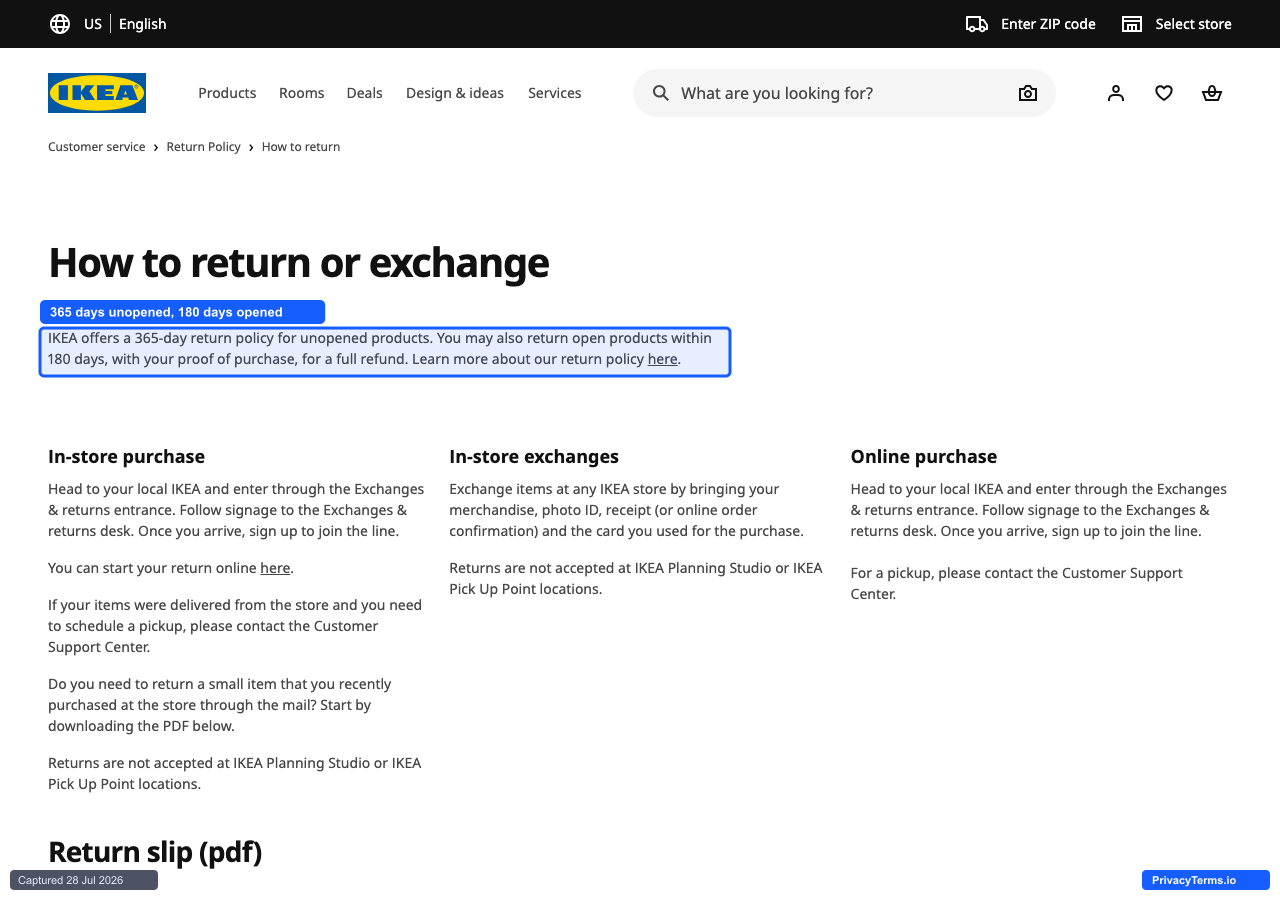
IKEA's "How to return or exchange" page stating its 365-day and 180-day return windows
IKEA’s page states two different windows for the same 365-day headline rather than one blanket rule: unopened products get the full 365 days, while opened products get a shorter 180-day window, both conditioned on proof of purchase for a full refund. Splitting the number by opened-versus-unopened, instead of applying one condition to every return regardless of whether the box was ever unsealed, is what lets IKEA offer a genuinely long window on furniture and housewares without inviting the abuse a flat “365 days, any condition” rule would.
5. L.L.Bean
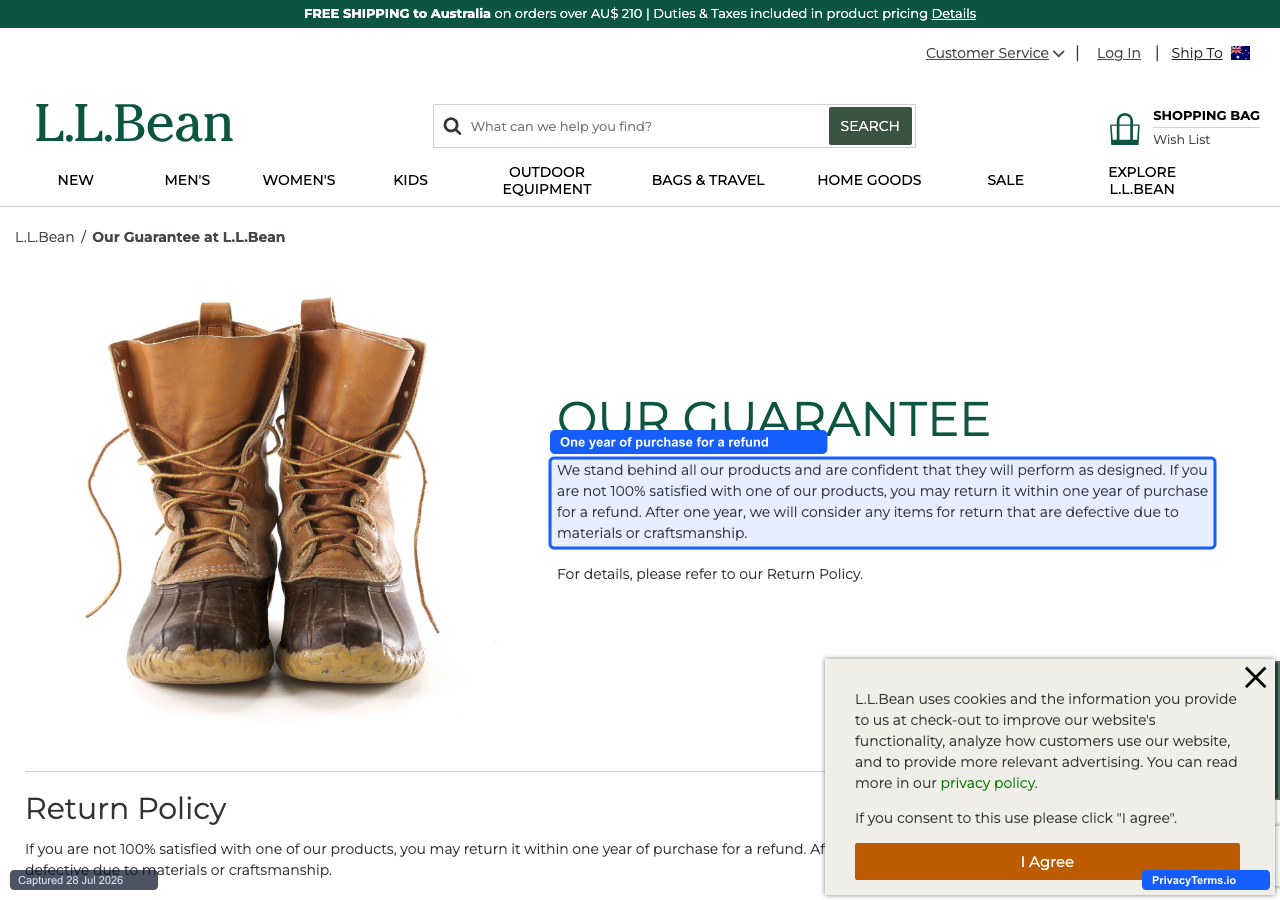
L.L.Bean's "Our Guarantee" page describing its one-year satisfaction guarantee
L.L.Bean’s page states its guarantee in one direct sentence: not 100% satisfied, return it within one year of purchase for a refund, with items past that year still considered case by case if the defect is in materials or craftsmanship. The page is equally direct about documentation, proof of purchase is required, either through the account record from checkout or a physical receipt, with the refund going back to the original payment method rather than left ambiguous. That combination, a full year framed as generous, paired with a plainly stated proof-of-purchase requirement, is what keeps the policy from being read as return-anything-no-questions.
6. Brooklinen
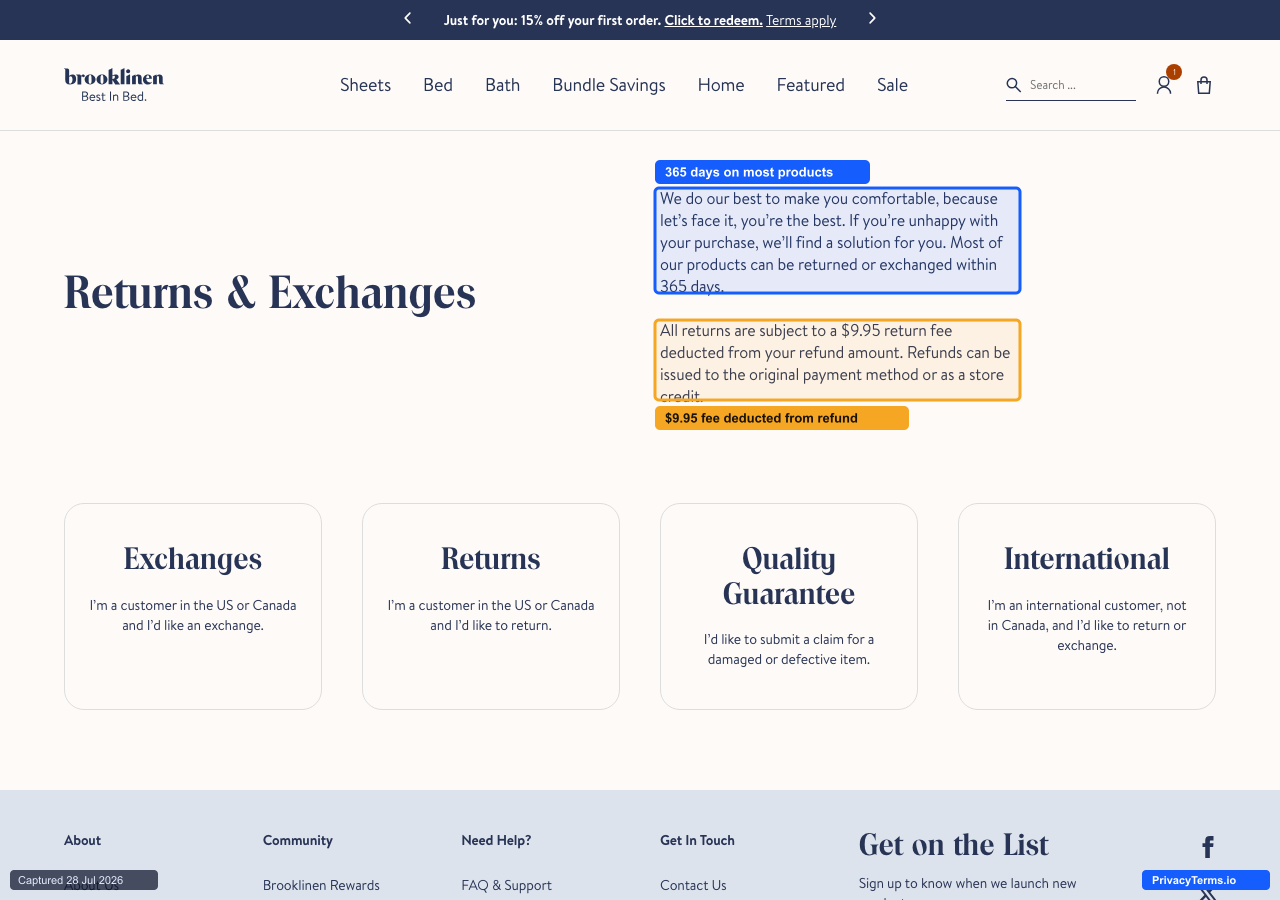
Brooklinen's Returns & Exchanges page stating its 365-day window and return fee
Brooklinen states its window in the same paragraph as the guarantee itself, “most of our products can be returned or exchanged within 365 days,” with no separate accordion or linked page needed to find the number. The catch is disclosed just as directly, immediately below it: all returns are subject to a $9.95 return fee deducted from the refund amount, waived only for the smaller set of customers returning through a retail location instead of by mail. Refunds go back to the original payment method by default, with store credit offered only when that payment method is no longer available, rather than left as an unexplained alternative. Naming the fee in the same breath as the 365-day promise, instead of a separate “shipping and handling may apply” footnote elsewhere, is what keeps a genuinely generous window from producing a surprised customer at the exact moment the refund posts for nine dollars and ninety-five cents less than expected.
Time-Boxed, Tiered by Membership, Condition, or Reason
Rather than a single number, these three commit to a shorter base window and then layer specific, named exceptions on top, by membership tier, product condition, or the reason for the return, instead of one blanket rule applied everywhere.
7. Best Buy
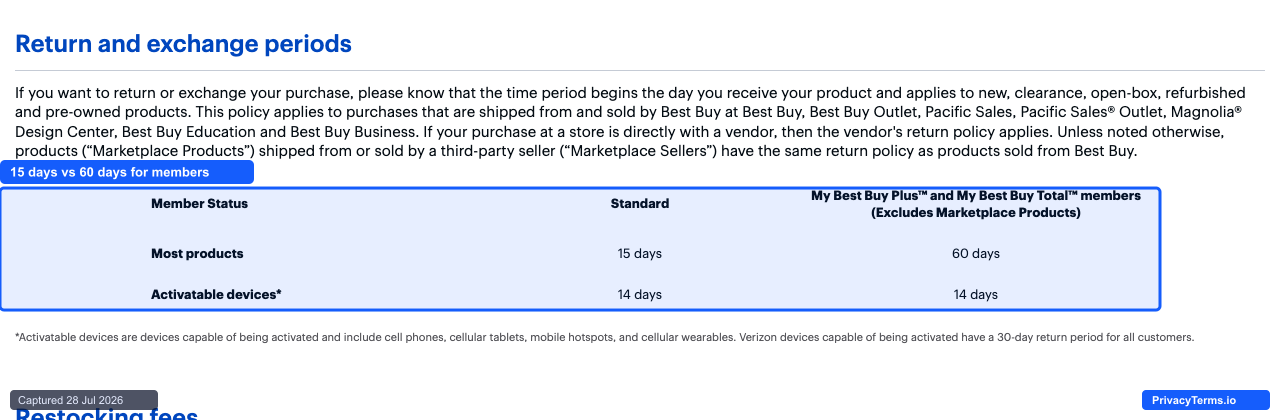
Best Buy's return and exchange policy page showing extended windows for My Best Buy members
Best Buy runs a two-tier system stated plainly on one page: 15 days for standard customers, extended to 60 days for My Best Buy Plus and My Best Buy Total members on most products. Electronics that require activation, cell phones and tablets specifically, are called out as a flat 14-day exception that applies no matter what membership tier a customer holds, which keeps the member benefit from accidentally implying a longer window on the exact category most likely to be resold or swapped for a newer model.
8. GameStop
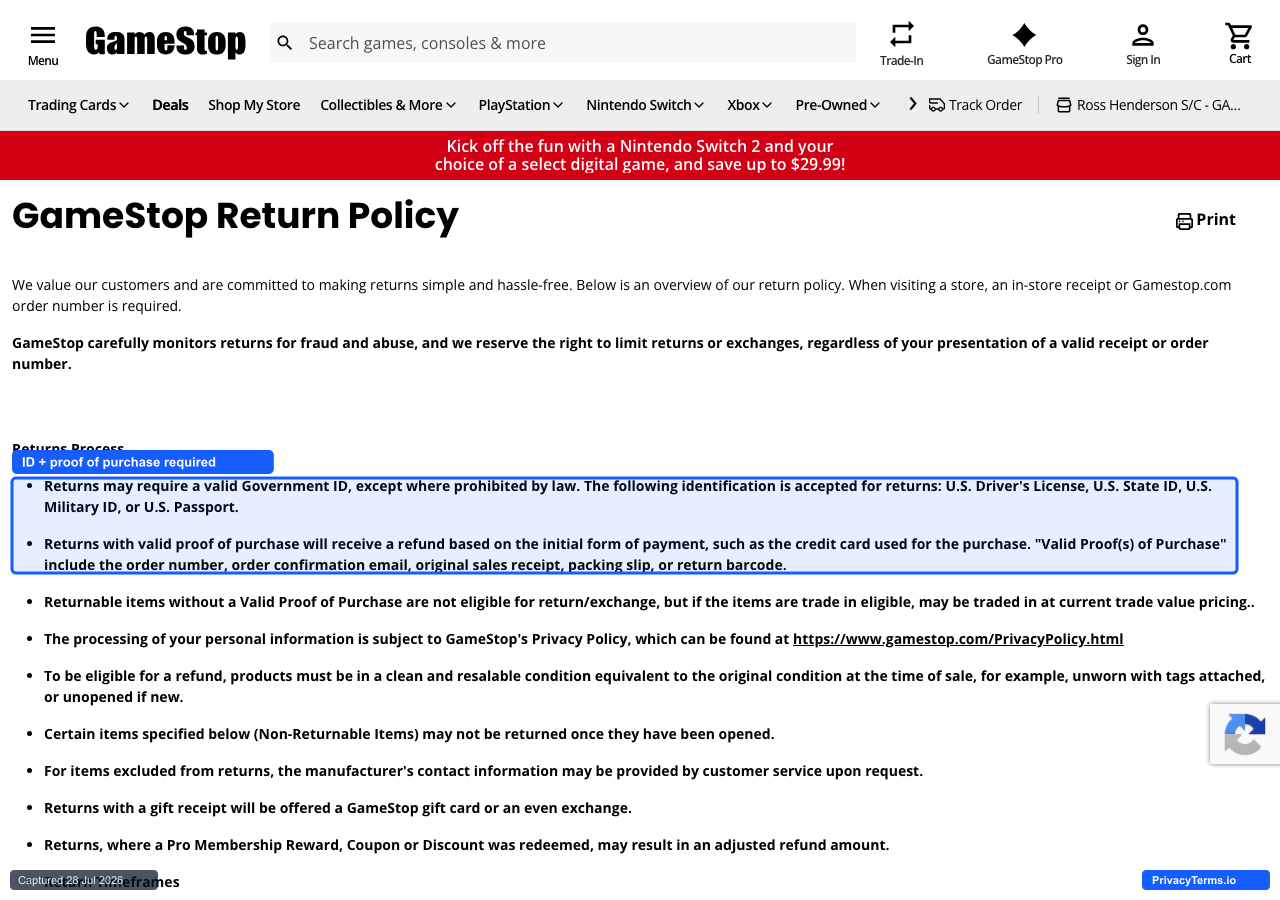
GameStop's Return Policy page listing ID and proof-of-purchase requirements
GameStop’s page opens with two blunt sentences most retailers soften: an in-store receipt or GameStop.com order number is required, full stop, and GameStop “carefully monitors returns for fraud and abuse” and can limit returns even with a valid receipt. The requirements underneath are equally specific rather than vague: a government-issued ID (driver’s license, state ID, military ID, or passport) for the return itself, and a refund issued to the original form of payment only when a valid proof of purchase, an order number, confirmation email, receipt, packing slip, or return barcode, is presented. Gift-receipt returns are called out separately too, a GameStop gift card or an even exchange rather than a cash refund, which a shopper finds out before mailing something back instead of after. It is a stricter tone than most of the retailers in this list, but stating the fraud-monitoring stance up front, instead of only in dispute correspondence after the fact, is itself a form of the same clarity this list rewards.
9. Bombas
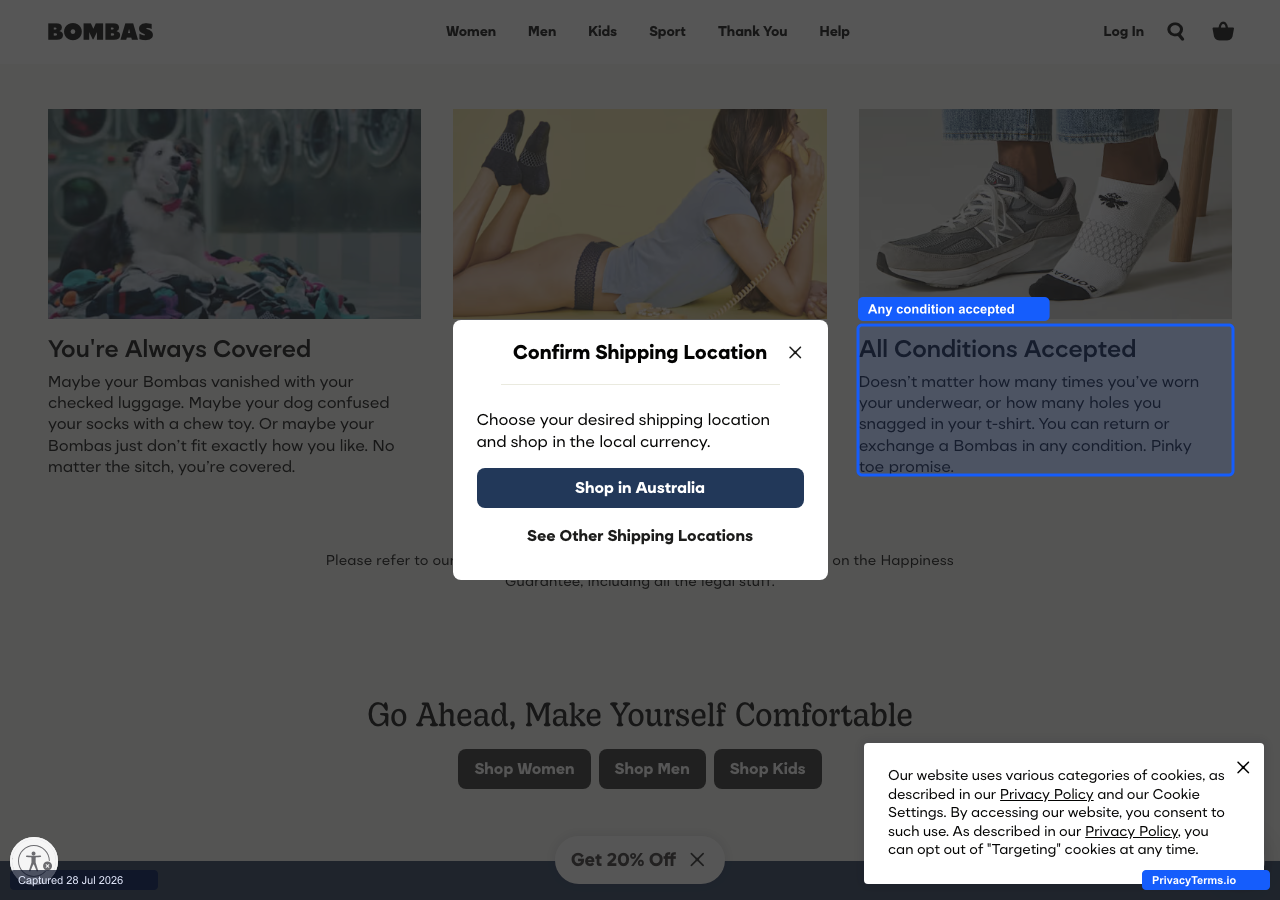
Bombas' Happiness Guarantee page describing its any-condition-accepted policy
Bombas runs two guarantees on the same page rather than one: a standard 30-day, no-questions-asked refund to the original payment method (extended to 60 days for purchases made in November and December), plus a separate, genuinely open-ended “Happiness Guarantee” covering worn-out, damaged, or lost socks and underwear with no stated day limit at all. The page states the open-ended half in specific, almost playful terms rather than vague legal language: “doesn’t matter how many times you’ve worn your underwear, or how many holes you snagged in your t-shirt.” Splitting the two into a fast, no-argument path for simple returns and a separate, condition-based path for the just-happened-to-wear-out case is a cleaner structure than a one-size-fits-all policy: a customer who changed their mind gets the fast path, and a customer with a genuine multi-year durability complaint still has somewhere to go, without either group being asked the wrong set of questions.
Refund Method and Subscription-Specific Terms
The last three handle a different variable entirely: not how long a customer has to return something, but what they actually get back and when, which matters most for marketplace sellers and subscription products where “mail it back” is not the whole story.
10. Zappos

Zappos' return policy page showing the 60-day refund window and one-year store credit option
Zappos states two distinct outcomes rather than one flat number: items returned within 60 days of purchase are eligible for a refund to the original payment method or as store credit, while returns made after 60 days but within a year of purchase are only eligible for store credit, not a refund back to the card. The page also flags a narrower rule for guest checkout orders, refunds only within 60 days, no store-credit extension, so a customer who skipped creating an account sees that limitation before they ship something back expecting the longer window to apply.
11. eBay
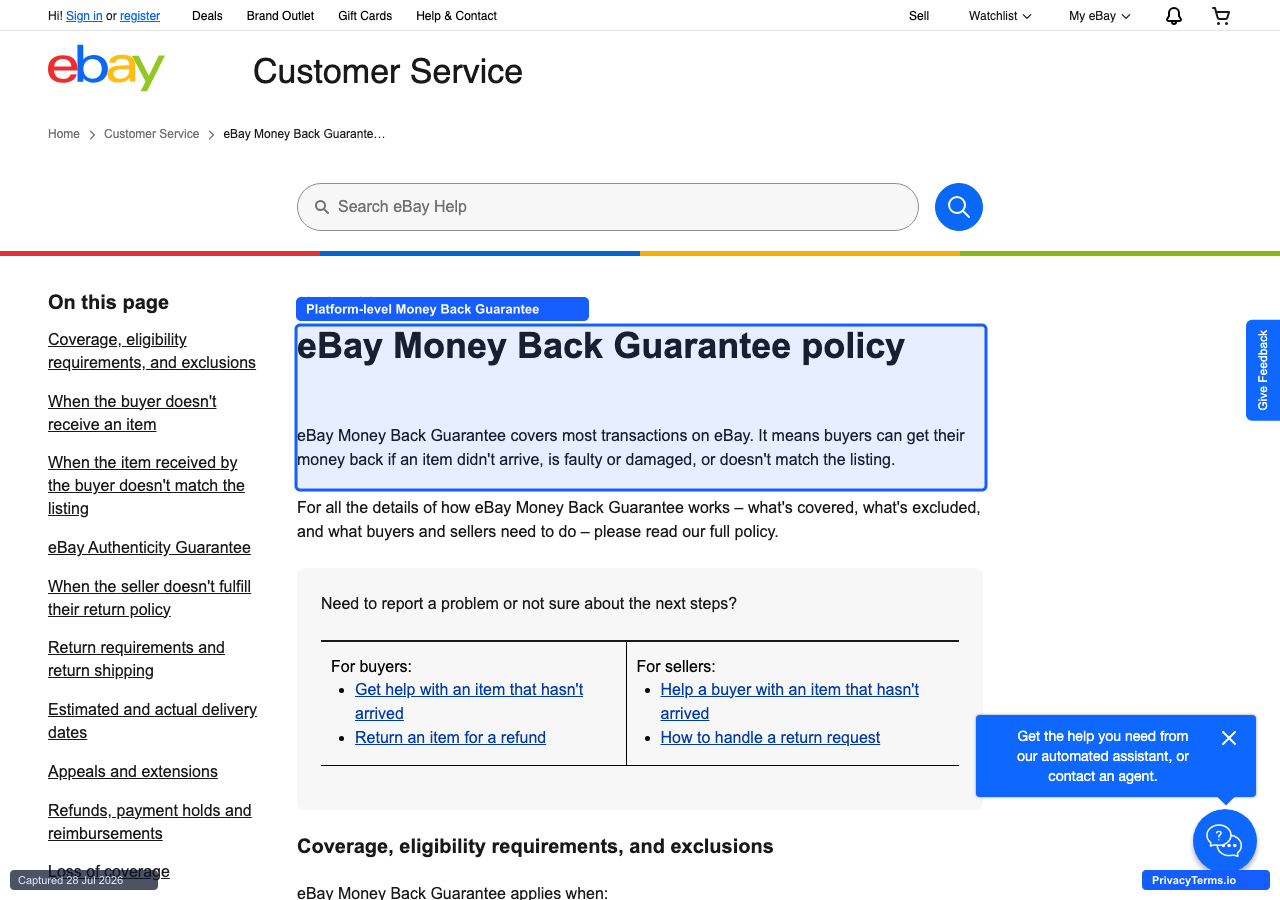
eBay's Money Back Guarantee policy page
eBay’s guarantee is platform-level rather than seller-level, and the page states that distinction directly in its first sentence: “eBay Money Back Guarantee covers most transactions on eBay,” refunding a buyer if an item never arrives, arrives damaged, or doesn’t match the listing, regardless of what any individual seller’s own return policy says. That is a materially different promise than a single retailer’s refund page, since eBay is guaranteeing the transaction rather than any one merchant absorbing the cost directly, and the page is explicit that sellers get a set window to resolve a claim before eBay steps in itself. The tradeoff, stated in the same help section rather than hidden, is scope: the guarantee covers non-arrival, damage, and mismatched listings specifically, not a simple change of mind, which is the seller’s own policy to set instead. Naming what the platform covers and what it leaves to the individual seller, in the same document, is what keeps a marketplace-scale guarantee from reading as a blanket promise it was never designed to be.
12. Microsoft Store
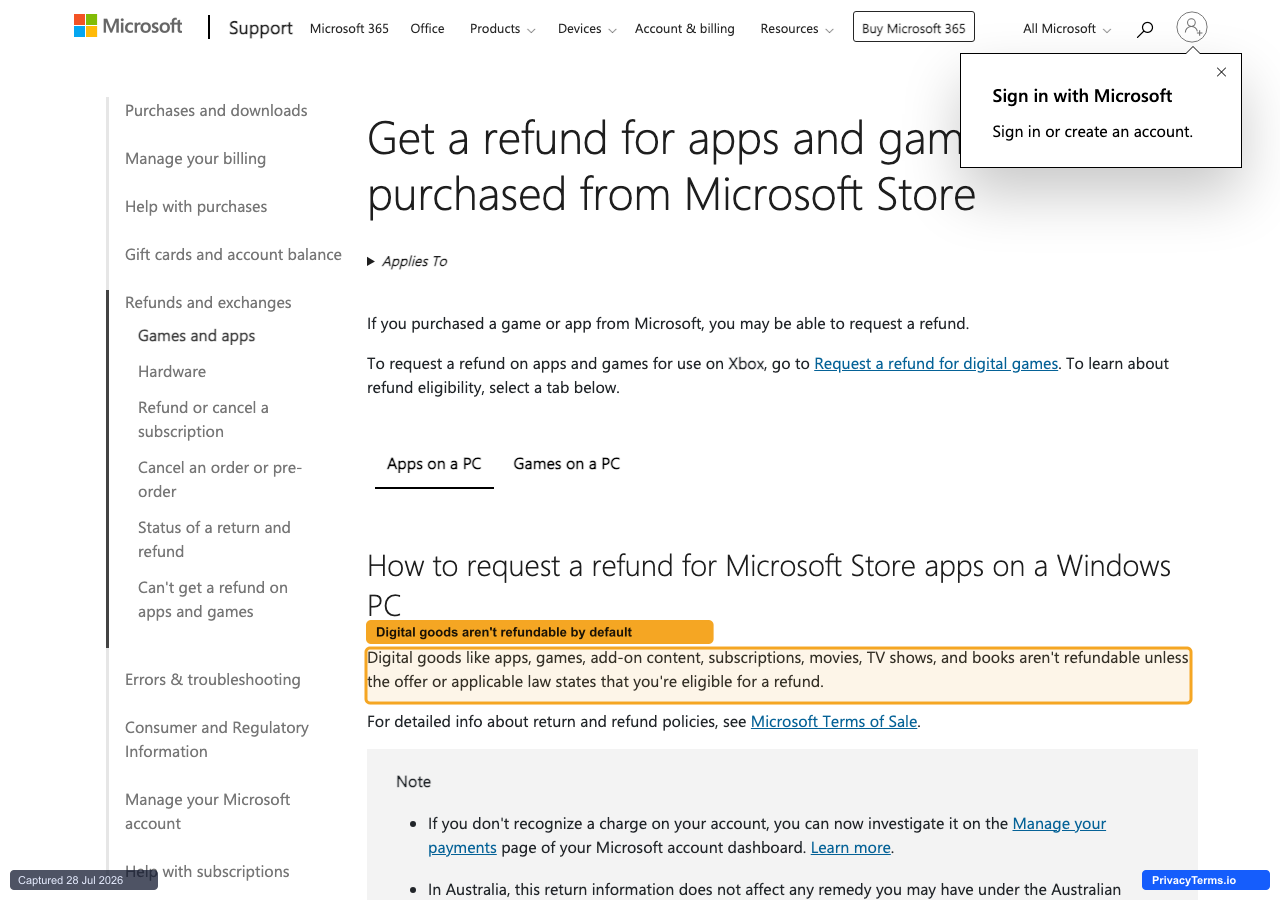
Microsoft's "Get a refund for apps and games" support page
Microsoft’s refund page leads with the harder truth most digital storefronts bury: “digital goods like apps, games, add-on content, subscriptions, movies, TV shows, and books aren’t refundable unless the offer or applicable law states that you’re eligible for a refund,” stated as the default rather than an exception found in a linked terms page. The 14-day window that follows is framed as the specific carve-out to that default, not a guarantee, and is paired with its own condition: an app or game should not have been used for more than a couple of hours across every account tied to the purchase. Separating “cancel a subscription going forward” from “get a refund for a charge already made” into two different linked flows, rather than one blended “refunds and cancellations” page, is the detail worth studying: a subscription business that blurs those two actions into one clause leaves a customer unsure which one they actually asked for.
The Common Threads
Strip away how generous or strict each policy reads and the same handful of habits show up across all twelve: the timeframe is a stated number or an explicitly named exception to having one, conditions are specific enough that a shopper knows before they ship something back whether it qualifies, and the refund method, cash to the original card, store credit, or a repair-first path, is named rather than left for the customer to discover after the fact. None of that requires a generous policy. A strict, clearly stated 15-day window with named conditions creates fewer disputes than a vague “extended returns available” that turns out to have caveats nobody read.
If you are writing or rewriting your own refund policy, start from those three specifics, timeframe, conditions, and refund method, rather than copying any single example’s generosity level. A refund policy generated for your specific business makes it straightforward to state all three clearly instead of reusing boilerplate that leaves the actual numbers vague.
Frequently Asked Questions
Does a longer return window actually cause more chargebacks, not fewer?
Not on its own. The dispute driver is ambiguity and friction, not window length: a 15-day policy that clearly states its conditions produces fewer chargebacks than a 90-day policy that is vague about what qualifies. Several retailers above run short windows successfully by pairing them with explicit per-category conditions instead of a longer, vaguer promise.
Should a refund policy state the refund method, or is “you’ll be refunded” enough?
State it. A refund to store credit versus the original payment method is a materially different outcome for the customer, and not stating which one applies, or at what point the option changes, is one of the more common triggers for a customer to dispute the charge with their bank instead of waiting to see what actually posts to their account.
Do digital or subscription products need a different refund policy than physical goods?
Yes. Physical condition and shipping are irrelevant to software or subscriptions, so the policy needs its own logic: a stated window tied to the charge date rather than a ship date, and a clear separation between canceling future billing and refunding a charge already made, the distinction Microsoft’s page above makes explicitly.