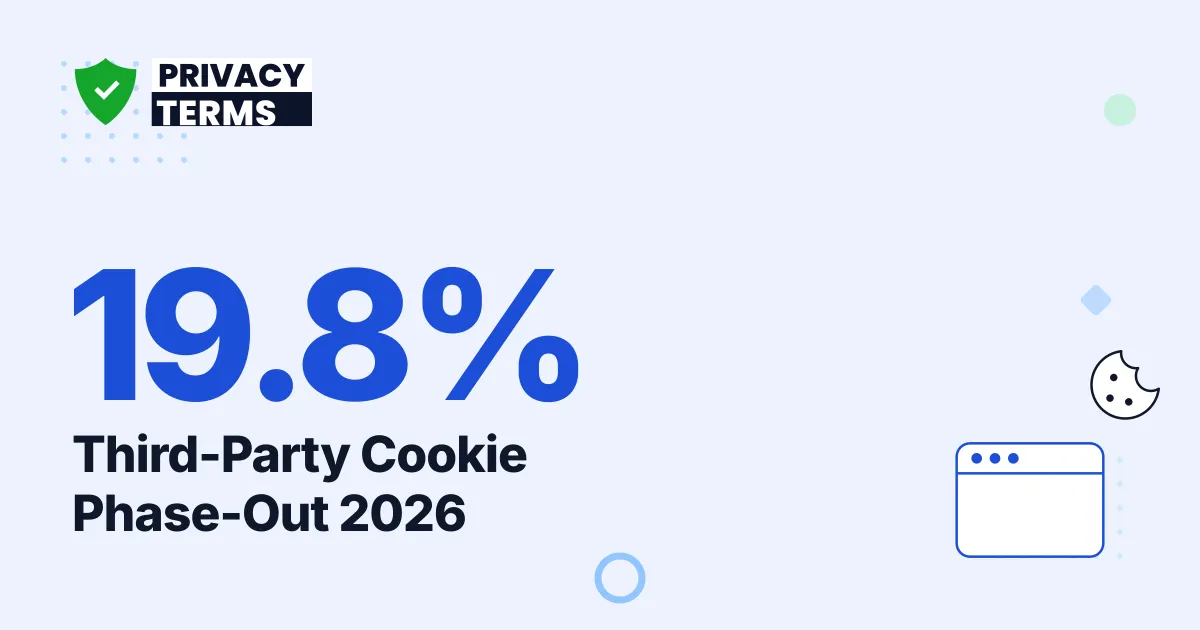
Only 19.8% of global browser traffic runs on a browser that blocks third-party cookies by default in 2026, according to StatCounter Global Stats for July 2026. That figure combines Safari's 16.47% global share with Firefox's 3.34%, while Chrome and Edge, a combined 73.59% of all browser traffic, keep third-party cookies switched on after Google's repeated reversals.
The gap between "browsers that block tracking cookies" and "browsers people actually use" is the real story of the third-party cookie phase-out. Google spent six years promising to close that gap in Chrome, the browser that decides the outcome for the majority of the web, and then walked the promise back twice. Below is the current browser-by-browser breakdown, the full timeline of Chrome's reversal, and how much of the ad industry actually adopted the replacement technology before Google retired it.
How many browsers block third-party cookies by default right now?
Two browsers do the blocking, and neither is the market leader. Apple's Safari has blocked all third-party cookies by default since Safari 13.1 in 2020, with no setting that lets a site or an app turn that protection back on; only the person using the browser can loosen it. Mozilla's Firefox blocks cookies from known trackers by default through Enhanced Tracking Protection and, since 2022, isolates every other third-party cookie to the site that set it through Total Cookie Protection, so a cookie set on one site cannot follow a visitor to the next one even when it is not blocked outright.
| Browser | Global market share (Jul 2026) | Blocks third-party cookies by default |
|---|---|---|
| Chrome | 68.22% | No |
| Safari | 16.47% | Yes |
| Edge | 5.37% | No |
| Firefox | 3.34% | Blocks trackers, isolates the rest |
| Samsung Internet | 2.06% | No |
| Opera | 1.88% | No |
| Safari + Firefox combined | 19.81% | Yes (default blocking share) |
Figure 1: Global browser market share by browser, July 2026. Source: StatCounter Global Stats.
Chromium-based browsers dominate the traffic that still allows third-party cookies. Chrome, Edge, Samsung Internet, and Opera are all built on the Chromium engine and, apart from Chrome's now-abandoned Privacy Sandbox effort, none of them blocks third-party cookies by default. Brave is the notable exception: it runs on Chromium but ships with Brave Shields blocking third-party cookies, cross-site trackers, and ad trackers from the first launch, though its individual line-item share in StatCounter's July 2026 breakdown falls below the browsers listed above.
Why did Google abandon Chrome's third-party cookie deprecation plan?
Google announced the plan to phase out third-party cookies in Chrome on January 14, 2020, in a Chromium Blog post titled "Building a more private web," targeting full removal within two years. That deadline never held.
Figure 2: Chrome's third-party cookie phase-out timeline, six years of delays and reversals. Source: Chromium Blog (2020), Google Privacy Sandbox blog (2024, 2025).
The delays tracked regulatory pressure as much as technical readiness. The UK Competition and Markets Authority pushed for evidence that Privacy Sandbox would not entrench Chrome and Google Ads at the expense of rival ad tech, and Google's own February 2024 test, disabling cookies for 1% of Chrome users, ran into industry pushback over broken login flows and measurement gaps. On July 22, 2024, Google published "A new path for Privacy Sandbox on the web," dropping the deprecation plan entirely in favor of a browser-level prompt that would let people choose their own cookie setting. On April 22, 2025, in a post titled "Next steps for Privacy Sandbox and tracking protections in Chrome," Google confirmed it would not build that prompt either, leaving Chrome's existing cookie controls, and third-party cookies, in place with no further deprecation timeline. If your site still needs to disclose exactly what tracking cookies it sets and why, you can generate a privacy policy that covers cookie categories, consent, and third-party data sharing without guessing at Chrome's next move.
What happened to the Privacy Sandbox APIs that were supposed to replace cookies?
Privacy Sandbox was Google's proposed replacement for third-party cookie tracking: a set of browser-native APIs, Topics, Protected Audience, and Attribution Reporting among them, meant to support interest-based ads and ad measurement without cross-site identifiers. On October 17, 2025, Google published "Update on Plans for Privacy Sandbox Technologies," announcing it would retire ten of these technologies, including all three flagship APIs, citing low industry adoption after roughly six years of development.
Figure 3: How a visitor's browser determines third-party cookie behavior in 2026. Source: WebKit Blog, Mozilla Support, Brave documentation, StatCounter Global Stats.
Only three narrower technologies survived the October 2025 retirement: CHIPS (partitioned first-party cookies for embedded services), FedCM (federated sign-in), and Private State Tokens (anti-fraud signals). Chrome began deprecating the retired APIs in January 2026, with removal proceeding through the year, according to trade press covering the Chrome release schedule. For a site owner, the practical effect is that no browser-native replacement for third-party cookie tracking now exists in Chrome; sites that built ad measurement around Privacy Sandbox APIs are migrating back to first-party data and server-side approaches instead.
How much did advertisers and publishers actually adopt Privacy Sandbox?
Adoption never came close to matching the ad industry's exposure to Chrome. A 2026 study by researchers Yohan Beugin, Paul Barford, and Patrick McDaniel, measuring the CrUX top 100,000 websites across Chrome Telemetry and HTTP Archive data from March 2021 through April 2026, found that the Attribution Reporting API peaked at 23.1% of page loads, the Topics API peaked at 14%, and the Protected Audience API peaked at just 5.7%. Adoption across all three "largely stabilized" by the third quarter of 2024, more than a year before Google retired the APIs, and never climbed higher.
Figure 4: Peak Privacy Sandbox API adoption among the top 100,000 websites, by API. Source: Beugin, Barford, and McDaniel, "Lessons from the Adoption and Deprecation of the Privacy Sandbox Web APIs" (2026).
The IAB Tech Lab reached a similar conclusion from the industry side. In a February 6, 2024 report compiled by senior technical staff from more than 65 companies over six months, the group found that Privacy Sandbox provided "discrete components that support aspects of use cases, but which ultimately cannot be assembled into a whole that provides a viable business foundation," pointing to gaps such as event-based metrics being only temporarily supported and bid-loss analysis being effectively impossible under the APIs as designed. Low adoption and unresolved capability gaps, reported by the industry's own working group more than a year and a half before the October 2025 retirement, line up with what the CrUX-scale measurement later confirmed.
Where do browsers stand on blocking versus market share?
Figure 5: Illustrative positioning of six browsers by global market share and default cookie-blocking policy. Source: StatCounter Global Stats (July 2026), WebKit Blog, Mozilla Support, Brave documentation.
The chart makes the imbalance visible: the only browser in the high-blocking, high-reach quadrant is Safari, and it got there through Apple's device ecosystem rather than through any coordinated industry standard. Every Chromium-based browser except Brave sits in the allows-by-default band, and Brave's strict blocking comes paired with a market share still measured in fractions of a percent.
Is the ad industry actually ready for a cookieless future anyway?
Despite Chrome keeping third-party cookies alive, a large share of the industry has already moved on. ID5's 2024 State of Digital Identity Report, based on 202 respondents spanning advertisers, publishers, and ad tech platforms worldwide, found that 76% had already adopted a cookieless targeting alternative and another 15% were planning to, leaving only 9% with no plan in place as of the report's October 2024 publication.
Figure 6: Ad industry adoption of cookieless targeting alternatives, late 2024. Source: ID5, 2024 State of Digital Identity Report.
IAB Europe's February 2024 survey of more than 160 European industry professionals told a more cautious story: 51% felt prepared for cookie deprecation and 34% did not, even though 76% acknowledged their business relied on third-party cookies at the time. Read together, the two surveys suggest the industry treated cookie deprecation as inevitable and began building alternatives years ahead of Chrome's actual timeline, then kept those alternatives in place even after Google reversed course, since Safari and Firefox already forced the issue on nearly a fifth of global traffic regardless of what Chrome did.
The Bottom Line
Third-party cookies are not going away in the browser that carries most of the web's traffic, and Google's proposed replacement is now largely dead. What changed permanently is the composition of the web: 19.8% of global traffic already runs cookieless by default, that share sits entirely outside Chrome's control, and Safari alone (16.47% of global traffic) has enforced full blocking since 2020 regardless of anything Google decided. A site that only ever built its tracking and consent flows around Chrome's now-abandoned timeline has spent years planning for the wrong browser. The practical move for any site owner is the same one 76% of the ad industry already made: treat first-party consent and disclosure as the baseline, not a contingency, since a clear cookie policy and privacy disclosure now matters on Safari and Firefox with or without whatever Chrome does next.
Frequently Asked Questions
What percentage of browsers block third-party cookies by default in 2026? About 19.8% of global browser traffic runs on a browser that blocks third-party cookies by default as of July 2026, per StatCounter Global Stats, combining Safari's 16.47% share and Firefox's 3.34% share. Chrome (68.22%) and Microsoft Edge (5.37%), a combined 73.59% of global traffic, still allow third-party cookies by default.
Did Google ever actually remove third-party cookies from Chrome? No. Google first announced plans to phase out third-party cookies in Chrome in January 2020, targeting full removal within two years, then delayed the deadline repeatedly before confirming on April 22, 2025 that it would keep third-party cookies enabled in Chrome indefinitely, dropping even the user-choice prompt it had proposed a year earlier.
What happened to Google's Privacy Sandbox? Google retired most Privacy Sandbox technologies, including the Topics API, Protected Audience API, and Attribution Reporting API, on October 17, 2025, after roughly six years of development. Chrome began deprecating the retired APIs in January 2026, with only CHIPS, FedCM, and Private State Tokens remaining in place.
How widely did advertisers and publishers adopt the Privacy Sandbox APIs? Adoption never reached even a quarter of sites. Among the CrUX top 100,000 websites, Attribution Reporting peaked at 23.1% of page loads, Topics API peaked at 14%, and Protected Audience API peaked at 5.7%, according to a 2026 academic study by Beugin, Barford, and McDaniel, with adoption stabilizing by Q3 2024 and never climbing further before Google's retirement announcement.
For a wider view of how consent requirements interact with browser-level cookie policy, see Cookie Consent Statistics 2026, which covers consent banner rates and compliance costs across the same period.
Where the Numbers Come From
- StatCounter Global Stats. (2026). "Browser Market Share Worldwide." Chrome 68.22%, Safari 16.47%, Edge 5.37%, Firefox 3.34%, Samsung Internet 2.06%, Opera 1.88%, July 2026.
- Chromium Blog. (2020). "Building a More Private Web: A Path Towards Making Third Party Cookies Obsolete." Original phase-out announcement, 14 January 2020.
- Google Privacy Sandbox. (2024). "A New Path for Privacy Sandbox on the Web." Deprecation plan dropped in favor of a user-choice prompt, 22 July 2024.
- Google Privacy Sandbox. (2025). "Next Steps for Privacy Sandbox and Tracking Protections in Chrome." Confirms no new cookie prompt, 22 April 2025.
- Google Privacy Sandbox. (2025). "Update on Plans for Privacy Sandbox Technologies." Retirement of Topics, Protected Audience, Attribution Reporting, and seven other APIs, 17 October 2025.
- WebKit Blog. (2020). "Full Third-Party Cookie Blocking and More." Safari ITP default blocking behavior, Safari 13.1.
- Mozilla Support. "Enhanced Tracking Protection in Firefox for Desktop." Default Standard-mode blocking and Total Cookie Protection behavior.
- Beugin, Y., Barford, P., and McDaniel, P. (2026). "Lessons from the Adoption and Deprecation of the Privacy Sandbox Web APIs." CrUX top 100,000 sites, Chrome Telemetry and HTTP Archive data, March 2021 to April 2026.
- ID5. (2024). "2024 State of Digital Identity Report." 202 respondents, advertisers, publishers, and ad tech platforms worldwide, published 31 October 2024.
- IAB Europe. (2024). "Report on the Digital Advertising Industry's Readiness for the Post Third-Party Cookie Era." Over 160 European industry professionals, published 22 February 2024.
- IAB Tech Lab. (2024). "In-Depth Analysis of Google's Privacy Sandbox for Public Comment." Compiled with senior staff from over 65 companies over six months, published 6 February 2024.
Note: All figures verified as of August 2026. Browser market share moves month to month; check StatCounter's live dashboard for the current figure before citing this page's percentages as current beyond a few months. Chrome's Privacy Sandbox retirement was still rolling out through Chrome's release schedule at the time of writing and this post will be refreshed as removal completes.