On July 6, 2026, the Supreme Court declined to block Texas's App Store Accountability Act, also known as SB 2420, clearing the state to keep enforcing its age-verification and parental-consent requirements on app stores while the underlying legal challenge continues. In a pair of brief, unsigned orders with no public dissents, the justices turned down requests from two separate sets of challengers to reinstate a federal judge's order that had blocked the law.
The two challengers were Students Engaged in Advancing Texas, a group of student policy activists, and the Computer & Communications Industry Association, a trade group representing app stores and app developers including Apple and Google. Both had asked the Court to vacate a Fifth Circuit stay that let SB 2420 take effect after a lower court blocked it. The Court's refusal means the law stays enforceable, at least for now, and both cases move to the Fifth Circuit for a fuller hearing on the merits.
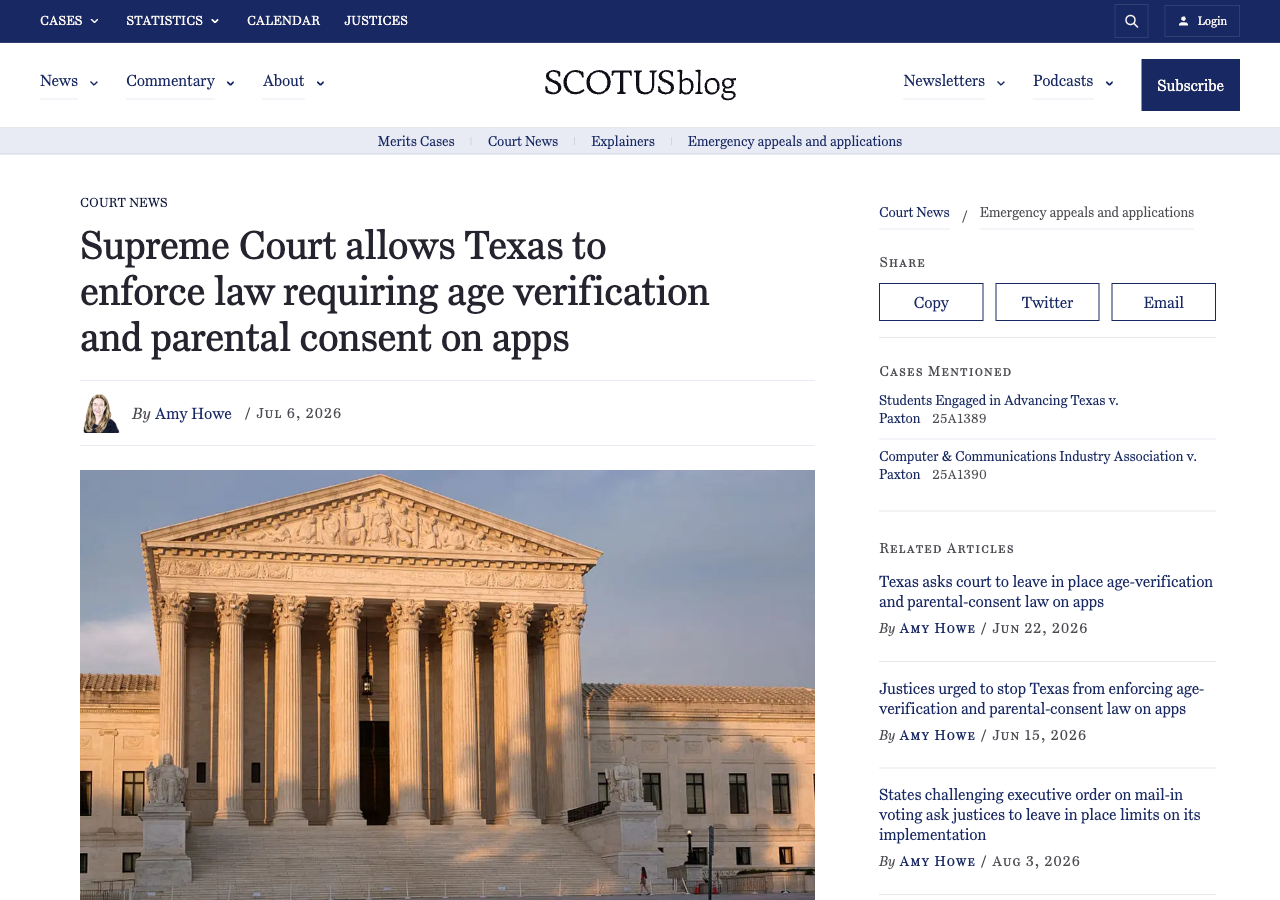
Source: SCOTUSblog, captured August 4, 2026.
How the case got here
SB 2420 was originally set to take effect January 1, 2026. Students Engaged in Advancing Texas sued in federal court the previous October to block it, and CCIA filed a similar challenge the same day, both arguing the law violates the First Amendment. U.S. District Judge Robert Pitman, sitting in Austin, agreed in December and temporarily blocked the state from enforcing the law.
That injunction did not last. The U.S. Court of Appeals for the Fifth Circuit put Pitman's order on hold in June 2026, which put SB 2420 back into effect and prompted both sets of challengers to ask the Supreme Court for emergency relief days later. Texas countered that the law regulates commercial transactions, not speech, comparing it to age restrictions on driver's licenses, and that the Fifth Circuit was right to apply a more permissive constitutional test than the one Pitman used. The Court's July 6 orders sided with Texas procedurally without ruling on any of that reasoning. CCIA has said it expects an expedited hearing before the Fifth Circuit on the First Amendment merits in early August, so this month's argument, not the emergency orders, is where the substantive fight actually happens.
What SB 2420 actually requires
The mechanics matter more than the litigation history for anyone running an app that reaches Texas users, because SB 2420 does not just ask app stores to check a birthdate once. It requires app stores, using what the statute calls a commercially reasonable method, to sort every user into one of four age categories: child (under 13), younger teenager (13-15), older teenager (16-17), and adult (18 or older).
Once a user is categorized, the app store has to make that age category, along with whether parental consent has been obtained, available to app developers through commercially available methods. Developers are also supposed to be notified when a parent revokes consent. For any download or in-app purchase involving a minor, consent has to be obtained separately each time; blanket, one-time parental approval does not satisfy the law. Parents have to be shown the app's content rating, the elements that produced that rating, what personal data the app collects, and what safeguards the developer has in place, and updated consent is required whenever a developer makes a material change. Violations are treated as deceptive trade practices under Texas law, which gives the state attorney general grounds to seek injunctions and civil penalties.
What this means for your privacy policy
The part of SB 2420 that touches privacy disclosures directly is the data flow between the app store and the developer. If your app is distributed through an app store operating under this law, you may start receiving a user's age category and consent status as structured data from the platform itself, not just self-reported. That is personal data your business is now processing, and it did not come from your own signup form.
A privacy policy that describes only the data your app collects directly from users, without mentioning data your app store passes to you (age category, parental consent status, consent-revocation notices) has a real gap the moment SB 2420 applies to your distribution channel. The same is true for the safeguards disclosure Texas requires parents to see before consenting: whatever you tell a parent about how you protect a minor's data during the consent flow has to match what your privacy policy says elsewhere, or you have created two inconsistent public statements about the same practice.
| Consideration | Before SB 2420 | Under SB 2420 (Texas users) |
|---|---|---|
| Age signal | Self-reported at signup, if collected at all | Structured age category assigned by the app store |
| Consent record | Handled entirely by the developer | Shared consent/revocation status from the app store |
| Disclosure needed to parents | Not standardized | Content rating, rating basis, data collected, safeguards |
| Update trigger | Developer's own change-management process | Material changes require renewed parental consent |
The bottom line
Nothing about the July 6 order resolves whether SB 2420 survives the First Amendment challenge; that question now goes to the Fifth Circuit. What it does resolve, for now, is that the law is live, and any business whose app reaches Texas users through Apple's or Google's app stores should assume the age-category and consent data flows described above are already running. If your privacy policy does not yet account for data your app store hands you about a user's age bracket or parental consent status, that is a disclosure gap worth closing before it becomes someone else's discovery request. Our Privacy Policy Generator helps you document exactly what data your app receives and from which sources, including third-party platforms, so your public disclosures keep pace with what your distribution channel is actually sending you.
The information in this article is for informational purposes only and should not be construed as legal advice on any matter, and does not create a lawyer-client relationship.