Three states passed AI chatbot laws this year, and only two of them are actually binding anyone right now. Tennessee's SB 1580 took effect July 1, 2026, banning AI systems from advertising themselves as licensed mental health professionals. Hawaii's SB 3001 became Act 248 when Governor Josh Green signed it on July 14, 2026, requiring AI companion services to disclose they are not human and to add minor-safety protocols. Washington's HB 2225, the Chatbot Disclosure Act, was signed back in March, but it does not bind anyone until January 1, 2027, five months from now.
That gap matters if you are trying to figure out what actually applies to a chatbot on your site today. A headline that lumps all three states together as "now in effect" gets one of them wrong, and the three laws are not even doing the same thing: Tennessee bans a specific kind of impersonation, Hawaii mandates an ongoing disclosure and a set of minor-safety behaviors, and Washington, once it does bind anyone, mandates a disclosure closer to Hawaii's than to Tennessee's.
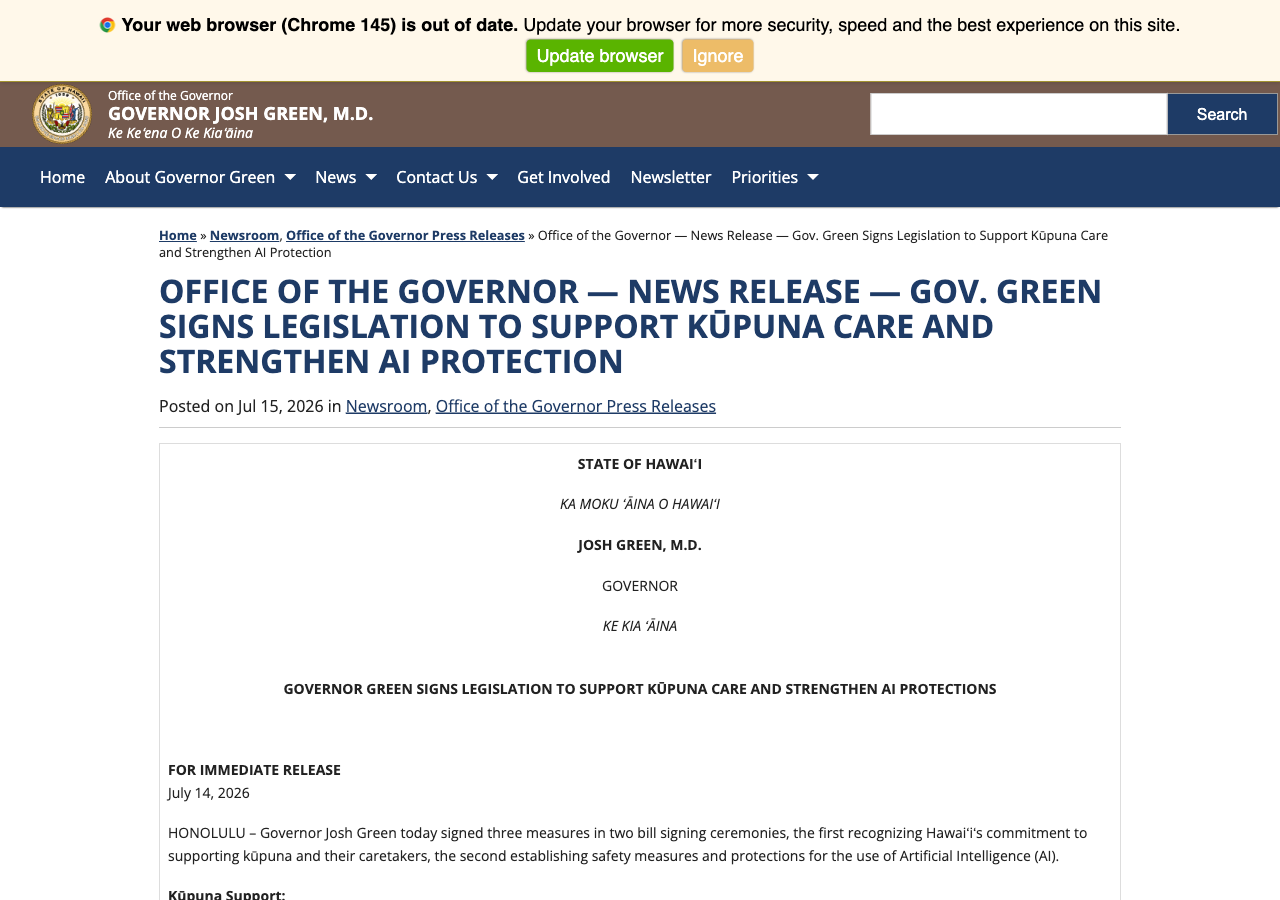
Source: Office of Governor Josh Green, "Governor Green Signs Legislation to Support Kupuna Care and Strengthen AI Protections," captured August 2026.
What each law actually requires
Tennessee's SB 1580, signed by Governor Bill Lee on April 1, 2026 and passed unanimously in both chambers, does not require a general "you are talking to AI" notice. It prohibits any person who develops or deploys an AI system from advertising or representing that the system is, or can act as, a qualified mental health professional, a term the law borrows from Tennessee's existing licensing statute covering psychiatrists, psychologists, social workers, and marriage and family therapists. According to Troutman Pepper's coverage of the bill, it is enforced through the Tennessee Consumer Protection Act of 1977, which gives individuals a private right of action and sets civil penalties up to $5,000 per violation.
Hawaii's SB 3001, now Act 248, is broader. It requires operators of AI companion services to issue a clear and conspicuous notification that a user is talking to artificial intelligence, not a human, whenever a reasonable person could otherwise believe they were talking to a person. Minors get stricter treatment: either a persistent, always-visible disclaimer, or a disclosure at the start of each session repeated at least every three hours during an extended conversation. The law also bans manipulative engagement techniques built to create emotional dependency, bars sexually explicit content aimed at minors, and requires operators to route conversations touching suicidal ideation or self-harm toward crisis resources. Hawaii's Attorney General and Office of Consumer Protection enforce it as an unfair or deceptive trade practice, with penalties up to $1,000 per violation capped at $1,000,000 per operator, according to WTL Governance's analysis of the enacted text. A separate annual-reporting obligation to the state's Behavioral Health Administration does not start until January 1, 2028, so that piece is not live yet even though the disclosure requirement is.
Washington's HB 2225 covers the same basic ground as Hawaii's law, once it takes effect. It requires companion chatbot operators to disclose that users are interacting with an automated system at the start of an interaction and again every three hours of continued use, with added protections when an operator knows or should know it is talking to a minor. Consumers can sue under Washington's Consumer Protection Act for actual damages plus discretionary treble damages capped at $25,000, per the National Law Review's summary of the signed bill. Governor Bob Ferguson signed it March 24, 2026, but the legislature built in a runway: nothing in it binds anyone until January 1, 2027.
Figure: Maximum monetary exposure per violation under each law's enforcement mechanism, in dollars. Hawaii's penalty is set by statute and capped at $1 million total per operator; Tennessee's is a Consumer Protection Act civil penalty; Washington's is a discretionary treble-damages ceiling under its own Consumer Protection Act, and does not apply to anyone until January 1, 2027. Source: Troutman Pepper, WTL Governance, National Law Review.
| Tennessee SB 1580 | Hawaii SB 3001 (Act 248) | Washington HB 2225 | |
|---|---|---|---|
| Signed | April 1, 2026 | July 14, 2026 | March 24, 2026 |
| Effective | July 1, 2026 | July 14, 2026 | January 1, 2027 |
| What it requires | Bans claiming to be a licensed mental health professional | Disclose AI is not human, plus minor-safety rules | Disclose AI is not human, plus minor-safety rules |
| Applies to | Any AI system, broadly | AI "companion" services | AI "companion" chatbots |
| Private right of action | Yes, under TN Consumer Protection Act | No, AG and Office of Consumer Protection only | Yes, under WA Consumer Protection Act |
| Max penalty | $5,000 per violation | $1,000 per violation, $1M cap per operator | Treble damages up to $25,000 |
Why the "not human" disclosure matters more than the deadline
Set the effective dates aside for a moment and look at what Hawaii and Washington are both actually asking for once their laws bind someone: an unambiguous statement, delivered at the point of interaction and repeated on a schedule, that the thing a visitor is talking to is software. That is a narrower ask than a general AI-use disclaimer, but it is also a more specific one. A line buried in a privacy policy that says "we may use artificial intelligence in our services" does not satisfy either law's actual mechanism, which requires the notice to appear where the interaction happens, not in a separate document a user has to go find.
Tennessee's law works differently and is easy to conflate with the other two because it also involves an AI system talking to someone. It is not a disclosure mandate at all. It is a prohibition on a specific claim, that the system is a licensed mental health professional, and it reaches any AI system making that claim, not just companion chatbots. A support widget or wellness app that lets its AI describe itself as a "therapist" or "counselor" is the exposure here, regardless of whether it also discloses it is AI somewhere else on the page.
What this means if you run a chatbot on your site
If your business operates in Hawaii, or your chatbot is reachable by Hawaii residents, and a reasonable user could mistake it for a human, Act 248 is binding on you today. The practical fix is a clear, visible statement at the start of the interaction, not a buried disclaimer link, plus a repeated reminder if conversations run long, and a written escalation path for anything resembling a mental health crisis.
If you are in Washington, you have a real runway, not an emergency. HB 2225 does not bind anyone until January 1, 2027, so there is time to build the disclosure and minor-safety mechanics properly rather than bolting on a rushed banner in the next few weeks. That said, the requirement itself will not change between now and then, so building it once to match Hawaii's near-identical language is not wasted work.
If your product uses AI in any customer-facing role and you describe it, anywhere, in a way that could suggest it is a licensed professional (a "therapist," a "counselor," a "financial advisor"), Tennessee's law is a reason to fix that language now, independent of where your business is based, since the prohibition is not limited to companion-chatbot products.
Bottom Line
None of these three laws are optional reading for anyone running an AI chatbot, support widget, or companion product that can be reached from Tennessee, Hawaii, or Washington. Tennessee's ban on AI claiming to be a licensed mental health professional has been enforceable since July 1, 2026. Hawaii's disclosure and minor-safety mandate has been enforceable since July 14, 2026. Washington's near-identical mandate is signed into law but does not bind anyone until January 1, 2027, so treat that one as a deadline to plan around, not one that is already past.
Our Disclaimer Generator includes AI-use and chatbot disclosure language you can add to your site now, so the "this is AI, not a human" notice these laws require is already in place before the next state's deadline arrives.
The information in this article is for informational purposes only and should not be construed as legal advice on any matter, and does not create a lawyer-client relationship.