All 4 of the world’s most-cited privacy laws GDPR, LGPD, PIPL and CCPA/CPRA now require some version of the same four core protections: a breach-notification clock, an accountability officer or equivalent audit obligation, limits on consent, and a fine that scales with company revenue. What differs is the specific number attached to each rule, and in several cases that number varies by a factor of ten or more between laws.
That is the convergence this comparison tests directly: not a vague claim that privacy law is becoming universal, but a provision-by-provision check of four specific, named requirements across four real statutes, each cited to its own article number and effective date. It follows directly from two patterns this cluster has already covered: how far each of these laws reaches outside its own borders, and GDPR’s own eight-year enforcement record, which shows what happens once a law with these provisions actually gets enforced at scale.
How does breach notification compare across the four laws?
GDPR sets the tightest fixed clock: 72 hours from the moment a controller becomes aware of a qualifying breach, under Article 33. Brazil’s LGPD, under a 2024 regulation from its national authority ANPD, requires a preliminary notification within 3 business days, a deadline doubled for small-size data processing agents, with a supplementary notification allowed once more facts are known. China’s PIPL requires immediate remedial measures and notification under Article 57, without stating a fixed number of hours or days the way GDPR and LGPD both do. CCPA has no dedicated breach-notification deadline written into the privacy statute itself; that obligation instead falls to California’s separate breach-notification law, which requires notice “in the most expedient time possible and without unreasonable delay.”
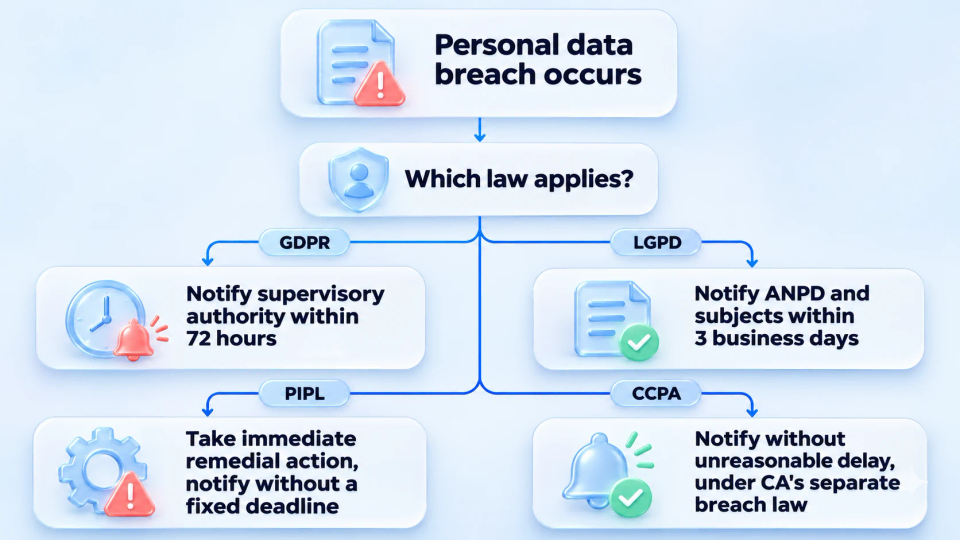
Figure 1: How the breach-notification clock differs across four major privacy laws. Source: GDPR Art 33, ANPD Resolution 15/2024, PIPL Art 57, Cal. Civ. Code 1798.82.
The practical gap is larger than the wording suggests. GDPR’s 72 hours is a hard calendar-hour deadline that includes weekends. LGPD’s 3 business days effectively runs longer in real time whenever a weekend or holiday falls inside the window, and doubles again for smaller processors. A compliance program built to satisfy GDPR’s 72-hour rule will comfortably clear LGPD’s deadline too, but assuming LGPD’s flexibility mirrors PIPL’s or CCPA’s would be a mistake, since neither of those two states a fixed number at all.
Do all four laws require a data protection officer?
No, and this is where the four laws diverge the most sharply in structure, not just in threshold size. GDPR requires a DPO only when the controller is a public authority, engages in large-scale systematic monitoring, or processes special-category data at scale, under Article 37, meaning most small and mid-size businesses fall outside the requirement entirely. LGPD takes the opposite approach: Article 41 requires every controller to appoint an accountability officer (encarregado), with no size or revenue threshold at all. PIPL sits in between, requiring a Personal Information Protection Officer once a processor’s data crosses 1 million individuals, under the Measures for Personal Information Protection Compliance Audits that took effect 1 May 2025; a separate rule, the Network Data Security Management Regulation effective 1 January 2025, adds a further network-security-officer requirement at the higher threshold of 10 million individuals. CCPA and CPRA skip the DPO model altogether, instead requiring covered businesses, those over roughly $26 million in revenue and processing 250,000+ consumers’ data or 50,000+ consumers’ sensitive data, to complete annual independent cybersecurity audits and risk assessments, phased in on a staggered timeline from 2028 to 2030.
| Law | Officer requirement | Trigger threshold | Effective |
|---|---|---|---|
| GDPR | Data Protection Officer (Art 37) | Public authority, large-scale monitoring, or large-scale special-category processing | 2018 |
| LGPD | Encarregado (Art 41) | None, applies to every controller | 2020 |
| PIPL | Personal Information Protection Officer | 1,000,000+ individuals processed | May 2025 |
| CCPA/CPRA | No DPO; independent cybersecurity audit instead | Approx. $26M revenue AND 250,000+ consumers or 50,000+ sensitive-PI consumers | Phased 2028-2030 |
Figure 2: How strongly each of four privacy laws implements the same four core requirement categories, scored 0 (absent) to 3 (strong, unconditional). Source: statutory text of each law as cited throughout this post.
If your business operates across two or more of these jurisdictions, the officer question is one of the first gaps worth checking, since assuming GDPR’s conditional threshold satisfies LGPD’s unconditional one is a common and easily avoidable mistake. Generating a privacy policy that names the correct accountability contact for each jurisdiction you actually serve is a cleaner starting point than writing one policy to GDPR’s standard and hoping it reads correctly everywhere else. This site’s broader tracker of privacy laws by country is a useful starting point for checking which of these four laws, or others, actually apply to a given jurisdiction before diving into provision-level detail.
How do maximum fines compare as a share of company revenue?
Three of the four laws scale their maximum fine to a percentage of company turnover, which makes them directly comparable in a way CCPA’s flat-dollar structure is not. PIPL sets the highest ceiling, up to 5% of the violator’s prior-year global turnover for serious violations. GDPR’s top tier caps at 4% of global annual turnover, or EUR 20 million, whichever is higher. LGPD caps out lower still, at 2% of the violator’s revenue in Brazil specifically, not global revenue, subject to an overall ceiling of 50 million reais per violation. CCPA does not use a percentage-of-revenue model at all; its statute instead sets a flat civil penalty of up to $7,500 per intentional violation, enforced by the California Privacy Protection Agency, a structure that scales with the number of violations rather than company size.
Figure 3: Maximum fine as a percentage of turnover, for the three laws that use that model. CCPA is excluded here because it uses a flat per-violation penalty instead. Source: GDPR Art 83, PIPL Art 66, LGPD Art 52.
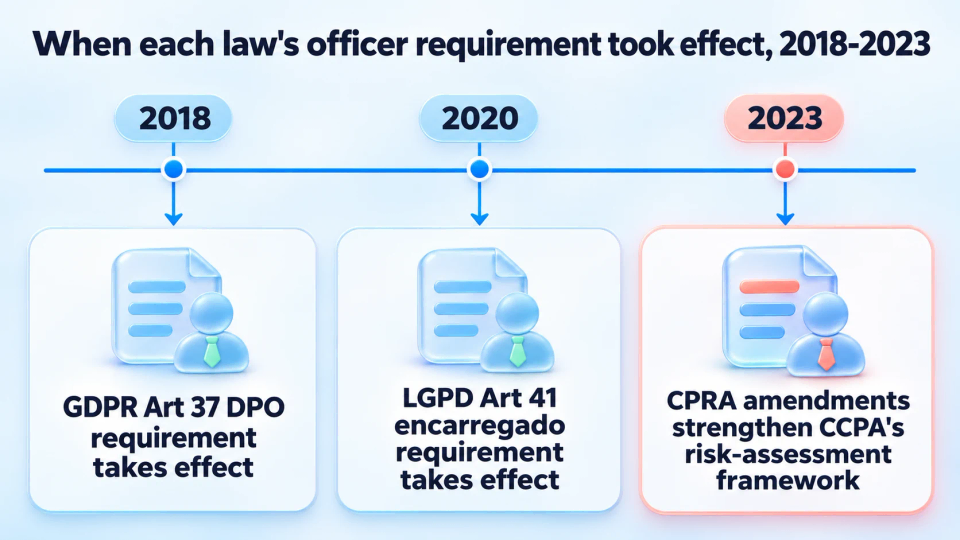
Figure 4: When each law’s accountability officer requirement became binding, 2018-2023. Source: official statute and regulation effective dates.
Figure 5: PIPL and CCPA’s newer audit and officer rules taking effect, 2025-2028. Source: official statute and regulation effective dates.
The Bottom Line
Privacy law convergence is real, but it is convergence on categories of rule, not on numbers. Every law compared here now expects a business to notify regulators of a breach within some defined window, to name someone accountable for data protection or submit to an independent audit, to limit what counts as valid consent, and to face a fine that scales with the size of the business. Treating any one law’s specific threshold as a universal safe harbor, assuming GDPR’s 72 hours covers LGPD, or that LGPD’s unconditional DPO rule covers PIPL’s 1-million-record threshold, is where most multi-jurisdiction compliance programs actually break down.
Frequently Asked Questions
Do GDPR, LGPD, PIPL and CCPA all require a data protection officer? Not identically. GDPR requires a DPO only for public authorities, large-scale systematic monitoring, or large-scale special-category processing (Article 37). LGPD requires an accountability officer for every controller with no threshold (Article 41). PIPL requires a Personal Information Protection Officer once processing crosses 1 million individuals, effective May 2025. CCPA/CPRA has no DPO title requirement at all, substituting mandatory independent cybersecurity audits and risk assessments above set thresholds, phased in from 2028.
How do breach notification deadlines compare across major privacy laws? GDPR gives controllers 72 hours to notify their supervisory authority. Brazil’s LGPD, under ANPD Resolution 15/2024, requires notification within 3 business days, doubled for small processors. China’s PIPL requires immediate remedial action and notification with no fixed hour figure. CCPA has no dedicated breach-notification deadline of its own; California’s separate breach law requires notice in the most expedient time possible without unreasonable delay.
Which of these laws has the highest maximum fine as a share of revenue? China’s PIPL, at up to 5% of the prior year’s annual turnover for serious violations. GDPR caps its highest tier at 4% of global annual turnover. Brazil’s LGPD caps fines at 2% of the violator’s revenue in Brazil, subject to an overall cap of 50 million reais per violation. CCPA uses a different structure entirely, a flat civil penalty of up to $7,500 per intentional violation rather than a percentage of revenue.
What does privacy law convergence actually mean if the numbers still differ this much? It means the four laws agree on which categories of rule matter, breach notice, an accountability function, consent limits, and revenue-scaled penalties, even though they disagree by as much as 10 times on the specific number attached to each one. A compliance program built around GDPR’s specific thresholds will miss real obligations under the other three laws rather than satisfy them by default.
Where the Numbers Come From
- ANPD via Machado Meyer. (2024). “CD/ANPD Resolution No. 15 of April 24, 2024.” LGPD’s 3-business-day breach notification deadline, doubled for small processors.
- Mayer Brown. (2025). “China Finalises the Measures for Personal Information Protection Compliance Audits.” PIPL’s 1-million-individual Personal Information Protection Officer threshold, effective 1 May 2025.
- DLA Piper Privacy Matters. (2024). “China: Enhanced and clarified data compliance obligations on handlers of network data.” Network Data Security Management Regulation’s 10-million-individual threshold, effective 1 January 2025.
- Ropes and Gray. (2026). “California’s CCPA Cybersecurity Audit Rule Takes Effect.” Revenue and consumer-count thresholds, phased certification deadlines from 2028 to 2030.
- GDPR.eu. GDPR Article 37 DPO trigger conditions and Article 83 fine tiers up to 4% of global turnover.
Note: All figures verified as of February 2026. PIPL’s compliance-audit and network-data-security thresholds were both new in this cycle (2025) and remain subject to further Cyberspace Administration of China guidance. Figures are refreshed at least twice a year to track new regulatory thresholds and amendments across all four laws.