California’s CCPA reaches any business worldwide once its global annual revenue crosses $26,625,000, with no requirement to have a single employee or office in California, according to the statute’s own inflation-adjusted 2025 threshold. That one number captures a pattern running through nearly every major privacy law passed since 2018: jurisdiction now follows the data subject, not the company’s mailing address.
The shift traces back to GDPR’s Article 3(2), which the European Data Protection Board’s territorial scope guidelines interpret broadly: an “offering of goods or services” or “monitoring of behavior” test with no revenue floor, no visitor-count minimum, and no requirement that the controller ever set foot in the EU. Every major privacy law written since has borrowed some version of that logic, though the specific trigger differs enough that a business compliant with one is not automatically compliant with the rest. That broad territorial test is also a big part of why GDPR’s enforcement record since 2018 includes fines against companies with no EU headquarters at all.
How does each major law define its extraterritorial reach?
Five of the six laws compared here use a version of GDPR’s “targeting” logic: does the business direct activity at people in this jurisdiction, regardless of where the business itself sits. The sixth, South Africa’s POPIA, uses an older and narrower “means” test inherited from pre-GDPR European law, which asks whether the responsible party is domiciled in South Africa or uses equipment or means located there, a standard that catches fewer foreign-only online businesses than a pure targeting test would.
| Law | Home jurisdiction | Extraterritorial trigger | Minimum threshold |
|---|---|---|---|
| GDPR | European Union, since 2018 | Offering goods/services to, or monitoring, EU data subjects (Art 3(2)) | None |
| CCPA/CPRA | California, since 2020 | $26.625M global revenue, OR 100,000+ CA residents’ data, OR 50%+ revenue from selling/sharing PI | Yes, one of three thresholds |
| LGPD | Brazil, since 2020 | Processing carried out in Brazil or related to individuals located there (Art 3) | None |
| PIPL | China, since 2021 | Processing outside China to offer products/services to, or analyze behavior of, people in China (Art 3) | None, but Art 53 requires a China-based representative |
A site that has only ever thought about GDPR compliance can still fall outside CCPA’s thresholds one year and inside them the next, since the revenue figure moves with inflation every two years while the 100,000-resident and 50%-revenue tests stay fixed. If your business collects data from visitors in multiple jurisdictions, generate a privacy policy that names every law that actually applies rather than defaulting to GDPR-only language, which is the most common gap this comparison turns up.
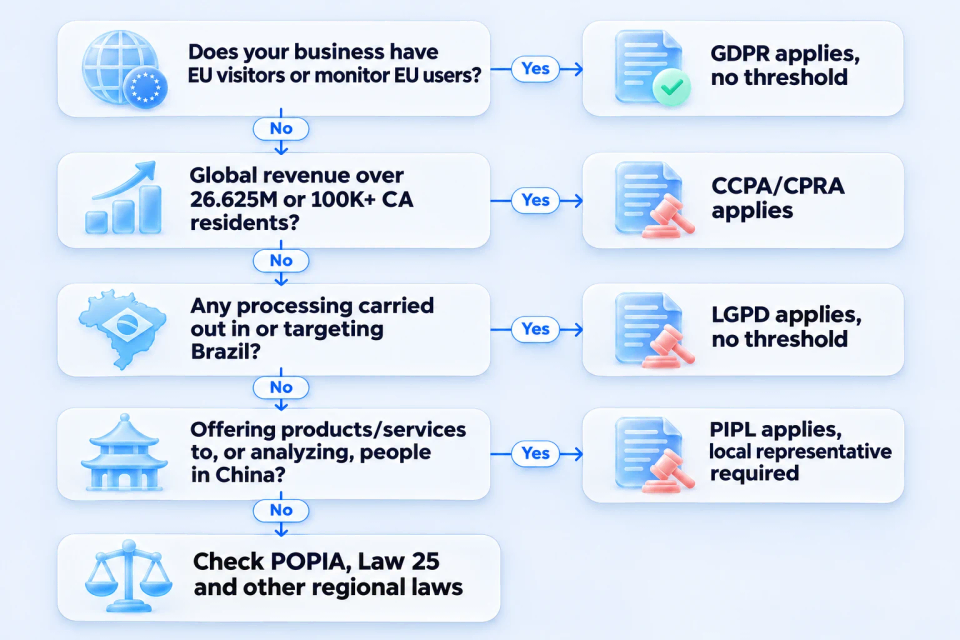
Figure 1: A simplified decision path through four major laws’ extraterritorial tests. Source: GDPR Art 3, CCPA statute, LGPD Art 3, PIPL Art 3 and 53.
How many countries actually have a data protection law in 2026?
71% of the 194 economies UNCTAD tracks in its Global Cyberlaw Tracker had enacted data protection and privacy legislation as of 2026, with another 9% showing draft legislation still moving through their legislatures and 15% showing no legislation at all. Europe leads every region at 96% coverage, which is unsurprising given GDPR’s role as the template most newer laws borrow structurally from, even where the extraterritorial trigger itself differs.
Figure 2: Data protection legislation status across 194 economies tracked by UNCTAD. Source: UNCTAD Global Cyberlaw Tracker, 2026.
That 71% figure undercounts how many of those laws actually reach outside their own borders, since not every enacted law includes an extraterritorial clause. This site’s own tracker of privacy laws by country lists 172 countries with a national privacy law, a slightly higher count than UNCTAD’s because it uses a different inclusion methodology; either way, DLA Piper’s Data Protection Laws of the World guide, tracking compliance requirements across more than 160 jurisdictions, remains the most complete practitioner reference for checking whether a specific country’s law includes an extraterritorial clause, since the answer varies enough by jurisdiction that no single rule of thumb holds.
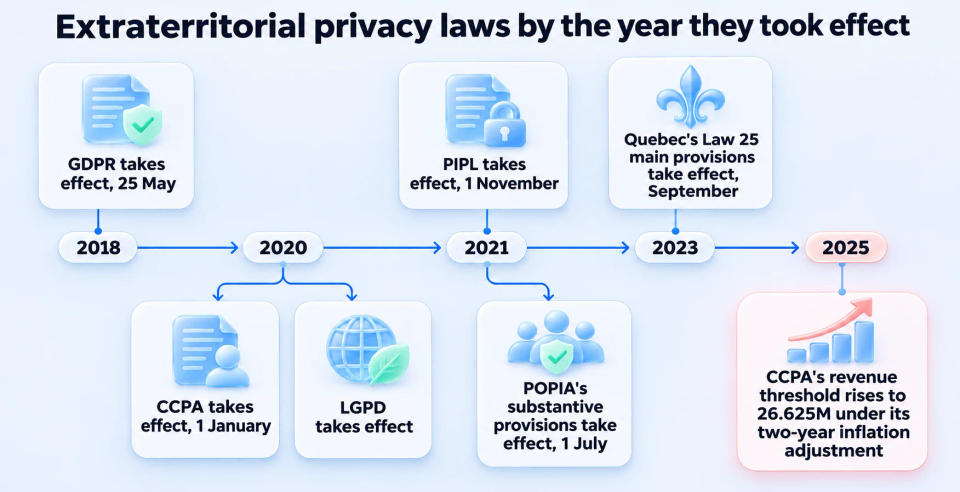
Figure 3: Six extraterritorial privacy laws, ordered by the year each took effect. Source: official statute effective dates.
Figure 4: How long each law has been in effect as of 2026. GDPR is the oldest at eight years; Quebec’s Law 25 the newest at three. Source: official statute effective dates.
Why does a “no threshold” law matter more than a high-threshold one?
A law with no minimum threshold, like GDPR, LGPD or PIPL, applies the moment a single qualifying interaction happens, which means a small business with one EU customer is technically as exposed as a multinational. A threshold-based law like CCPA only bites once a business crosses a specific revenue or volume line, which gives smaller operations real headroom that GDPR, LGPD and PIPL do not offer. The practical result is that a small e-commerce site serving a handful of EU and Brazilian customers can be in scope for GDPR and LGPD while comfortably under CCPA’s $26.625 million threshold, which is a common source of confusion when businesses assume “small” means “exempt everywhere.”
How aggressively each of these laws actually gets enforced against foreign-only businesses varies enormously in practice, a comparison this cluster’s companion post on which privacy law issues the largest fines will cover directly once it publishes.
The Bottom Line
Extraterritorial reach is no longer a GDPR-specific quirk; it is the default design of nearly every privacy law written since 2018. GDPR and LGPD apply with no threshold at all, PIPL adds a local-representative requirement on top of its own no-threshold test, CCPA gates its reach behind three alternative numeric thresholds, and POPIA sticks with an older, narrower “means” test that catches fewer purely foreign businesses. A privacy policy written only against one of these standards, most often GDPR, is the most common compliance gap this comparison surfaces, since it is easy to assume GDPR-style language automatically satisfies a CCPA, LGPD or PIPL reader.
Frequently Asked Questions
Does GDPR apply to a business with no office in the EU? Yes. Article 3(2) of GDPR applies to any controller or processor outside the EU that offers goods or services to people in the EU or monitors their behavior, with no revenue or visitor-count threshold at all, according to the European Data Protection Board’s territorial scope guidelines.
What is the CCPA’s revenue threshold for businesses outside California? As of January 1, 2025, a for-profit business anywhere in the world must comply with the CCPA once its global annual gross revenue exceeds $26,625,000, or it processes the personal information of 100,000 or more California residents or households, or it derives 50% or more of its annual revenue from selling or sharing personal information.
Do Brazil’s LGPD and China’s PIPL apply to companies with no local presence? Yes, both apply with no threshold. LGPD Article 3 covers any processing carried out in Brazil or related to individuals located in Brazil, regardless of where the controller is based. PIPL Article 3 covers processing outside China done to offer products or services to people in China or to analyze their behavior, and Article 53 requires the foreign company to appoint a China-based representative.
How many countries have a data protection law in 2026? 71% of the 194 economies tracked by UNCTAD’s Global Cyberlaw Tracker had data protection and privacy legislation enacted as of 2026, with a further 9% showing draft legislation. Europe has the highest coverage of any region, at 96% of countries.
Where the Numbers Come From
- Clym. (2026). “CCPA Applicability 2026: Does the Law Apply to You?” $26,625,000 global revenue threshold effective 1 January 2025, adjusted for inflation every two years by the California Privacy Protection Agency.
- GDPR.eu. GDPR Article 3(2) territorial scope: offering goods/services to, or monitoring the behavior of, EU data subjects, with no minimum threshold.
- UNCTAD. (2026). “Data protection and privacy legislation worldwide.” Global Cyberlaw Tracker: 71% of 194 economies with enacted legislation, 9% draft, 15% none, Europe at 96% regional coverage.
- DLA Piper. “Data Protection Laws of the World.” Practitioner guide covering compliance requirements across more than 160 jurisdictions.
- Mayer Brown. (2025). “China Finalises the Measures for Personal Information Protection Compliance Audits.” PIPL Article 53 local-representative requirement for foreign processors.
- ANPD via Machado Meyer. (2024). “CD/ANPD Resolution No. 15.” Confirms LGPD Article 3’s extraterritorial processing scope applied by Brazil’s national data protection authority.
Note: All figures verified as of February 2026. CCPA’s revenue threshold is scheduled for its next inflation adjustment on 1 January 2027; other statutory thresholds cited here have no scheduled adjustment. Figures are refreshed at least twice a year to track threshold updates and newly enacted extraterritorial provisions.