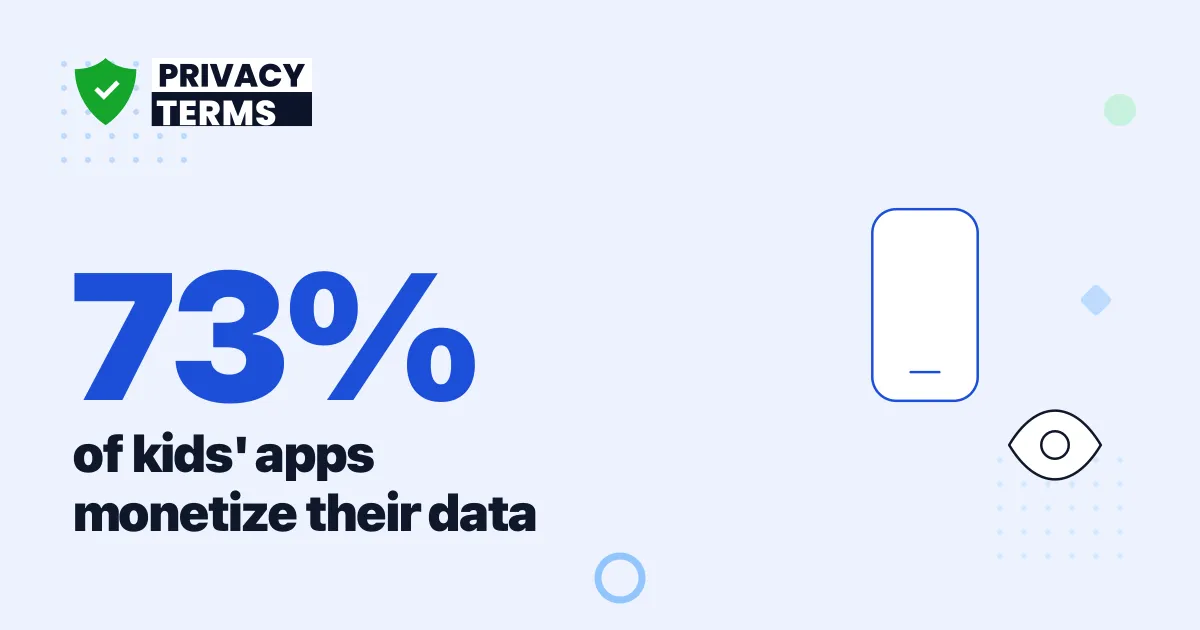
73% of the 200-plus popular children's apps Common Sense Media reviewed for its 2023 State of Kids' Privacy report monetize personal data in some way. That number matters because most parents never open the privacy policy that discloses it. Pew Research Center's 2019 survey of US adults found only 9% always read a privacy policy before agreeing to one, and separate surveys show real gaps in how closely parents track the apps their kids actually install. Below is what the survey and audit data actually show about children's app privacy, and how rarely anyone reads the policy behind it.
What percentage of kids' apps actually share or sell children's data?
73% of the more than 200 popular apps and online platforms Common Sense Media evaluated in its 2023 State of Kids' Privacy report were found to monetize kids' and families' personal information in some way, whether through behavioral tracking, ad-sharing, or data practices that meet California's CCPA/CPRA definition of "selling or sharing" data. The report's authors called the gap between what these apps say in their policies and what they actually do "unfair and deceptive to parents and caregivers."
| Survey | What it measured | Result | Sample |
|---|---|---|---|
| Common Sense Media (2023) | Kids' and family apps that monetize personal data | 73% | 200-plus apps and platforms |
| Pew Research Center (2019) | US adults who always read a privacy policy | 9% | 4,272 adults |
| HostingAdvice (2024) | US adults who read an app's privacy policy before download | 50% | 1,015 adults |
| Aura and Gallup (2024) | Parents highly confident in which apps their kids use | 46% | 5,926 parents |
Table 1: Four separate studies measuring different sides of the same problem. Sources: Common Sense Media (2023), Pew Research Center (2019), HostingAdvice (2024), Aura and Gallup (2024).
That monetization rate is the reason a privacy policy is worth reading in the first place. A document that discloses tracking and ad-sharing practices only protects a family if someone actually opens it before the app is installed on a child's device.
How many people read a privacy policy before agreeing to it?
No survey specifically isolates parents downloading an app for their child, but the closest available measurements of general reading behavior are not encouraging. Pew Research Center's November 2019 report on Americans and privacy, based on a survey of 4,272 US adults fielded June 3 to 17, 2019, found only 9% always read a company's privacy policy before agreeing to it, 13% often read one, 38% sometimes read one, and 36% never read one at all. Among the minority who do read policies, only 22% read them all the way through.
Figure 2: How often US adults say they read a privacy policy before agreeing to it. Source: Pew Research Center, "Americans and Privacy" (2019), survey of 4,272 US adults.
A more recent, app-specific figure from HostingAdvice's February 2024 survey of 1,015 US adults found 50% read the privacy policy before downloading a new app, and 87% consider app privacy policies important overall, split between 37% who call them somewhat important and 41% who call them very important. That is a higher self-reported figure than Pew's general finding, though it is still a general-population number rather than one specific to parents evaluating a child's app, and self-reported reading rates in survey research typically run well above rates measured through direct observation.
How many parents actually know what apps their kids use?
Just 46% of parents feel highly confident about which apps their children use, according to Aura and Gallup's 2024 State of the Youth Report, a survey of 5,926 US parents of children ages 8 to 18 fielded May 1 to 14, 2024. That confidence drops sharply as kids get older: 60% of parents of elementary-school children (ages 8 to 11) report high confidence, compared to 46% of middle-school parents and only 24% of high-school parents.
Figure 3: Parental confidence in knowing which apps a child uses falls by more than half between elementary and high school. Source: Aura and Gallup, "2024 State of the Youth Report," survey of 5,926 US parents.
If fewer than half of parents feel confident about which apps are even on their child's device, checking the privacy policy for each one is a smaller task still. The confidence gap widening with age lines up with a pattern seen elsewhere in children's online privacy research: oversight tends to loosen as kids move from elementary school into the teenage years, right as the broader landscape of children's online privacy statistics shows enforcement and consent failures concentrated in that same age range.
How many parents use privacy-related parental controls?
Parents in nearly three in four households, 74%, set app-download restrictions on their children's devices, making this the single most common parental control category tested, according to FOSI and Ipsos's Spring 2025 Online Safety Survey of 1,000 US parents and 1,000 children ages 10 to 17. But adoption of parental controls generally is inconsistent and often low: on every device type tested, more than half of parents report not using parental controls at all.
Figure 4: Parental control adoption by device type, the highest reaching barely half of tablet owners. Source: FOSI and Ipsos, "Connected and Protected: Insights from FOSI's 2025 Online Safety Survey," survey of 1,000 US parents.
App restrictions, the control type that governs whether a child can download a new app at all without a parent's permission, outpace every other control category the survey tested, including privacy settings that limit what personal information gets shared. That suggests parents are more focused on gatekeeping which apps land on a device than on reviewing the data practices of the apps already there, which is exactly the gap a privacy policy is meant to close.
How does checking kids' apps compare to other parental monitoring habits?
Checking which apps a child uses is one of the more common monitoring behaviors parents report, but it still sits behind blunter controls like screen-time limits. Pew Research Center's March 2020 survey of 3,640 US parents found 75% of parents of a child age 5 to 11 say they check the websites or apps their child visits, compared to 86% who limit screen time, 72% who use parental controls to restrict device use, 49% who look at call or text records, 33% who track location through GPS, and 28% who friend or follow their child on social media.
Figure 5: The typical path an app takes from a child's request to installation, with the privacy policy rarely in the loop. Sources: Aura and Gallup (2024), FOSI and Ipsos (2025).
Checking which apps or websites a child visits requires almost no technical setup, which likely explains why it outranks GPS tracking or social-media following. Reading the actual privacy policy behind each app is a separate, more time-consuming step that none of these monitoring surveys measure directly, which is itself informative: the behavior is common enough to be asked about in a survey, while policy reading specifically is not.
How has scrutiny of children's app privacy evolved?
Attention to what children's apps do with personal data has built gradually since COPPA became US law in 1998, with the pace of documented findings accelerating over the past several years as more organizations run their own audits and surveys.
Figure 6: Six years of separate surveys and audits, each measuring a different piece of the same problem. Sources: 1998 COPPA statute, Pew Research Center (2019, 2020), Common Sense Media (2023), Aura and Gallup (2024), FOSI and Ipsos (2025).
Each new report adds a different angle rather than repeating the last one: Pew measures general reading habits, Common Sense Media audits what apps actually do, Aura measures parental awareness, and FOSI measures which controls parents turn on. None of the five actually asks "did you read this specific app's privacy policy," which is itself the clearest evidence that the question the content-plan brief poses has no single dedicated survey answering it directly yet.
The Bottom Line
Nobody has run a survey that asks parents point-blank whether they read the privacy policy of a specific app before their child downloaded it, but the surrounding data paints a consistent picture. 73% of kids' apps monetize personal data in some way, only 9% of adults always read a privacy policy at all, fewer than half of parents feel confident about which apps their kids even use, and parental controls sit unused on more than half of tested devices. Reading behavior and app oversight both fall short of what the stakes call for. For a site or app that collects data from children, the practical takeaway is not to assume a caregiver will ever open the document: a privacy policy generated in plain, scannable language, with the data practices that matter to a parent stated up front rather than buried on page six, is far more likely to actually get read by the small share of parents who do check.
Frequently Asked Questions
What percentage of children's apps share or sell kids' personal data? 73% of the 200-plus popular children's apps and platforms Common Sense Media reviewed for its 2023 State of Kids' Privacy report monetize personal information in some way, such as tracking behavior or sharing data with advertisers.
How many parents actually read the privacy policy of an app before their kid downloads it? No survey measures reading rates specifically among parents downloading kids' apps, but Pew Research Center's 2019 survey of 4,272 US adults found only 9% always read a company's privacy policy before agreeing to it, and HostingAdvice's 2024 survey of 1,015 US adults found 50% read an app's privacy policy before downloading it.
How confident are parents that they know what apps their children use? Only 46% of parents feel highly confident about which apps their children use, falling to just 24% among parents of high schoolers, according to Aura and Gallup's 2024 State of the Youth Report, a survey of 5,926 parents.
What percentage of parents use parental controls to manage app downloads? Parents in nearly three in four households, 74%, set app-download restrictions on their children's devices, the most common parental control tested, though more than half of parents do not use parental controls on any single device type, per FOSI and Ipsos's Spring 2025 survey of 1,000 parents.
Where the Numbers Come From
- Common Sense Media. (2023). "2023 State of Kids' Privacy." Analysis of over 200 popular apps and online platforms; 73% found to monetize kids' and families' personal information in some way, such as tracking behavior and sharing data with advertisers.
- Pew Research Center. (2019). "Americans and Privacy: Concerned, Confused and Feeling Lack of Control Over Their Personal Information." Survey of 4,272 US adults conducted June 3 to 17, 2019; 9% always read a company's privacy policy before agreeing to it, 36% never do.
- HostingAdvice. (2024). "50% of Americans Read the Privacy Policy Before Downloading a New App." Survey of 1,015 US adults age 18 and older fielded February 2024; nationally representative for age, gender, region, and ethnicity, margin of error plus or minus 3 percentage points.
- Family Online Safety Institute and Ipsos. (2025). "Connected and Protected: Insights from FOSI's 2025 Online Safety Survey." Survey of 1,000 US parents and 1,000 children ages 10 to 17, fielded February through March 2025.
- Aura and Gallup. (2024). "2024 State of the Youth Report." Survey of 5,926 US parents of children ages 8 to 18, fielded May 1 to 14, 2024; margin of error plus or minus 2 percentage points.
- Pew Research Center. (2020). "Parenting Children in the Age of Screens." Survey of 3,640 US parents conducted March 2 to 15, 2020; margin of error plus or minus 2.2 percentage points.
Note: All figures verified as of July 2026. No survey identified in this research directly measures the share of parents who read the privacy policy of a specific app before their child downloads it; the figures above measure the closest available adjacent behaviors, each clearly attributed to its own source. Statistics are refreshed at least twice a year as newer research becomes available.