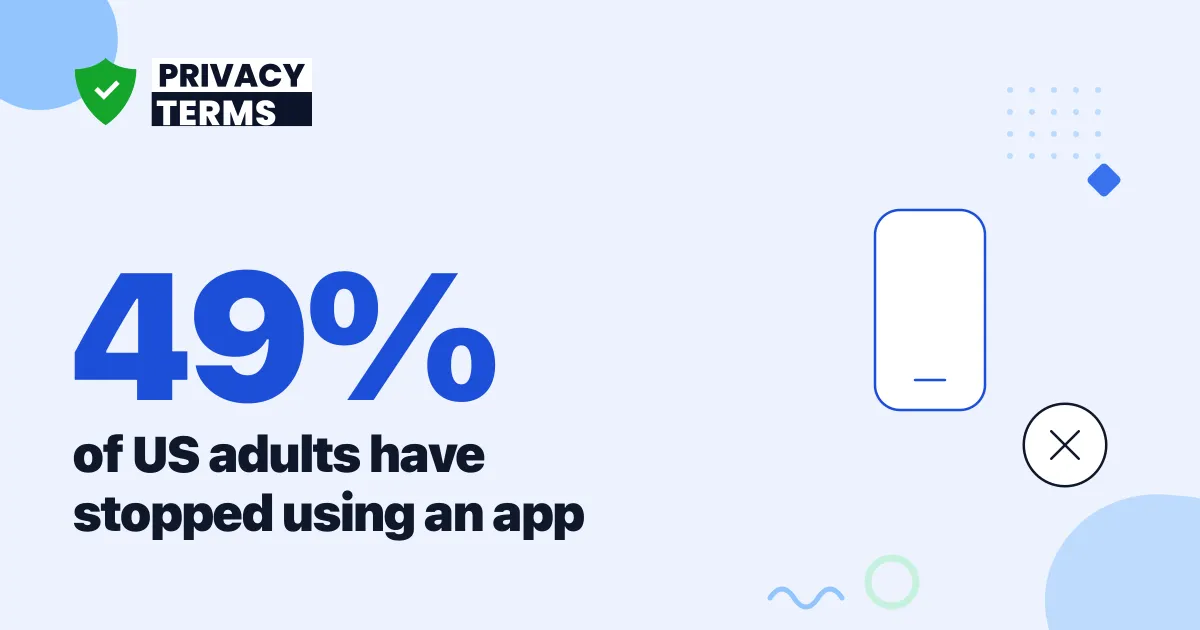
49% of US adults say they have stopped using a digital device, website, or app because they were worried about how their personal information was being used, according to Pew Research Center's survey of 5,101 US adults, fielded in May 2023 and published in October 2023. No major national tracker isolates app deletions on their own, so this combined figure, devices, websites, and apps together, is the closest verifiable answer to how many consumers have walked away from an app over privacy, and it sits alongside a fast-growing body of adjacent data on why they do it.
How many consumers have stopped using an app over privacy?
Pew's figure comes from a nationally representative survey question that asked whether respondents had ever "stopped using a digital device, website or app because they were worried about how their personal information was being used." 49% said yes, a smaller share than the 68% who say they have changed their social media privacy settings or the similar share who have declined or turned off tracking cookies, but still nearly one in two adults.
Pew's report does not break that 49% into separate device, website, and app columns, and no other public tracker we could verify publishes an app-isolated version of this exact question. Treat 49% as the best available answer for "stopped using an app, site, or device over privacy" as a combined behavior, not a precise count of app deletions alone.
Why do consumers abandon apps over privacy in the first place?
Permission overreach is the most measurable trigger. 87% of Android apps and 60% of iOS apps request at least one permission they do not need for their core function, according to NordVPN's mobile app research, published in May 2026 and based on an audit of 103 top apps across 18 categories. The average Android app requests 19 permissions in total, of which about 4 are unneeded, while the average iOS app requests just 5 permissions, with roughly 1 unneeded.
That gap between what an app asks for and what it actually needs is exactly the kind of disclosure gap a clear, specific privacy policy is supposed to close. A policy that names every data type collected, why it is collected, and who it is shared with gives a user a reason to trust a permission request instead of reflexively declining it or deleting the app; you can generate a privacy policy that covers exactly those disclosures for your own app or site in a few minutes.
Apple's App Tracking Transparency prompt is the clearest real-world test of how consumers respond once they are asked directly. Roughly 27 to 35% of iOS users opt in to cross-app tracking when the prompt appears, depending on the measurement window, according to 2025 and 2026 industry benchmarks from Adjust and Business of Apps. The opt-in rate has climbed slowly from about 21% in 2022 but has not come close to a majority, meaning somewhere between roughly two-thirds and three-quarters of iPhone users decline tracking outright every time they are asked.
Figure 1: How permission overreach and Apple's tracking prompt feed into the broader pattern of consumers walking away from an app. Sources: NordVPN (May 2026), Adjust and Business of Apps (2025 to 2026), Pew Research Center (2023).
What else are privacy-conscious consumers doing besides deleting apps?
Stopping use of an app, site, or device is only one item on a longer list of self-protective actions US adults report taking. Pew's October 2023 survey found 68% of social media users have changed their privacy settings, a similar share of all US adults say they have declined or turned off cookies or other tracking on websites, 44% have used a browser or search engine that does not track them, and 36% have used a messaging app or service that encrypts their communications.
Figure 2: Share of US adults who have taken each privacy-protective action. Source: Pew Research Center, "How Americans Protect Their Online Data" (October 2023).
Stopping use of an app sits in the middle of that list rather than at the extreme end, which suggests that abandoning an app or device entirely is a less common response than smaller adjustments like changing a privacy setting or blocking cookies, but still a mainstream one that close to half of US adults have taken at least once.
Do consumers even read an app's privacy policy before installing it?
Most do not read carefully before agreeing. 56% of Americans say they always, almost always, or often click "agree" on a privacy policy right away without reading it, according to the same Pew October 2023 survey. Another 22% say they do this sometimes, and just 18% say they rarely or never agree without reading first. Adults with a bachelor's degree or higher are even more likely to skip reading, at 68%, and adults under 30 skip it at 72% versus 39% of those 65 and older.
Figure 3: How often US adults agree to a privacy policy without reading it first. Source: Pew Research Center, "How Americans Protect Their Online Data" (October 2023).
That reading gap matters for app abandonment specifically, because it means most consumers only discover what an app actually collects after the fact, through a permission prompt, a news story, or a friend's warning, rather than at install time. For the broader picture of how concerned consumers say they are about their data even when they are not reading the fine print, see our look at how many people care about online privacy.
Is app abandonment getting more common over time?
The available year-over-year data points in the same direction: worry is rising, and self-protective behavior is rising with it. Password manager use among US adults climbed from 20% in 2019 to 32% in 2023, per Pew's two comparable surveys, evidence that consumers are adopting more deliberate privacy habits over time rather than fewer.
Figure 4: Milestones in consumer privacy worry and self-protective behavior, 2019 to 2026. Sources: Pew Research Center (2019, 2023), Cisco (2024), Deloitte (2024, 2025), NordVPN (2026).
Deloitte's Connected Consumer Survey, run among 3,524 US consumers in Q2 2025, found that 70% now say they are worried about data privacy and security, up from 60% just a year earlier. The same survey found 90% of US consumers believe tech companies should do more to protect their privacy and security, and 90% believe people should be able to view and delete the data collected about them. Rising worry does not automatically translate into more app deletions specifically, but it is the underlying pressure behind every self-protective statistic in this post.
Are younger consumers more likely to walk away over privacy?
Age is the single clearest predictor of who actually acts on privacy worry. 49% of consumers aged 25 to 34 say they have switched companies or providers because of data policies or data-sharing practices, compared with just 18% of those aged 75 and older, according to Cisco's 2024 Consumer Privacy Survey of thousands of respondents across 12 countries.
Figure 5: Share of consumers who switched companies or providers over data practices, by age. Source: Cisco 2024 Consumer Privacy Survey.
The same Cisco research found that 60% of Gen Z and Millennial respondents say the benefits they get from online services outweigh their privacy concerns, versus roughly four in ten older consumers, yet younger consumers are simultaneously the ones most willing to switch providers or take other action when a specific company crosses a line. Younger consumers use privacy tools more too: Pew found 49% of adults under 50 have used a private browser or search engine, compared with 38% of those 50 and older, and 42% of adults under 50 use encrypted messaging versus roughly three in ten of those 50 and older.
How do the major privacy-behavior stats compare?
Every figure in this post comes from a different survey with its own sample and methodology, so it helps to see them side by side against the same measuring stick.
| Behavior | Share | Source | Year |
|---|---|---|---|
| Stopped using a device, website, or app over privacy worry | 49% | Pew Research Center | 2023 |
| Changed social media privacy settings | 68% | Pew Research Center | 2023 |
| Declined or turned off tracking cookies | 68% | Pew Research Center | 2023 |
| Switched companies or providers over data practices, ages 25 to 34 | 49% | Cisco Consumer Privacy Survey | 2024 |
| Opted in to Apple's cross-app tracking prompt | 27 to 35% | Adjust / Business of Apps | 2025 to 2026 |
| Android apps requesting an unneeded permission | 87% | NordVPN | 2026 |
The 49% figure repeats twice in this table for two different behaviors, once for stopping use of a device, site, or app over privacy, and once for switching providers among the youngest age group Cisco measured, which is a coincidence worth noting rather than a sign the two surveys are measuring the same thing.
The Bottom Line
Roughly half of US adults have walked away from a digital device, website, or app at some point because they were worried about how their personal data was being used, and the behaviors that lead up to that decision, permission requests that overreach, tracking prompts that get declined, and rising general worry about data privacy, are all measurable and all trending in the same direction. Younger consumers act on this worry more often than older ones, and the gap between what an app asks for and what it discloses clearly is the single biggest lever a site or app owner controls directly. If your privacy policy does not plainly explain what you collect and why before a user has to guess, you are giving them a reason to hit delete instead of a reason to trust you.
Frequently Asked Questions
How many consumers have stopped using an app over privacy? 49% of US adults say they have stopped using a digital device, website, or app because they were worried about how their personal information was being used, according to Pew Research Center's survey of 5,101 US adults conducted in May 2023. No tracker isolates the app-only share, so this combined figure is the closest verifiable answer available.
Why do people delete apps over privacy concerns? The most common trigger is permission overreach. 87% of Android apps and 60% of iOS apps request at least one permission they do not need for their core function, according to NordVPN's May 2026 research. When an app asks for data it clearly does not need, users are far more likely to decline its tracking prompt or remove it entirely.
Are younger consumers more likely to abandon apps or services over privacy? Yes. 49% of consumers aged 25 to 34 have switched companies or providers over data practices, compared with just 18% of those 75 and older, according to Cisco's 2024 Consumer Privacy Survey of thousands of respondents across 12 countries.
How many people accept Apple's App Tracking Transparency prompt? Roughly 27 to 35% of iOS users opt in to cross-app tracking when Apple's prompt appears, depending on the measurement window, according to 2025 and 2026 benchmarks from Adjust and Business of Apps. That leaves somewhere between roughly two-thirds and three-quarters of iPhone users declining tracking outright, and some go a step further and remove the app.
Where the Numbers Come From
- Pew Research Center. (2023). "How Americans Protect Their Online Data." Source of the 49% device/website/app, 68% social media settings, 68% declined cookies, 44% private browser, 36% encrypted messaging, and 56/22/18 privacy-policy reading figures.
- Pew Research Center. (2023). "How Americans View Data Privacy." Survey of 5,101 US adults, fielded May 15 to 21, 2023, American Trends Panel. Source of the 73% little-or-no-control and 32% password manager figures.
- Pew Research Center. (2019). "Americans and Privacy: Concerned, Confused and Feeling Lack of Control Over Their Personal Information." Survey of 4,272 US adults, fielded June 3 to 17, 2019. Source of the 2019 baseline figures, including 81% little-or-no-control and 20% password manager use.
- Cisco. (2024). "Cisco 2024 Consumer Privacy Survey." Global consumer survey covering 12 countries. Source of the 49% vs 18% generational switching figures.
- Deloitte. (2025). "2025 Connectivity and Mobile Trends Survey." 3,524 US consumers surveyed in Q2 2025. Source of the 70% worry figure, up from 60% in the 2024 edition.
- NordVPN. (2026). "Mobile privacy: What do your apps want to know?" Research Lab report, 103 apps audited across 18 categories, published May 2026.
- Business of Apps. (2026). "App Tracking Transparency Opt-In Rates." Aggregated industry benchmark tracker, 2022 to 2026.
- Adjust. "ATT opt-in rates by app category and region." Global and regional opt-in benchmarks, 2025 data.
Note: All figures verified as of August 2026. Pew Research Center has not published an app-only version of the 49% figure as of this writing; treat it as a combined device, website, and app measure rather than an app-isolated statistic. This post will be refreshed at least twice a year to track new editions of these surveys.