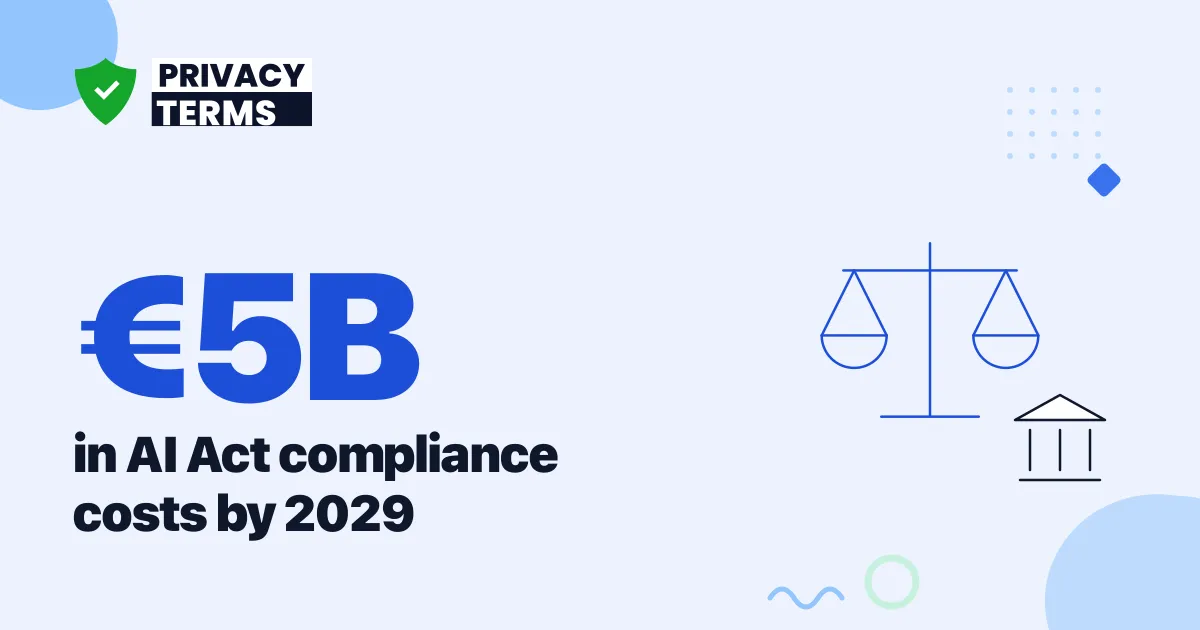
The European Commission's own Digital Omnibus proposal, published November 19, 2025, estimates that simplifying the EU AI Act and related digital rules could save European businesses up to €5 billion in administrative costs by 2029. That admission from Brussels is the clearest official signal yet of how expensive AI Act compliance has become, and it arrives while the Act's toughest obligations are still phasing in.
How much does the European Commission say AI Act compliance costs?
€5 billion is the administrative cost savings the Commission's Digital Omnibus package projects by 2029, if its proposed simplification of the AI Act and adjacent digital laws is adopted. A related initiative, the European Business Wallet, is projected separately to unlock another €150 billion in savings per year once fully rolled out, though that figure spans digital identity and reporting obligations well beyond the AI Act alone.
Figure 1: The European Commission's own administrative cost-cut target for the AI Act and related digital rules by 2029. Source: European Commission, "Simpler Digital Rules to Help EU Businesses Grow" press release, November 19, 2025.
The Commission has not published a single official total for what AI Act compliance costs businesses today. Instead, this savings figure is the closest thing to an official price tag: regulators would not propose cutting €5 billion in red tape if the current rules did not already cost businesses at least that much. The Digital Omnibus is still a proposal, not adopted law, and it needs sign-off from the European Parliament and the Council of the EU before any of its simplification measures take effect, so the €5 billion figure is a target the Commission is asking lawmakers to help it hit rather than a savings amount already banked.
What are the EU's official targets for cutting compliance burden?
Alongside the €5 billion savings estimate, the Commission set explicit percentage targets: cut administrative burden by at least 25% for all businesses and by 35% for small and medium-sized enterprises, both by the end of 2029. SMEs get the steeper cut because compliance costs fall disproportionately on smaller companies that lack in-house legal and technical teams to absorb the AI Act's documentation and conformity assessment requirements, the same requirements that drive most of the per-company cost figures in the rest of this post.
Figure 2: The European Commission's administrative burden reduction targets by 2029, all businesses versus SMEs specifically. Source: European Commission, "Simpler Digital Rules to Help EU Businesses Grow" press release, November 19, 2025.
A 35% target for SMEs only makes sense if regulators already know small companies are carrying a heavier relative load, and the per-company cost data below shows exactly why. None of these EU-wide percentage targets say anything about what a single business actually pays out of pocket to reach compliance in the first place, which is where the next figure becomes useful.
What does AI Act compliance cost a single business?
A small or medium-sized business deploying one high-risk AI system can face total compliance costs of up to €400,000 for a single product requiring a quality management system, according to the Commission's original AI Act impact assessment as analyzed by the Center for Data Innovation in a July 2021 report. Because the average SME profit margin runs close to 10%, that cost translates into a roughly 40% reduction in profit for a business with €10 million in annual turnover, before accounting for the cost of the AI system itself. An external conformity assessment alone, one line item within that total, can run as high as €1 million for a company that cannot complete the assessment in-house.
Figure 3: Projected profit impact for a 10 million euro-turnover SME deploying one high-risk AI system, based on the Commission's own AI Act impact assessment. Source: Center for Data Innovation, "How Much Will the Artificial Intelligence Act Cost Europe?" (July 2021), citing the European Commission's impact assessment of the AI Act.
That €400,000 figure predates the AI Act's final adopted text and was built from the Commission's draft-stage impact assessment, so it should be read as a directional estimate rather than a precise current price, but no newer EU-wide per-company estimate has replaced it. Businesses that process personal data through an AI system still need a privacy policy that discloses that processing accurately; a privacy policy generator built for AI-era disclosure requirements keeps that language current without adding to a dedicated compliance budget. That kind of documentation cost is exactly the category the Commission's own impact assessment flagged as the heaviest line item for a smaller company, ahead of the AI system's purchase price itself.
Are companies actually budgeting for these costs?
Only 26.2% of German AI decision-makers had engaged deeply with EU AI Act compliance preparation as of September 2024, according to a Deloitte Legal Germany survey of 500 managers conducted through Civey. Nearly half, 48.6%, had not prepared intensively at all, and 52.3% said they feared the regulation would restrict their company's innovation opportunities.
Figure 4: Share of German AI decision-makers actively engaged in AI Act compliance preparation versus full readiness. Source: Deloitte Legal Germany, "AI Act Survey," September 2024, n=500 managers.
That readiness gap is not unique to compliance specifically. Our breakdown of AI and privacy program data found that organizations expanding privacy programs because of AI often still lack a dedicated budget line for the work, which tracks with a wider finding: the IAPP-EY AI Governance Profession Report, published April 16, 2025 from a survey of more than 670 professionals across 45 countries, found 77% of organizations actively working on AI governance overall, rising to nearly 90% among organizations already using AI. Working on governance and having a funded compliance budget for it are not the same thing, and the gap between the two is where AI Act cost surprises tend to show up. A company that starts governance work without first pricing out documentation, conformity assessment, and monitoring costs is likely to find itself back at the budget table once those line items land.
How does 2026's compliance picture compare to the original 2021 cost forecast?
Before the AI Act's final text existed, the European Commission projected that EU-wide AI investment would grow from €16 billion in 2021 to almost €70 billion by 2025, absent any added regulatory overhead. The Center for Data Innovation's July 2021 analysis of that same impact assessment concluded the AI Act's compliance requirements would add roughly 17% overhead onto that AI spending, pushing the Act's total cost to the European economy past €31 billion cumulatively between 2021 and 2025, or more than €10 billion a year by 2025 alone.
Figure 5: The European Commission's own 2021 projection for EU AI investment growth, before the AI Act's added compliance costs were factored in. Source: Center for Data Innovation, "How Much Will the Artificial Intelligence Act Cost Europe?" (July 2021), citing the European Commission's impact assessment of the AI Act.
Regulatory momentum around AI has not slowed since that 2021 estimate, either inside or outside the EU. Elsewhere, US states alone enacted more than a hundred AI-related bills in 2025; see our count of AI bills passed in 2025 for how that compares to the EU's single, unified AI Act. The compliance cost conversation the Commission is now having with its own Digital Omnibus, cutting rather than adding rules, suggests 2021's cost forecast was directionally correct even if the exact euro figures have since moved.
AI Act compliance cost figures at a glance
| Cost figure | Amount | What it measures | Source (year) |
|---|---|---|---|
| Digital Omnibus savings target | €5 billion by 2029 | Administrative cost cut from simplifying the AI Act and related rules | European Commission (2025) |
| SME high-risk compliance cost | Up to €400,000 | Total cost for one high-risk AI product requiring a QMS | Center for Data Innovation / EC impact assessment (2021) |
| EU-wide annual compliance cost | Over €10 billion per year by 2025 | Estimated AI Act overhead across the EU economy | Center for Data Innovation / EC impact assessment (2021) |
| Deloitte Legal Germany readiness | 26.2% actively engaged | Share of 500 surveyed German AI decision-makers | Deloitte Legal Germany (2024) |
Source: figures compiled by PrivacyTerms.io from the European Commission, the Center for Data Innovation, and Deloitte Legal Germany; see the full citations below.
Every figure in this table points the same direction: the cost of AI Act compliance has been high enough, for long enough, that the EU's own regulator is now proposing to cut it.
The Bottom Line
€5 billion is the number that matters most here, not because it measures what compliance costs today, but because it is the European Commission's own admission that current AI Act compliance costs are high enough to justify cutting by that much. The per-company data backs that up: a €400,000 compliance bill for a single high-risk AI product is a real constraint for a mid-sized business, and only about a quarter of surveyed German decision-makers had engaged deeply with that reality as of late 2024. With the high-risk compliance deadline now pushed to December 2027, businesses have more runway than the original schedule allowed, but the practical move is the same either way: budget for AI-related compliance work now, including updated privacy disclosures for any AI system that touches personal data, rather than waiting for the deadline to force the spending.
Frequently Asked Questions
How much does the European Commission itself say AI Act compliance costs? The Commission's own Digital Omnibus proposal, published November 19, 2025, estimates that simplifying the AI Act and related digital rules could save European businesses up to 5 billion euros in administrative costs by 2029, alongside a separate 150 billion euro annual savings target from a related European Business Wallet initiative.
What does AI Act compliance cost a single business? Up to 400,000 euros for a small or medium-sized business deploying one high-risk AI system requiring a quality management system, enough to cut profits by 40% for a company with 10 million euros in annual turnover, according to the Commission's original AI Act impact assessment as analyzed by the Center for Data Innovation in July 2021.
Are most companies actually prepared for AI Act compliance costs? No. Only 26.2% of German AI decision-makers had engaged deeply with AI Act compliance preparation as of September 2024, according to a Deloitte Legal Germany survey of 500 managers, while 48.6% had not prepared intensively at all.
Has the EU AI Act's compliance deadline changed? Yes. The Commission's November 2025 Digital Omnibus proposal deferred the high-risk AI system compliance deadline from August 2, 2026 to December 2, 2027, giving businesses up to 16 additional months to budget once required support tools and standards are in place.
Where the Numbers Come From
- European Commission. (2025). "Simpler Digital Rules to Help EU Businesses Grow." Press release, November 19, 2025. Source of the 5 billion euro Digital Omnibus savings estimate, the 25%/35% administrative burden reduction targets, and the deferred high-risk compliance deadline.
- Center for Data Innovation. Mueller, Benjamin. (2021). "How Much Will the Artificial Intelligence Act Cost Europe?" July 2021 analysis of the European Commission's own AI Act impact assessment, source of the 400,000 euro SME compliance cost estimate, the 40% profit reduction figure, and the 16 billion to 70 billion euro AI investment projection.
- Deloitte Legal Germany. (2024). "AI Act Survey." Survey of 500 German AI decision-makers conducted via Civey, published September 2024.
- IAPP. (2025). "AI Governance Profession Report 2025." Survey of over 670 professionals across 45 countries, published April 16, 2025.
Note: All figures verified as of October 2026. The 400,000 euro SME compliance cost and the 16 billion to 70 billion euro investment projection date to the European Commission's original 2021 impact assessment of the draft AI Act and have not been officially updated since; they are presented here as the last EU-wide estimates tied directly to a Commission impact assessment, alongside the Commission's own more current November 2025 savings targets. Compliance cost data is refreshed at least twice a year as the Commission's Digital Omnibus process moves through the EU legislative pipeline.





