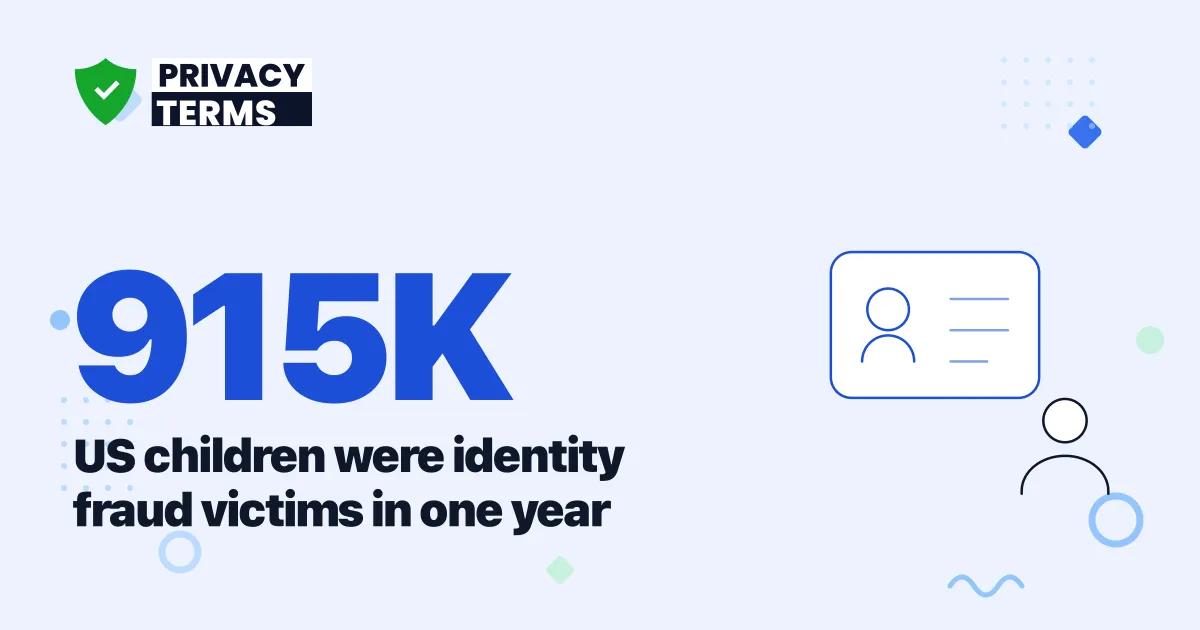
An estimated 915,000 U.S. children were victims of identity fraud in a single year, according to Javelin Strategy & Research's 2022 Child Identity Fraud Study, still the most recent large-scale count of child victims available as of 2026. The average affected household loses $1,128 resolving the fraud, and in most cases the person responsible is someone the family already knows.
How many children are victims of identity theft each year?
915,000 U.S. children were identity fraud victims in the 12-month period Javelin Strategy & Research measured for its 2022 Child Identity Fraud Study, down from 1.25 million in the prior year's edition of the same study. The figures come from a survey of 5,000 U.S. households conducted by Javelin earlier in 2022, and no comparably sized study has replaced them since. In the same period, 1.7 million children, or 1 in every 43, had personal information exposed through a data breach, a separate and larger exposure pool than the confirmed-fraud victim count.
Figure 1: An estimated 915,000 U.S. children were identity fraud victims in the year Javelin Strategy & Research surveyed. Source: Javelin Strategy & Research, 2022 Child Identity Fraud Study.
Javelin's research also found that children under age 7 are the age group most likely to be victimized, since a young child's Social Security number can go unused, and therefore unmonitored, for a decade or more before anyone checks it.
Is child identity theft getting better or worse?
The picture is mixed. Javelin's confirmed-victim count fell from 1.25 million children in its 2021 study to 915,000 in its 2022 study, a real decline, but the newer Identity Theft Resource Center data described below shows the crime shifting toward harder-to-detect misuse types rather than disappearing. Because no equivalent large-scale victim-count survey has been published since 2022, this year-over-year comparison remains the most current one available, and it should be read as a two-point trend rather than a settled trajectory.
Figure 2: Confirmed child identity fraud victims fell between Javelin's 2021 and 2022 study years, but both remain in the hundreds of thousands to millions. Source: Javelin Strategy & Research, 2021 and 2022 Child Identity Fraud Studies.
This is part of a broader pattern in how weakly children's data gets protected online; see our full children's online privacy statistics roundup for consent and tracking data across kids' apps that feed into the same exposure pipeline.
How much does child identity theft cost a family?
A household with a child identity theft victim loses $1,128 on average, according to Javelin's 2022 study: $752 in direct fraud losses plus $376 spent out of pocket on resolution costs like credit freezes, notarized affidavits, and lost work time. Families in the study spent a median of 16 hours resolving a single case, time that mostly falls on a parent since a minor cannot legally manage their own credit file.
Figure 3: Two-thirds of the average child identity theft cost is the fraud itself; the remaining third is what a family spends fixing it. Source: Javelin Strategy & Research, 2022 Child Identity Fraud Study.
That $1,128 average, multiplied across an estimated 915,000 households, roughly matches the nearly $1 billion in annual child identity fraud costs Javelin has reported across both its 2021 and 2022 studies.
How much more likely are children to be targeted than adults?
Children face Social Security number misuse at close to 51 times the rate adults do, based on a 2011 Carnegie Mellon CyLab study led by researcher Richard Power. The study examined 42,232 minors enrolled in AllClear ID's breach-notification protection service and found that 10.2% already had another person using their Social Security number, compared with 0.2% of adults in the same non-random, breach-affected population. Power's own report cautions that the sample was not drawn randomly from the general population, so the 51-times figure should be read as a signal from a breach-exposed group, not a nationally representative rate.
Figure 4: In a 2011 study of breach-affected households, children were found to have their Social Security number misused at a far higher rate than adults in the same families. Source: Carnegie Mellon CyLab, Richard Power, 2011.
No comparably large study has repeated this exact measurement since 2011, which is itself a data gap worth noting for a crime type that specifically depends on years passing before anyone checks.
How common is child identity theft in a given year?
Javelin describes the overall incidence rate as affecting roughly 1 in every 50 U.S. children annually, a figure the firm has used consistently across its 2021 and 2022 study summaries alongside the 915,000 and 1.25 million victim counts. As an annual rate, that works out to about 2% of the U.S. child population, a small share individually but a large total given that the U.S. has roughly 73 million residents under 18.
Figure 5: Javelin frames child identity fraud as affecting about 1 in 50 US children each year, roughly a 2% annual incidence rate. Source: Javelin Strategy & Research, 2021 to 2022 Child Identity Fraud Studies.
A 2% annual rate compounds over an 18-year childhood in a way a single-year snapshot does not capture, which is part of why some industry estimates of lifetime exposure run far higher than any single year's count.
Who steals a child's identity, and how do they use it?
67% of households with a child identity theft victim personally knew the person responsible, according to Javelin's 2022 study, with parental figures such as partners, spouses, and stepparents the most commonly identified perpetrators. That distinguishes child identity theft from most adult identity theft, which more often involves a stranger using breached data. Once a child's identity is misused, the Identity Theft Resource Center's 2026 Trends in Identity Report, covering cases from April 2025 through March 2026, found that fraudulent employment has become the single most common misuse type, present in 40% of minor and dependent cases, ahead of new credit accounts or government benefits fraud. Financial institutions caught 26.8% more attempted misuse cases in the same period, which the report attributes to improving fraud detection on credit products even as employment and benefits systems lag behind.
Company-side data handling failures also feed into this picture. Regulators have fined organizations directly over how they collect and secure children's data under COPPA; see our ranked list of COPPA fines and settlements for how those penalties compare in size to the family-level costs described here.
How do the confirmed child identity theft numbers compare?
| Metric | Figure | Study period | Source |
|---|---|---|---|
| U.S. children victimized by identity fraud | 915,000 | 2022 study year | Javelin Strategy & Research |
| U.S. children with data exposed in breaches | 1.7 million (1 in 43) | 2022 study year | Javelin Strategy & Research |
| Average household cost per child victim | $1,128 ($752 fraud + $376 resolution) | 2022 study | Javelin Strategy & Research |
| Children's SSNs misused vs. adults' | 10.2% vs 0.2% (about 51x) | 2011 (non-random sample) | Carnegie Mellon CyLab |
| Households that personally knew the perpetrator | 67% | 2022 study | Javelin Strategy & Research |
| Minor/dependent misuse cases that were fraudulent employment | 40% | Apr 2025 to Mar 2026 | Identity Theft Resource Center |
Source: Javelin Strategy & Research's 2021 and 2022 Child Identity Fraud Studies, Carnegie Mellon CyLab (2011), and the Identity Theft Resource Center's 2026 Trends in Identity Report.
Six figures from three separate named studies all point the same direction: children are a disproportionately attractive target, and the crime is shifting in form even where raw victim counts have leveled off.
The Bottom Line
915,000 confirmed child identity fraud victims in a single study year, at an average cost of $1,128 per household, makes this a bigger problem than most parents assume, and one that is unusually likely to involve someone the family already knows rather than a stranger. Businesses that collect children's or family account data carry a share of this exposure too: every one of the 1.7 million children whose information leaked in a breach traces back to an organization that held it. A privacy policy generator built for today's children's privacy obligations helps keep data-handling disclosures accurate as COPPA guidance and state-level children's privacy rules continue to change. For families, the practical takeaway is that a child's Social Security number deserves the same monitoring as an adult's, starting well before the child is old enough to apply for credit.
Frequently Asked Questions
How many children are victims of identity theft each year? About 915,000 U.S. children were victims of identity fraud in the 12 months studied by Javelin Strategy & Research's 2022 Child Identity Fraud Study, the most recent large-scale count available as of 2026, based on a survey of 5,000 U.S. households.
How much more likely are children to be targeted than adults? Roughly 51 times more likely by one measure. A 2011 Carnegie Mellon CyLab study of 42,232 minors enrolled with AllClear ID found that 10.2% had another person using their Social Security number, versus 0.2% of adults in the same non-random sample.
How much does child identity theft cost a family? $1,128 on average per affected household: $752 in direct fraud losses plus $376 spent out of pocket resolving the case, according to Javelin Strategy & Research's 2022 Child Identity Fraud Study.
How do criminals typically use a stolen child identity today? Fraudulent employment is now the single most common use, accounting for 40% of misuse cases involving children and dependents between April 2025 and March 2026, according to the Identity Theft Resource Center's 2026 Trends in Identity Report.
Where the Numbers Come From
- Javelin Strategy & Research. (2022). "Child Identity Fraud: The Perils of Too Many Screens and Social Media." Survey of 5,000 U.S. households; source of the 915,000 victim count, 1.7 million breach-exposure figure, and $1,128 average household cost, published October 26, 2022.
- Javelin Strategy & Research. (2021). "Child Identity Fraud: A Web of Deception and Loss." Source of the 1.25 million prior-year victim count and the nearly $1 billion annual cost estimate, published November 2, 2021.
- Identity Theft Resource Center. (2026). "2026 Trends in Identity Report." Based on 6,188 individuals and 9,253 cases reported between April 1, 2025, and March 31, 2026; source of the 40% fraudulent-employment misuse share for minors and dependents, published June 9, 2026.
- ASIS International, Security Management. (2011). "Safeguarding Children." Summary of Richard Power's Carnegie Mellon CyLab study of 42,232 minors enrolled with AllClear ID, source of the 10.2% versus 0.2% Social Security number misuse comparison.
Note: All figures verified as of October 2026. Javelin's child-specific victim-count study has not been repeated at the same 5,000-household scale since 2022; the Identity Theft Resource Center and Carnegie Mellon CyLab figures come from separate studies with different methodologies and are presented alongside, not merged with, Javelin's totals. Child identity theft data is refreshed here at least twice a year as new studies are published.





