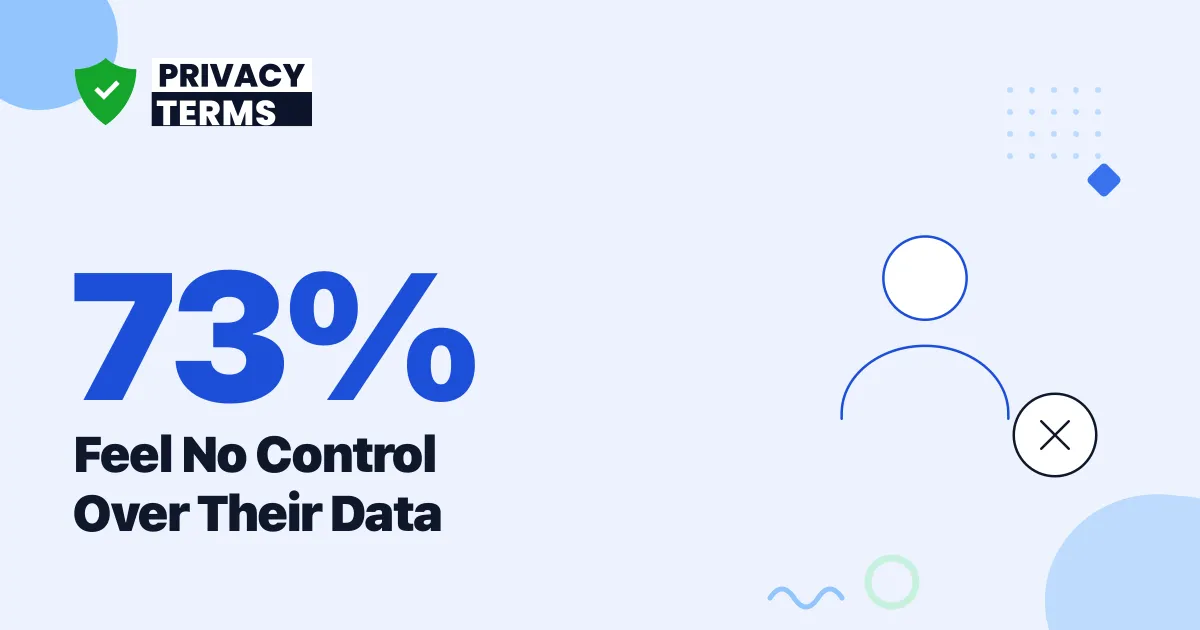
73% of American adults say they have little to no control over what companies do with the data collected about them, according to Pew Research Center's 2023 survey of 5,101 U.S. adults, still the most recent large-scale study of its kind cited across the industry in 2026. The same survey found deep skepticism about corporate accountability alongside a behavior gap: most people say they worry about their data, then click "agree" anyway without reading what they agreed to.
That combination, high anxiety paired with low label-reading and near-zero belief that companies will self-police, is the throughline of every major consumer privacy study run since. Below is what the data says about how people feel, whom they trust, and what they actually do when a privacy policy shows up on screen.
How many people feel they have no control over their data?
73% of adults feel they have little to no control over data collected by companies, and an even higher 79% feel the same about government data collection, according to Pew Research Center's May 2023 survey. That gap, companies scoring "better" than government by only 6 points, is not much comfort given how low both numbers are.
Figure 1: Neither companies nor government score well on perceived data control. Source: Pew Research Center, "How Americans View Data Privacy" (October 2023), survey of 5,101 U.S. adults, May 15 to 21, 2023.
The feeling of powerlessness is not vague background anxiety. 67% of respondents say they understand "little to nothing" about what companies actually do with the data they collect, which means most people are worried about a process they cannot describe. A clear, current privacy policy is one of the few concrete things a site can put in front of a visitor to close part of that literacy gap, since it is the one document regulators and users alike expect to actually explain the data flow in plain language.
Do people actually read privacy policies before agreeing?
No. Only 22% of adults say they always or often read a privacy policy before agreeing to it, while 56% say they always, almost always, or often click "agree" without reading it at all, per Pew Research Center's 2023 survey. Among the smaller group that does read policies at least sometimes, most only skim: 13% read all the way through, 21% read part of the way through, and 26% just glance over the text.
The read-through rate has stayed low for years, and the reason people give is not laziness alone. 61% of U.S. users say privacy policies are ineffective at actually explaining how a company uses their data, and 69% describe the policy as something to get past rather than something to learn from. That is a design and clarity problem as much as an attention problem: a document nobody trusts to be useful gets skipped, regardless of how much people say they care about privacy in the abstract.
How much do consumers trust companies with their data?
Trust is thin. Only about 20% of Americans are confident that companies will handle their personal data responsibly, and 77% say social media company executives have little to no accountability when they mishandle user data, according to Pew Research Center's 2023 survey. On AI specifically, 70% of adults who are aware of AI's growing use in products say they have little to no trust that companies will make responsible decisions about it.
Figure 2: Roughly four in five Americans lack confidence that companies will handle their data responsibly. Source: Pew Research Center, "How Americans View Data Privacy" (October 2023).
Cisco's 2024 Consumer Privacy Survey, run across thousands of consumers in 12 countries, found a related pattern from the other direction: trust is earnable, and awareness drives it. 53% of global respondents said they were aware of their country's privacy laws, the first time a majority has said so since Cisco started the survey in 2019, and among that aware group, 81% felt confident their data was protected, compared to just 44% of those who were unaware. Trust does not come from a company's marketing copy; it comes from a visitor understanding, concretely, what rights they have and how to use them.
What do people fear most about their data?
Concern skews toward government use of data even more than corporate use. 71% of U.S. adults are very or somewhat concerned about how the government uses the data it collects about them, up sharply from 64% in a comparable 2019 Pew survey. Corporate concern is close behind and has been consistently high across every recent survey wave: at least three in four adults describe themselves as at least somewhat concerned about company data practices.
Figure 3: Concern about government data use has grown, not shrunk. Source: Pew Research Center, "How Americans View Data Privacy" (October 2023), compared to Pew's 2019 survey wave.
Figure 4: How the consumer privacy conversation shifted from raw concern toward literacy and enforcement. Source: Pew Research Center (2019, 2023), KPMG Corporate Data Responsibility survey (2021), Cisco Consumer Privacy Survey (2024), Cisco Data Privacy Benchmark Study (2025).
This is why regulation keeps polling well regardless of political affiliation. 72% of Americans say there should be more regulation of what companies can do with personal data, including 78% of Democrats and 68% of Republicans, according to Pew Research Center's 2023 survey. Fear of misuse, not partisan messaging, is the more consistent driver of that support.
Does privacy concern actually change consumer behavior?
Sometimes, and the pattern is strongly generational. 49% of consumers aged 25 to 34 say they have switched companies or providers because of data policies or data-sharing practices, compared to just 18% of those aged 75 and older, according to Cisco's 2024 Consumer Privacy Survey. Younger consumers are also far more likely to exercise a formal data right: 46% of younger respondents have submitted a data subject access request to access, correct, delete, or transfer their personal data, versus 16% of those 65 and older.
Figure 5: Younger consumers are close to three times as likely to walk away over data practices. Source: Cisco 2024 Consumer Privacy Survey.
The behavior gap tracks a belief gap. 60% of Gen Z and Millennial respondents in the same Cisco research say the benefits they get from online services outweigh their privacy concerns, versus roughly four in ten older consumers, yet younger consumers are simultaneously the ones most willing to act, switch providers, request their data, or turn on stricter settings, when a specific company crosses a line. More than 75% of all consumers surveyed, across every age group, say they will not purchase from an organization they do not trust with their data, which makes trust a purchase-funnel issue as much as a compliance one.
How does stated concern compare across the major surveys?
| Metric | Value | Source | Year |
|---|---|---|---|
| Feel little to no control over company data use | 73% | Pew Research Center | 2023 |
| Click "agree" on policies without reading | 56% | Pew Research Center | 2023 |
| Confident companies handle data responsibly | 20% | Pew Research Center | 2023 |
| Concerned about government data use | 71% | Pew Research Center | 2023 |
| Support more regulation of company data use | 72% | Pew Research Center | 2023 |
| Switched providers over data practices, ages 25-34 | 49% | Cisco Consumer Privacy Survey | 2024 |
The Bottom Line
The 2026 picture is consistent with every prior wave: consumers say they feel powerless, at 73% reporting no real control over company data use, and they behave in a way that mostly confirms it, with 56% clicking through policies unread. That is not apathy so much as a trust failure; only 20% believe companies will act responsibly with their data in the first place, so reading the fine print feels pointless to most people even when they are anxious about it. The businesses that close this gap are the ones that make their data practices genuinely legible rather than merely compliant on paper, since younger, more privacy-literate consumers are already proving they will switch providers and file access requests when a company fails that test. A privacy policy that is current, specific, and easy to actually parse is the cheapest available signal a site has to offer.
Frequently Asked Questions
What percentage of people feel they have no control over their data? 73% of American adults say they have little to no control over what companies do with the data collected about them, according to Pew Research Center's 2023 survey of 5,101 U.S. adults, the most recent large-scale study of its kind still cited in 2026.
Do most people actually read privacy policies? No. Only 22% of adults say they always or often read a privacy policy before agreeing to it, per Pew Research Center, and 56% say they always, almost always, or often click agree without reading it at all.
How many consumers trust companies to protect their data? Roughly 20% of Americans are confident that companies handle their personal data responsibly, per Pew Research Center's 2023 survey, and 77% say social media executives have little to no accountability when they mishandle user data.
Do younger and older consumers behave differently around privacy? Yes. 49% of consumers aged 25 to 34 have switched companies or providers over data practices, compared to 18% of those 75 and older, according to Cisco's 2024 Consumer Privacy Survey of thousands of respondents across 12 countries.
Where the Numbers Come From
- Pew Research Center. (2023). "How Americans View Data Privacy." Survey of 5,101 U.S. adults conducted May 15-21, 2023, published October 18, 2023. Source of the 73% no-control, 20% trust, 71% government-concern, and 72% regulation-support figures.
- Pew Research Center. (2023). "Key findings about Americans and data privacy." Companion short-read summarizing the 56% click-without-reading and 22% read-first figures from the same May 2023 survey wave.
- Cisco. (2024). "Cisco 2024 Consumer Privacy Survey." Global consumer survey covering 12 countries. Source of the 53% awareness, 49% vs 18% generational switching, and 46% vs 16% data-request figures.
- Cisco. (2025). "Cisco 2025 Data Privacy Benchmark Study." Organizational survey of 2,600 security and privacy professionals across 12 countries, conducted April 2025.
Note: All figures verified as of July 2026. Pew Research Center's October 2023 report remains the most recent full consumer privacy survey of its scale and is the primary basis for the trust and control figures in this post; Cisco's Consumer Privacy Survey last published a dedicated consumer wave in 2024, with its 2025 and 2026 editions focused on organizational respondents instead. This post will be refreshed when either organization publishes a newer consumer-facing wave.