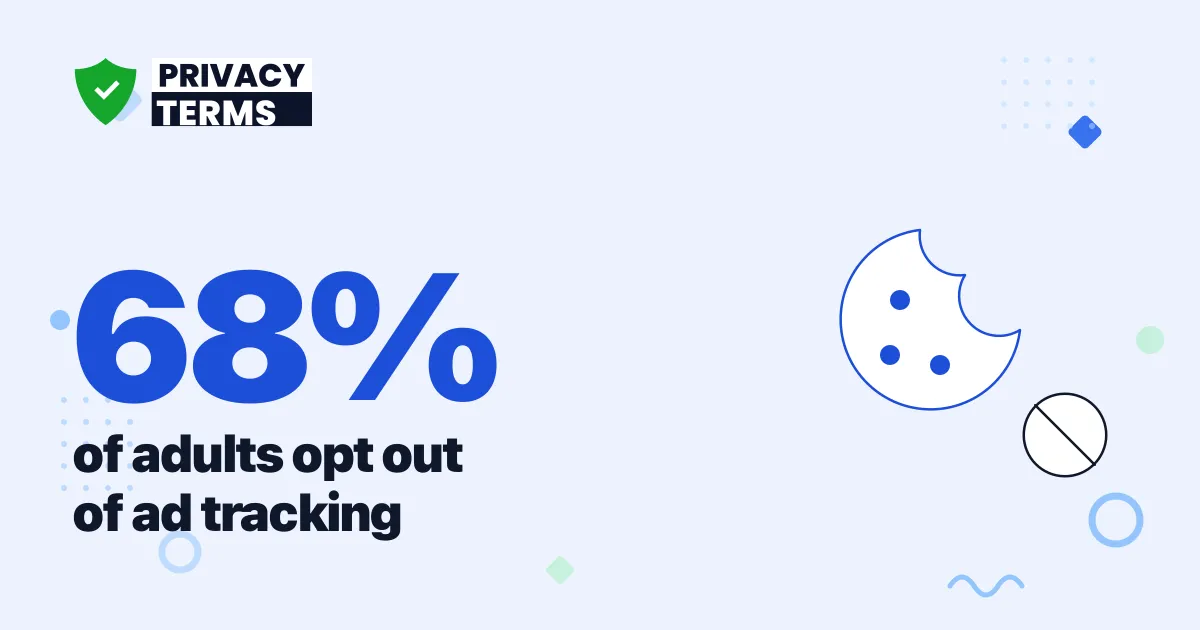
68% of US adults say they have declined or turned off cookies on a website specifically to protect their privacy, according to Pew Research Center's 2023 survey of 5,101 US adults, published October 18, 2023. That self-reported figure is the single most common step people describe taking to opt out of ad tracking. It is also, as the rest of this post shows, a much higher number than what actually shows up in measured, revealed opt-out behavior once the action requires more than clicking a button on a banner.
What percentage of people opt out of ad tracking?
68% of US adults say they have declined or turned off cookies on a website to protect their privacy, per Pew Research Center's October 2023 report on how Americans protect their online data. That ties for the most common privacy action Pew measured, matched only by the 68% of social media users who say they have changed their social media privacy settings. Every other action Pew asked about was less common: 49% have stopped using a device, app, or website over data worries, 44% have used a browser or search engine that does not track them, and 36% have used encrypted messaging.
Figure 1: Declining or turning off tracking cookies is tied for the most common privacy action US adults report taking. Source: Pew Research Center, "How Americans Protect Their Online Data," October 2023, survey of 5,101 US adults fielded May 15 to 21, 2023.
Declining cookies sits ahead of every other listed action because a cookie banner is the most frequent, most visible ad-tracking opt-out prompt most people encounter. Sites that keep that prompt current and honest, and back it with a privacy policy that clearly discloses what tracking is used for, give visitors an opt-out path they will actually recognize and use.
Do people actually follow through when they say they want to opt out?
Stated intent to opt out of ad tracking is far more common than measured, revealed opt-out behavior, and the gap gets wider the more effort the opt-out requires. Gartner's 2026 marketing survey found 81% of US consumers say they try to ignore and tune out ads, and 52% say they take active steps such as paying for ad-free content or using a VPN or ad blocker. Neither of those actions requires finding a dedicated privacy setting. Once the action does require that, the number collapses.
Figure 2: Every opt-out action drops in prevalence as the number of required steps increases, and Android's manual advertising ID deletion drops furthest of all. Sources: Gartner (April 2026), Pew Research Center (2023), Adjust (2026), Singular (2023).
Singular's January 2023 analysis of more than 5 billion Android ad events found that only 9.2 million, or 0.18%, came from a device that had deleted its Google advertising ID, the deliberate multi-step action Android requires to opt out of ad personalization. That is the most recent large-scale measurement of this kind publicly available as of this post's writing; treat it as a snapshot from three years ago rather than a live figure, since no fresher public dataset of comparable scale has replaced it.
How does ad-tracking opt-out differ between iPhone and Android?
The two mobile platforms handle ad-tracking opt-out with opposite defaults, and the measured opt-out rates reflect that difference directly. Apple's App Tracking Transparency framework makes denial the one-tap default response to a mandatory prompt, and Adjust's 2026 Mobile App Trends Report puts the resulting denial rate at roughly 62% of users globally, with AppsFlyer's competing measurement putting it as high as 71%. For the full breakdown by app category and country, see our ATT opt-in and denial statistics for 2026.
Android carries no equivalent mandatory prompt. A user who wants to stop ad personalization has to open Settings, find the ads menu, and manually delete or reset the advertising identifier, a path most users never take.
| Channel | Opt-out action required | Measured or self-reported rate | Source, year |
|---|---|---|---|
| Web cookies | Decline or turn off cookies (self-reported) | 68% | Pew Research Center, 2023 |
| iOS apps | Deny the mandatory ATT prompt | ~62% (Adjust) to 71% (AppsFlyer) | 2026 |
| Android apps | Manually delete the advertising ID | 0.18% | Singular, 2023 |
| General ad exposure | Say they try to tune out ads (self-reported) | 81% | Gartner, 2026 |
The pattern across every row is the same: opt-out rates track the number of steps required, not how much people say they dislike being tracked.
Figure 3: Whether an opt-out is the default action or requires manual effort predicts the measured rate far better than stated attitude. Source: synthesis of Adjust, Singular, DataGrail, and Pew figures cited throughout this post.
Which legal opt-out mechanisms actually work?
State privacy laws give US consumers one enforceable channel that does not depend on a platform's own default settings: the right to opt out of the sale or sharing of personal data. Do Not Sell opt-out requests filed under the CCPA rose 37% in 2024 over 2023, according to DataGrail's 2025 Data Privacy Trends Report, which tracked data subject requests processed for its customers between January and December 2024. See our full breakdown of CCPA opt-out request volume for the request-type comparison.
Figure 4: Legal opt-out rights are expanding even as most opt-out requests still go unhonored in practice. Sources: Adjust (2026), Singular (2023), DataGrail (2025), California Privacy Protection Agency (2025).
Filing an opt-out request is not the same as having it honored. DataGrail's audit of more than 5,000 websites found 69% still fire three or more cookie trackers after a visitor opts out, which is why California, Colorado, and Connecticut announced a joint investigative sweep in September 2025 against businesses ignoring Global Privacy Control signals specifically.
Figure 5: Android's advertising ID opt-out rate sits close to zero even where users can technically self-serve the setting. Source: Singular, "5 Billion Ad Events Show That Fewer Than 1% of Android Users Opt Out of Personalized Ads," January 2023.
The Bottom Line
Ask people whether they want to opt out of ad tracking, and most say yes: 68% have declined cookies, 81% try to tune out ads altogether. Look at what people actually do once opting out requires more than one click, and the number collapses toward zero, all the way down to 0.18% on Android. The practical lesson for any site collecting visitor data is that the opt-out mechanism itself determines the outcome far more than visitor sentiment does. A cookie banner with a real reject option, a privacy policy that names every opt-out channel in plain language, and a consent tool that actually blocks trackers after a visitor opts out will do more to close this gap than anything aimed at changing how people feel about tracking.
Frequently Asked Questions
What percentage of people opt out of ad tracking? 68% of US adults say they have declined or turned off cookies on a website to protect their privacy, according to Pew Research Center's 2023 survey of 5,101 US adults, published October 18, 2023. It is the single most common ad-tracking opt-out action Pew measured.
Do people actually follow through when they say they want to opt out of ad tracking? Rarely, once opting out requires a deliberate extra step. Only 0.18% of more than 5 billion Android ad events analyzed by Singular in January 2023 came from a device that had deleted its Google advertising ID, even though 81% of US consumers tell Gartner they try to tune out ads and 52% say they take active steps to block them.
How does ad-tracking opt-out differ between iPhone and Android? iOS makes tracking opt-out the default one-tap action through Apple's App Tracking Transparency prompt, and roughly 62% of users deny it, per Adjust's 2026 Mobile App Trends Report. Android requires users to find and delete their advertising ID manually, and only 0.18% of tracked ad events came from a device that had done so, according to Singular's January 2023 analysis of 5 billion-plus ad events.
What can businesses do to honor ad-tracking opt-out requests? Very few currently do. DataGrail's audit of more than 5,000 websites found 69% still fire three or more cookie trackers after a visitor opts out, even as Do Not Sell requests under the CCPA rose 37% in 2024. A privacy policy that clearly names opt-out mechanisms, and a cookie banner or consent tool that actually honors them, closes most of that gap.
Where the Numbers Come From
- Pew Research Center. (2023). "How Americans Protect Their Online Data." 68% of US adults have declined or turned off cookies on a website to protect their privacy; survey of 5,101 US adults fielded May 15 to 21, 2023, published October 18, 2023.
- Gartner, Inc.. (2026). "Gartner Marketing Survey Finds 81% of Consumers Tune Out Ads." Press release, April 13, 2026. 81% of consumers say they try to tune out ads; 52% report taking active steps such as ad-free subscriptions, VPNs, or ad blockers.
- Singular. (2023). "5 Billion Ad Events Show That Fewer Than 1% of Android Users Opt Out of Personalized Ads." Blog post by John Koetsier, January 26, 2023. 9.2 million of 5 billion-plus analyzed Android ad events, or 0.18%, came from devices that had deleted their Google advertising ID.
- The Conference Board, with Nielsen. (2021). "Consumers' Attitudes about Data Practices, US Edition." Published April 13, 2021. Almost 60% of US consumers prefer data privacy over data-enabled personalization.
- Adjust. (2026). "2026 Mobile App Trends Report." Published February 18, 2026. Global industry-average App Tracking Transparency opt-in rate of 38% in Q1 2026, implying a denial rate of roughly 62%.
- DataGrail. (2025). "Data Privacy Trends Report 2025, Opt-Out Requests." Do Not Sell opt-out requests rose 37% in 2024 over 2023; 69% of audited organizations still fire three or more cookie trackers after a visitor opts out, from an audit of more than 5,000 websites.
Note: All figures verified as of September 2026. The Singular Android figure dates to January 2023, the most recent large-scale public measurement of its kind identified for this post; it will be updated if a fresher comparable dataset is published. Figures are refreshed at least twice a year to track new survey and report editions from Pew, Gartner, Adjust, and DataGrail.