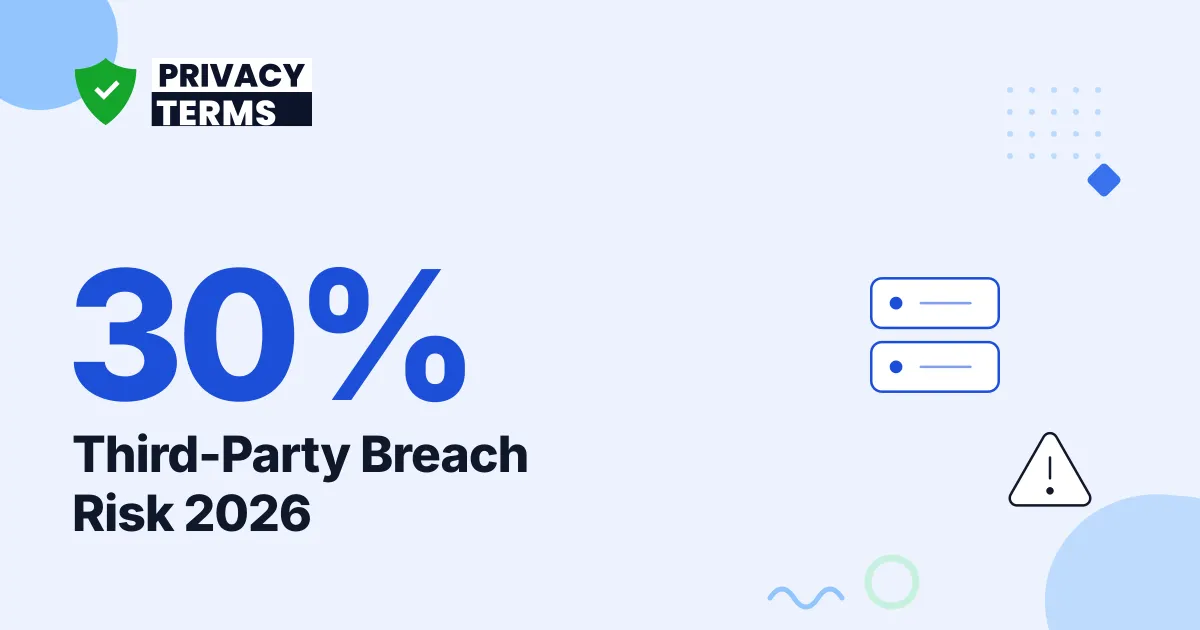
Third parties were involved in 30% of confirmed data breaches in 2025, double the 15% share recorded a year earlier, according to Verizon’s 2025 Data Breach Investigations Report, which analyzed more than 22,000 security incidents including 12,195 confirmed breaches. A vendor, contractor, or software supplier is now a factor in roughly one out of every three breaches an organization has to disclose, and these breaches cost more and take longer to fix than any other kind.
That doubling in a single year is the headline finding, but the deeper story is what happens once a vendor is compromised: the breach does not stay contained to one company. A single vulnerability in one piece of shared software can cascade into thousands of downstream victims who never had a direct security relationship with the attacker at all, only with a vendor they trusted.
How common is third-party involvement in data breaches now?
Verizon’s 2025 Data Breach Investigations Report puts third-party involvement at 30% of confirmed breaches, up from 15% in the prior year’s edition, a 100% year-over-year increase. The report, based on more than 22,000 security incidents and 12,195 confirmed data breaches, specifically calls out software supply chain compromises and weak security practices at service providers as the two dominant patterns behind the jump.
Figure 1: Nearly one in three confirmed breaches now involves a third party. Source: Verizon 2025 Data Breach Investigations Report.
The shift matters because it changes where a security team’s attention has to go. A breach caused by an organization’s own misconfigured server is at least visible to that organization’s own monitoring tools. A breach that starts inside a vendor’s environment is often invisible until the vendor discloses it, or until stolen data surfaces for sale.
Why do third-party breaches cost more and take longer to fix?
A third-party or supply chain compromise costs $4.91 million on average, compared with the $4.44 million global average across all breach types, according to IBM and the Ponemon Institute’s Cost of a Data Breach Report 2025. That report is based on 600 breached organizations studied across 17 industries and 16 countries and regions, with fieldwork running from March 2024 to February 2025.
The bigger gap shows up in time, not just dollars. Third-party and supply chain breaches took 267 days on average to identify and contain, longer than any other initial attack vector the report tracked, split into 196 days to identify the intrusion and 71 more days to contain it. Malicious insiders came next at 260 days, followed by phishing at 254 days.
Figure 2: Third-party and supply chain compromises take the longest of any attack vector to identify and contain. Source: IBM and the Ponemon Institute, Cost of a Data Breach Report 2025.
Figure 3: Third-party breaches and attacker-disclosed ransomware both run well above the global average cost. Source: IBM and the Ponemon Institute, Cost of a Data Breach Report 2025.
The reason both figures run high is the same: attackers exploit the trust relationship between a vendor and its customers, and that trust relationship is exactly what makes the intrusion hard to spot. A customer organization’s own monitoring tools were never built to watch a vendor’s internal network, so the first sign of trouble is often the vendor’s own breach notification, or a stolen-data listing, arriving months after the actual compromise.
What does a single vendor breach look like in practice?
The 2023 MOVEit Transfer breach is the clearest recent example of how far one vendor compromise can spread. The Cl0p ransomware group exploited a zero-day SQL injection vulnerability in Progress Software’s MOVEit Transfer file-transfer product starting May 27, 2023, deploying a custom web shell to extract data directly from victim servers. More than 2,773 organizations and roughly 93.3 million individuals ultimately had data exposed, even though most of those organizations were never directly hacked, only their shared file-transfer vendor was. Those counts are Emsisoft’s tally as of June 28, 2024, compiled from state breach notifications, SEC filings and Cl0p’s own leak site, and Emsisoft cautions the individual count is an undercount.
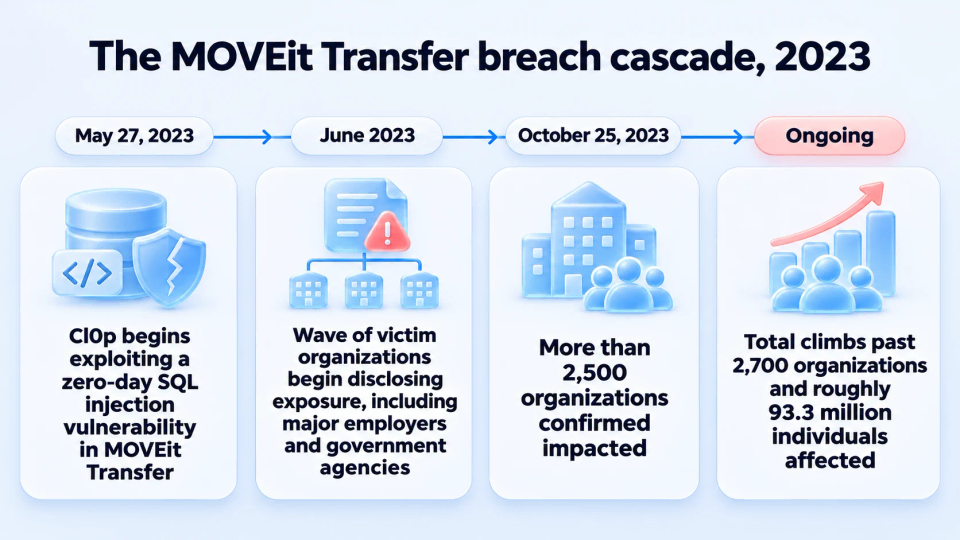
Figure 4: A single software vulnerability, exploited once, cascaded through thousands of unrelated organizations. Source: Emsisoft MOVEit breach tracker (June 2024), CISA and FBI advisory AA23-158A.
This is the pattern behind Verizon’s 30% figure: it is rarely one company’s third-party breach in isolation. It is one vendor’s breach becoming hundreds or thousands of separate breach notifications sent by that vendor’s customers, each of whom now has to update their own privacy policy disclosures and notify their own users about an incident they did not directly cause.
Is open-source software supply chain risk getting worse?
Yes, on the numbers Sonatype tracks. The company identified more than 454,600 new malicious open-source packages in 2025 alone, pushing its cumulative total of known and blocked malicious packages past 1.233 million across npm, PyPI, Maven Central, NuGet, and Hugging Face. npm accounted for more than 99% of all open-source malware Sonatype tracked in 2025, meaning software supply chain risk is heavily concentrated in a single package ecosystem rather than spread evenly across all of them.
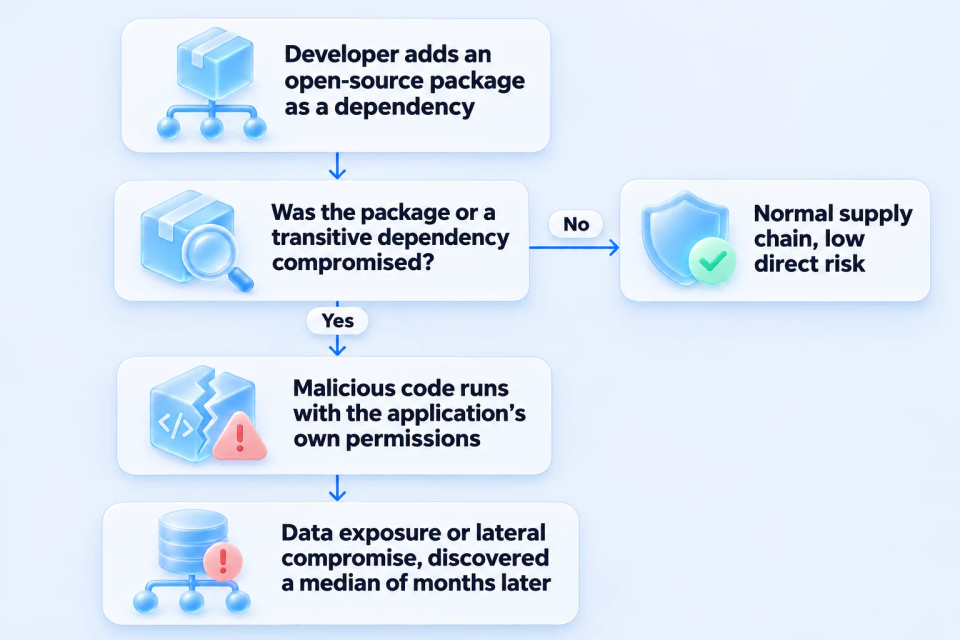
Figure 5: A single compromised dependency inherits every permission the application already has. Source: Sonatype 2026 State of the Software Supply Chain report.
Sonatype’s own analysis describes 2025 as a turning point where open-source malware shifted from opportunistic spam and stunts toward sustained, industrialized campaigns, some of them state-sponsored, aimed directly at developer tooling rather than end users. That shift compounds the Verizon and IBM findings above: a growing share of the vendors and dependencies an organization trusts are themselves being deliberately targeted, not just occasionally and incidentally compromised.
The Bottom Line
Third-party involvement in data breaches doubled in a single year, from 15% to 30%, and the breaches that involve a vendor cost more and take far longer to resolve than any other kind: $4.91 million on average and 267 days to identify and contain, against a $4.44 million and generally shorter timeline for breaches overall. The MOVEit cascade showed what that risk looks like at scale, turning one vendor’s zero-day vulnerability into more than 2,700 separate organizational breaches, while Sonatype’s package-registry data shows the same dynamic building in open-source software dependencies. An organization’s own security posture increasingly matters less than the security posture of every vendor, contractor, and software dependency it relies on, which is exactly the kind of disclosure a current, accurate privacy policy needs to account for.
Frequently Asked Questions
What percentage of data breaches involve a third party? 30% of confirmed data breaches in 2025 involved a third party, double the 15% share Verizon recorded a year earlier, according to the 2025 Data Breach Investigations Report, which analyzed more than 22,000 security incidents including 12,195 confirmed breaches.
How much more does a third-party or supply chain breach cost? $4.91 million on average, compared with $4.44 million across all breach types globally, according to IBM and the Ponemon Institute’s Cost of a Data Breach Report 2025, based on 600 breached organizations across 17 industries and 16 countries and regions.
How long does it take to identify and contain a third-party breach? 267 days on average, the longest of any initial attack vector IBM and the Ponemon Institute tracked in the Cost of a Data Breach Report 2025, split into 196 days to identify the breach and 71 days to contain it once found.
How many organizations were affected by the MOVEit breach? More than 2,700 organizations and roughly 95.8 million individuals had data exposed after the Cl0p ransomware group exploited a zero-day SQL injection vulnerability in Progress Software’s MOVEit Transfer product starting May 27, 2023, one of the largest single-vendor breach cascades on record.
Where the Numbers Come From
- Verizon. (2025). “2025 Data Breach Investigations Report.” Third-party involvement in confirmed breaches doubled to 30%, from 22,000-plus incidents and 12,195 confirmed breaches analyzed.
- IBM and the Ponemon Institute. (2025). “Cost of a Data Breach Report 2025.” Third-party vendor and supply chain compromise average cost $4.91 million, 267-day average identify-and-contain lifecycle, from 600 breached organizations across 17 industries and 16 countries and regions, fieldwork March 2024 to February 2025.
- Emsisoft. “Unpacking the MOVEit Breach: Statistics and Analysis.” Live tracker, snapshot as of June 28, 2024: 2,773 organizations and about 95.8 million individuals affected, built from state breach notifications, SEC filings and Cl0p’s leak site.
- CISA and FBI. (2023). “#StopRansomware: CL0P Ransomware Gang Exploits CVE-2023-34362 MOVEit Vulnerability” (AA23-158A). Exploitation of the MOVEit Transfer zero-day began on May 27, 2023, per open source information cited in the advisory.
- Sonatype. “2026 State of the Software Supply Chain Report.” More than 454,600 new malicious open-source packages identified in 2025, cumulative total past 1.233 million across npm, PyPI, Maven Central, NuGet, and Hugging Face.
Note: All figures verified as of November 2026. Verizon and IBM/Ponemon publish new annual editions each spring; check for a newer Data Breach Investigations Report and Cost of a Data Breach Report before citing these year-over-year figures after this post’s next scheduled refresh.