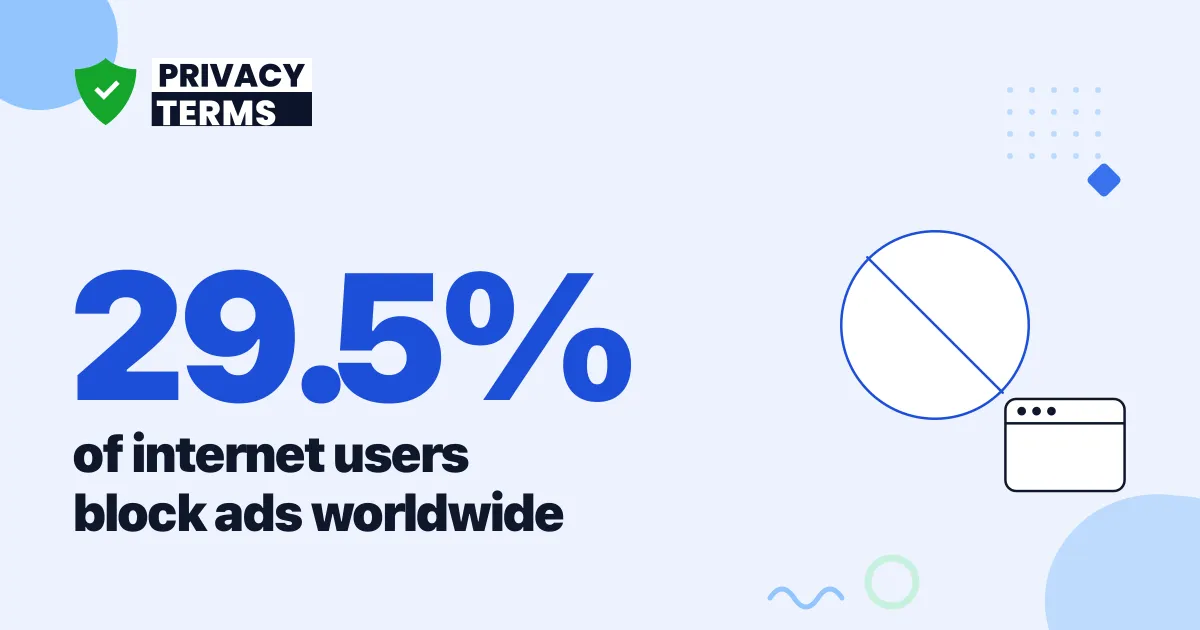
Roughly 29.5% of internet users worldwide use an ad blocker, according to GWI's Core survey data as compiled by DataReportal in its Q2 2025 update. eyeo's Ad Filtering Report counts the underlying installs directly and put the global total at 912 million active ad-blocking browser installs as of Q2 2023, the most recent year with a full worldwide count, using tracked install activity rather than self-reported survey answers. Both figures agree on the same conclusion: blocking ads is now mainstream behavior, not a niche one.
How many people use ad blockers worldwide?
29.5% of internet users worldwide report using an ad blocker, per GWI's Core survey data as compiled by DataReportal's Q2 2025 update. That works out to roughly three in ten people online, though the share varies widely by country: usage tops 40% in Indonesia and drops below 25% in some of the most ad-tolerant markets tracked.
Country-level differences track local ad load and mobile data costs more than any single cultural factor. Markets where mobile data is expensive tend to show higher ad blocker adoption, since blocking ads also cuts page-load data usage on a metered connection. Indonesia, South Africa, and Vietnam, three of the top five countries by usage rate, all fit that pattern.
Figure 1: Indonesia reports the highest ad blocker usage rate of any tracked country, well above the 29.5% global average. Source: GWI Core survey data via DataReportal, Q2 2025 update, as compiled by Backlinko.
The average website also loads dozens of third-party trackers per visit, which is part of why a general-purpose ad blocker doubles as a tracker blocker for most users; see our breakdown of how many trackers show up on the average website for the tracking side of the same behavior. No single country crosses 50% usage, which means ad blocking is common everywhere but still a minority behavior even in the highest-usage markets.
Why do global ad blocker counts differ between trackers?
No two trackers count ad blocker users the same way, and that gap explains why headlines about ad blocking cite wildly different numbers. GWI's Core survey, syndicated through DataReportal, asks internet users a self-reported question about whether they use ad-blocking software, then extrapolates a percentage across the online population of each surveyed market. eyeo, the company behind Adblock Plus and the Acceptable Ads program, instead measures active browser-extension installs directly through its own ad-filtering infrastructure and reports a raw count rather than a percentage.
The two approaches produce different pictures of growth. eyeo's Ad Filtering Report tracked active installs from 44 million in 2012 to 912 million by Q2 2023, a period covering the rise and later plateau of desktop ad blocking as browsers added their own built-in tracker protections. Self-reported survey data from GWI, by contrast, captures anyone who says they use an ad blocker on any device, including built-in browser features and mobile apps that eyeo's install-tracking infrastructure does not directly observe.
Figure 2: Tracked ad-blocking browser installs grew more than twentyfold in a decade, then leveled off near 900 million. Source: eyeo's Ad Filtering Report 2023, using DataReportal's historical install estimates through 2020.
Treat the 29.5% survey figure and the 912 million install figure as complementary rather than interchangeable. One measures the share of the online population that self-identifies as an ad blocker user; the other measures a tracked count of active software installations, which is a narrower and more conservative slice of the same behavior.
What percentage of US and UK internet users block ads?
About 32.5% of US internet users use an ad blocker, close to the 29.5% global average, according to DataReportal's Q2 2025 country data. The United Kingdom sits slightly below the global figure at 28.5%, but the more striking UK number is the trend: usage has nearly halved since 2016.
UK ad blocker usage stood at 47% in 2016, the year after GDPR-era privacy scrutiny of tracking practices began building momentum across Europe, then fell to 41% in 2018, 36% in 2020, and 28.5% by 2025. The US rate has stayed comparatively flat across the same period, hovering in the low-to-mid 30s.
Figure 3: UK ad blocker usage has fallen by nearly half since 2016, even as global usage held closer to flat. Source: DataReportal, Q2 2025 country data via GWI Core survey.
| Region | Usage rate | Trend since 2016 | Source (year) |
|---|---|---|---|
| Global average | 29.5% | New tracked metric, no 2016 baseline | DataReportal (2025) |
| United States | 32.5% | Roughly steady, low-to-mid 30s | DataReportal (2025) |
| United Kingdom | 28.5% | Down from 47% in 2016 | DataReportal (2025) |
A steadily declining UK rate alongside a flat US rate suggests the driver is not a single global trend but a mix of local factors: ad formats, publisher paywall adoption, and how aggressively each market's browsers ship built-in tracker blocking by default.
Which device do people use ad blockers on most?
Desktop remains the most-blocked surface. In the US, 37% of ad blocker users report blocking on desktop, compared with 15% on mobile and 10% on tablet, according to AudienceProject's 2020 study of advertising attitudes and ad-blocking behavior.
That gap exists mainly because desktop browsers make ad-blocking extensions easy to install, while blocking ads inside a native mobile app usually requires a system-level content blocker or a separate blocking browser, both extra steps most mobile users skip. eyeo's Blockthrough division reports a similar pattern for the current US market: 27% desktop penetration versus 22% combined mobile, tablet, and connected-TV penetration.
Figure 4: Desktop remains the most-blocked surface among US ad blocker users. Source: AudienceProject, Attitude Towards Advertising and Use of Ad Blocking (2020).
Mobile ad blocking is still growing faster in relative terms, even if the absolute share stays below desktop, as more phone browsers ship built-in tracker and ad controls by default.
Who is most likely to use an ad blocker?
Younger internet users block ads at nearly three times the rate of the oldest age group. In the US, 41% of 18-to-24-year-olds use an ad blocker, compared with 15.6% of users 65 and older, according to eMarketer data as compiled in Backlinko's 2026 ad blocker usage roundup.
Usage declines steadily with each age bracket in between: 36.8% among 25-to-34-year-olds, 29.9% among 35-to-44-year-olds, and 29.8% among 45-to-54-year-olds, before dropping to 24.8% among 55-to-64-year-olds. AudienceProject's separate UK study found a similar but flatter pattern, with usage staying above 33% across every age group under 56.
Figure 5: Ad blocker usage falls steadily with age, from 41% among 18-to-24-year-olds to 15.6% among users 65 and older. Source: eMarketer, as compiled in Backlinko's 2026 ad blocker usage roundup.
Gender shows a similar split: AudienceProject reports 49% of US men and 33% of US women use an ad blocker, a gap that appears in both the US and UK datasets.
Why do people use ad blockers, and what does it cost publishers?
Too many ads is the single most common reason people give for installing a blocker. 63.5% of ad blocker users cite ad volume, 53.5% say ads get in the way of the content they came for, 42.4% specifically cite privacy protection, and 39.8% point to irrelevant, poorly targeted ads, per DataReportal's Q2 2025 survey.
Privacy protection sitting at 42.4% is worth pausing on: a large share of ad blocker users are not just annoyed by ad volume, they are actively trying to limit the tracking that funds ad targeting in the first place. A site that clearly discloses what it collects and why, through a privacy policy generator that keeps tracking and third-party sharing disclosures current, addresses that specific objection directly rather than treating every blocked ad as pure lost revenue.
For publishers, the financial stakes are large and growing. eyeo's Ad Filtering Report projected that ad blocking would cost publishers 54 billion dollars in lost advertising revenue in 2024, about 8% of the 695 billion dollars in total projected global digital ad spend that year. Not every ad blocker user blocks everything, though: eyeo's own Acceptable Ads program, which allowlists non-intrusive ad formats, grew from 216 million users in Q4 2021 to more than 300 million by 2023, a roughly 39% increase in two years.
Figure 6: How an ad-filtering allowlist program changes the outcome for a publisher once a visitor's ad blocker is active. Source: eyeo's Acceptable Ads and Ad Filtering Report 2023 methodology notes.
Publishers who lean entirely on intrusive ad formats face the full 54-billion-dollar exposure. Publishers who adopt an allowlist standard, or who diversify away from ad revenue toward subscriptions and first-party data, absorb less of that loss.
How does ad blocker usage compare by country?
| Country | Usage rate | Global rank | Source (year) |
|---|---|---|---|
| Indonesia | 40.1% | #1 | DataReportal (2025) |
| South Africa | 35.6% | #2 | DataReportal (2025) |
| Serbia | 35.2% | #3 | DataReportal (2025) |
| Vietnam | 34.6% | #4 | DataReportal (2025) |
| United States | 32.5% | #10 | DataReportal (2025) |
| Global average | 29.5% | -- | DataReportal (2025) |
Source: GWI Core survey data via DataReportal, Q2 2025 update, as compiled by Backlinko.
The Bottom Line
Whether a tracker counts 912 million active browser installs or reports 29.5% of internet users self-identifying as ad blocker users, the two measurement approaches land on the same broad picture: close to three in ten internet users actively block ads, and privacy protection, not just ad annoyance, is a top-four reason they give for doing it. For any site that runs ads or third-party trackers, that means a meaningful share of visitors are already trying to opt out of tracking by default, whether or not a cookie banner asked them first. The practical response is not to fight the blocker; it is to make sure the site's own disclosures, what gets collected, what gets shared, and why, hold up whether or not a given visitor's blocker lets an ad through.
Frequently Asked Questions
How many people use ad blockers worldwide? Roughly 29.5% of internet users worldwide use an ad blocker, according to GWI's Core survey data as compiled by DataReportal (Q2 2025 update). Separately, eyeo's 2023 Ad Filtering Report counted 912 million active ad-blocking browser installs worldwide as of Q2 2023; the two figures measure different things but point to the same conclusion.
What percentage of Americans use an ad blocker? About 32.5% of US internet users use an ad blocker, per DataReportal's Q2 2025 country data. eyeo's Blockthrough division separately measures 27% desktop penetration and 22% mobile, tablet, and CTV penetration in the US market.
Why do most people use ad blockers? 63.5% of ad blocker users cite too many ads as their top reason, 53.5% say ads get in the way of content, and 42.4% specifically cite privacy protection, according to DataReportal's Q2 2025 survey data.
How much revenue does ad blocking cost publishers? eyeo's 2023 Ad Filtering Report estimated ad blocking would cost publishers 54 billion dollars in lost advertising revenue in 2024 alone, about 8% of the 695 billion dollars in total projected global digital ad spend that year.
Where the Numbers Come From
- eyeo. (2023). "Ad Filtering Report 2023." 912 million active ad-blocking users worldwide by Q2 2023, up 11% from Q4 2021; Acceptable Ads allowlist users grew from 216 million to more than 300 million over the same period; 54 billion dollars in projected 2024 publisher revenue loss from ad blocking.
- Backlinko. (2026). "Ad Blocker Usage Statistics." Compiles GWI's Core survey data as published by DataReportal (Q2 2025 update): 29.5% global usage rate, country-level rankings, US and UK figures, age and gender breakdowns, and reasons for blocking ads.
- AudienceProject. (2020). "Attitude Towards Advertising and Use of Ad Blocking." Device, age, and gender breakdowns of ad blocker usage in the US and UK.
Note: All figures verified as of September 2026. Ad blocker usage figures mix two measurement approaches, self-reported survey data from GWI and DataReportal and tracked browser-extension installs from eyeo, so treat percentage and raw user-count figures as complementary rather than directly interchangeable. This post is refreshed at least twice a year as new survey waves and ad filtering reports are published.