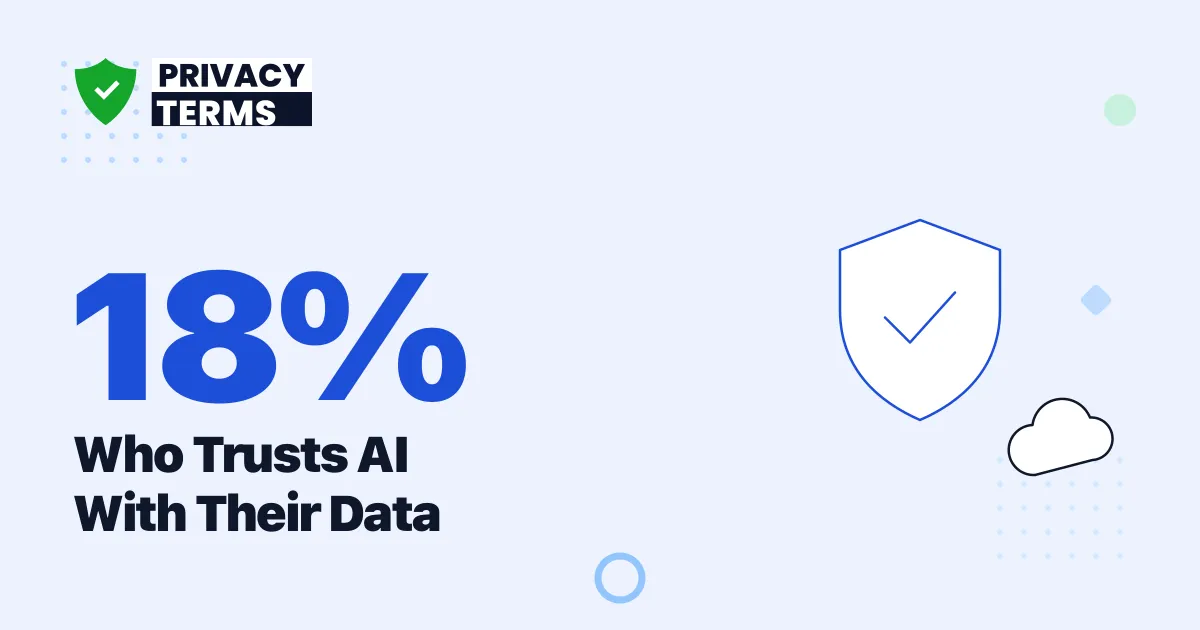
Only 18% of Americans trust AI platforms to keep their personal data secure, according to a survey of 1,009 U.S. adults commissioned by Cloaked and published in April 2026. That figure sits well below trust in businesses generally to use AI responsibly, and it lines up with a separate Pew Research Center report finding most adults expect AI to make their personal information less secure, not more.
The gap between how many people use AI tools and how many trust those tools with their data is one of the widest in current privacy research. Below is what four separate 2025-2026 surveys found, broken out by platform, by year, and by what each survey actually asked.
How many people trust AI with their data?
Only 18% of Americans say they trust AI platforms to keep their personal data secure, per Cloaked's April 2026 survey of 1,009 U.S. adults. Cloaked, a consumer privacy company, does not disclose the exact fieldwork dates or the polling firm behind the survey, but it does publish the sample size and the full question set, so the figure is treated here as a company-commissioned consumer poll rather than independent academic research.
That low trust number is not an outlier. Pew Research Center's June 2026 report, based on 5,119 U.S. adults surveyed February 17-23, 2026, found that 71% of adults think increased AI use will make their personal information less secure, against just 3% who think it will get safer. The remaining share landed in the "no real difference or not sure" category once those two headline figures are subtracted from the total.
Figure 1: Seven in ten U.S. adults expect AI to hurt their data security, not help it. Source: Pew Research Center, "Americans and AI 2026," June 2026.
Both figures point the same direction: a small minority actively trusts AI with personal data, and a large majority expects the opposite outcome. That combination is unusual compared to other consumer technology categories, where usage typically climbs alongside at least some improvement in trust.
Takeaway: fewer than 1 in 5 Americans trust AI platforms with their data, and most expect the situation to get worse, not better.
Which AI platforms do people trust most and least with their data?
Trust is not uniform across AI products. In Cloaked's April 2026 survey, Meta AI ranked highest on both measures asked: 67% of respondents said they were comfortable with it handling their personal data, ahead of Claude at 63% and Grok at 62%. On the narrower question of trusting a platform's data security specifically, Meta AI again led at 36%, followed by Perplexity at 31%, Grok at 27%, and ChatGPT at 20%, the lowest of the four platforms Cloaked asked about by name.
| Platform | Trusts its data security |
|---|---|
| Meta AI | 36% |
| Perplexity | 31% |
| Grok | 27% |
| ChatGPT | 20% |
The gap between "comfortable using it" and "trust its security specifically" is worth noting on its own. Meta AI's 67% comfort score is nearly double its 36% security-trust score, suggesting a sizable share of users keep using a product they are not actually confident will protect their data.
Figure 2: Comfort using an AI platform runs well ahead of trusting its data security specifically. Source: Cloaked, April 2026 survey.
Takeaway: even the most-trusted AI platform in Cloaked's ranking is trusted with data security by barely a third of respondents.
How does trust in AI companies compare across major 2025-2026 surveys?
Four separate surveys asked a version of "do you trust AI with your data," and none of them asked exactly the same question, so the results are not directly interchangeable, but placed side by side they show a consistent pattern: broad, vaguely worded trust questions produce higher numbers than specific, data-focused ones.
| Survey (year) | What it measured | Result | Sample size |
|---|---|---|---|
| KPMG (2025) | Willing to trust AI systems, global | 46% trust | 48,000+ adults, 47 countries |
| Gallup / Bentley (2025) | Trust businesses to use AI responsibly | 31% trust | 3,007 U.S. adults |
| Cloaked (2026) | Trust AI platforms to keep data secure | 18% trust | 1,009 U.S. adults |
| Pew Research (2026) | Not confident in companies' responsible AI use | 59% not confident | 5,119 U.S. adults |
KPMG's global study, fielded between November 2024 and January 2025 across more than 48,000 respondents, found 46% willing to trust AI systems generally, even though 58% separately rated AI systems as "trustworthy" in the abstract, a gap the report's authors describe as a difference between perceiving a technology as capable and actually being willing to rely on it. The Bentley University-Gallup Business in Society survey, fielded in May 2025 among 3,007 U.S. adults, found 31% trust businesses to use AI responsibly, up steadily from prior years.
Figure 3: U.S. trust in businesses' responsible AI use has climbed each year Gallup has measured it. Source: Bentley University-Gallup Business in Society survey, 2023-2025.
Once the question narrows to data security specifically, as Cloaked's does, the number drops to 18%. That gap, roughly 13 to 28 points depending on which broader survey is the comparison point, suggests people are more willing to say they trust AI in the abstract than they are to say they trust it with their own personal information. Businesses appear to sense the same gap: see our AI and privacy statistics for 2026 for how many organizations have expanded their privacy programs specifically because of AI in the past year.
Takeaway: the more specifically a survey asks about personal data, the lower the trust number gets.
Why don't people trust AI with their data?
The most commonly cited reason is a perceived lack of consent. 64% of Americans believe AI is making decisions about them without their knowledge or consent, according to Cloaked's April 2026 survey. That sits alongside Pew Research Center's finding that 59% of U.S. adults are not confident in U.S. companies to develop and use AI responsibly, and a further 67% have little to no confidence in the U.S. government to regulate AI effectively.
Consumers are already acting on that distrust rather than just reporting it. More than half of Cloaked's respondents said they have opted out of data collection, tracking, or targeted ads specifically because of AI-related concerns, and 44% said they would pay more for a service that guaranteed their personal data would never be processed by AI at all.
Figure 4: Whether AI processing is disclosed in a privacy policy is one of the few variables a site actually controls. Source: Cloaked, April 2026 survey; Pew Research Center, June 2026.
For any site or app that uses AI on customer data, whether for personalization, support automation, or fraud detection, that 64% figure is a direct signal about what visitors already assume happens without their consent. A privacy policy generator built for AI-era disclosures can add clear, specific language about what AI processing occurs and why, closing part of that gap before a regulator or a customer asks about it.
Takeaway: most of the distrust traces back to a perceived lack of consent, which a specific, current privacy disclosure can directly address.
How has AI data trust changed since 2023?
Trust in AI, measured broadly, has been rising slowly since 2023. Trust in AI with personal data specifically looks more mixed, and the most recent 2026 readings show it getting worse in at least one closely tracked survey.
Figure 5: Broad trust in AI has inched up since 2023, while data-specific trust readings in 2026 point the other way. Sources: Bentley University-Gallup (2023-2025), Pew Research Center (2024, 2026), KPMG (2025), Usercentrics (2025-2026), Cloaked (2026).
Usercentrics' State of Digital Trust 2026 report, based on 11,000 consumers surveyed across the UK, U.S., Germany, Spain, Italy, the Netherlands, and Sweden in March 2026, found 52% now trust AI less than they trust humans with their data, up from 48% in the same survey a year earlier. Read together with Cloaked's 18% figure and Pew's 71% "less secure" expectation, the 2026 data points cluster toward declining data-specific trust even as broader business-AI trust and general chatbot usage both continue to climb.
Takeaway: general trust in AI is trending up slowly, but trust in AI with personal data specifically looks flat to declining through mid-2026.
The Bottom Line
Only 18% of Americans trust AI platforms to keep their personal data secure, a number that sits well below every broader "trust in AI" figure surveyed in 2025 and 2026, and one that Pew Research Center's finding that 71% of adults expect AI to make their data less secure only reinforces. The practical pattern across every survey cited here is the same: the more specifically a question asks about personal data, the lower trust drops, and the most commonly cited reason is a perceived lack of consent rather than opposition to AI itself. For any business running AI against customer or user data, that 64% "deciding without consent" figure is a concrete, addressable gap. A privacy policy that names what AI does with personal data, rather than describing data use in generic terms that predate AI features, is one of the few trust signals a company fully controls, and it is a cheaper fix than winning back a customer who has already opted out. That signal is rarely used: just 8.5% of privacy policies disclose whether they train an AI model on user data at all, let alone in specific enough terms to rebuild the trust this post measures.
Frequently Asked Questions
How many people trust AI with their personal data? Only 18% of Americans say they trust AI platforms to keep their personal data secure, according to a survey of 1,009 U.S. adults commissioned by Cloaked and published in April 2026.
Which AI platform do people trust most with their data? Meta AI ranks highest on both measures in Cloaked's April 2026 survey: 67% of respondents say they are comfortable with it handling their data, and 36% say they trust its data security specifically, more than any other platform tested.
Is trust in AI companies improving or getting worse? It depends on what is measured. Gallup's Bentley University survey found trust in businesses to use AI responsibly rose from 21% in 2023 to 31% in 2025, while Usercentrics' 2026 State of Digital Trust report found 52% of consumers now trust AI less than humans with their data, up from 48% in 2025.
Why don't people trust AI with their data? 64% of Americans believe AI is making decisions about them without their knowledge or consent, and 71% think increased AI use will make their personal information less secure, according to Cloaked's 2026 survey and Pew Research Center's June 2026 report.
Where the Numbers Come From
- Cloaked. (2026). "How Americans Feel About Sharing Their Data With AI." Survey of 1,009 U.S. adults, published April 2, 2026. 18% trust AI platforms to keep personal data secure; platform-level trust and comfort figures; 64% believe AI decides about them without consent.
- Pew Research Center. (2026). "Americans and AI 2026: Chatbots, Smart Devices and Views on Impact." Survey of 5,119 U.S. adults, fielded February 17-23, 2026, published June 17, 2026. 71% expect AI to make personal data less secure; 59% not confident in companies' responsible AI use.
- KPMG International. (2025). "Trust, Attitudes and Use of Artificial Intelligence: A Global Study 2025." Survey of more than 48,000 people across 47 countries, fielded November 2024 to January 2025. 46% willing to trust AI systems; 58% view AI systems as trustworthy.
- Gallup and Bentley University. (2025). "Business in Society: Trust in Businesses' Use of AI Improves Slightly." Survey of 3,007 U.S. adults, fielded May 5-12, 2025. Trust in businesses' responsible AI use at 31%, up from 21% in 2023 and 23% in 2024.
- Usercentrics. (2026). "State of Digital Trust 2026." Survey of 11,000 consumers across the UK, U.S., Germany, Spain, Italy, the Netherlands, and Sweden, fielded March 2026. 52% trust AI less than humans with their data, up from 48% in 2025.
Note: All figures verified as of August 2026. Cloaked's methodology page does not disclose exact fieldwork dates or the polling firm used, which is noted above wherever that figure appears. These numbers are refreshed at least twice a year as newer survey waves publish.