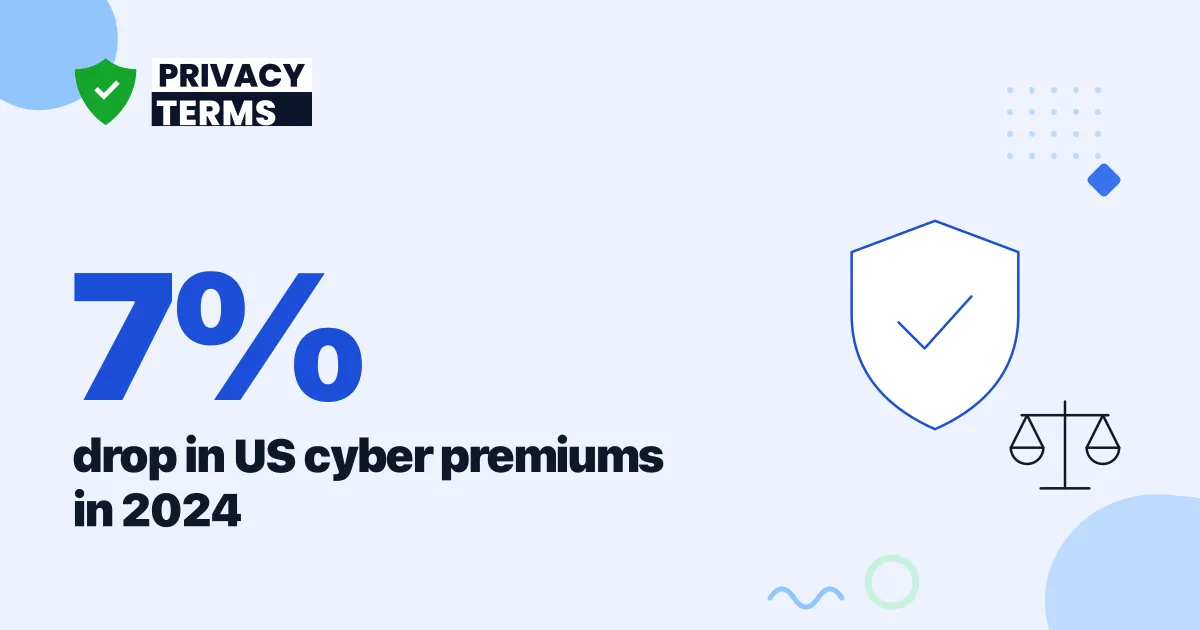
US cyber insurance premiums fell 7% to $9.14 billion in 2024, the market's first-ever annual decline, according to the National Association of Insurance Commissioners' 2025 Report on the Cybersecurity Insurance Market. That drop happened even as reported claims climbed almost 40%, and most of those claims never resulted in a payout at all. The numbers below track where the money went instead.
How much have cyber insurance premiums fallen?
US direct written premium (DWP) for cybersecurity insurance, including alien surplus lines, dropped 7.11% to $9.14 billion in 2024 from $9.84 billion in 2023, the first year-over-year decline the NAIC's Cyber Supplement has ever recorded. Restricted to US-domiciled insurers only, DWP fell a smaller 2.3%, to $7.08 billion. The reversal follows four years of explosive growth: premiums grew 60.96% in 2021 alone, as ransomware losses pushed insurers to raise rates and tighten underwriting standards.
Figure 1: US domestic cyber insurance premiums grew for three straight years before flattening in 2023 and declining in 2024. Source: NAIC, 2025 Report on the Cybersecurity Insurance Market.
Globally, cyber insurance premiums kept growing even as the US market contracted, reaching nearly $15 billion in 2024, a 7% increase, per the NAIC's report. Most of that growth happened outside the United States, in markets where cyber coverage is still expanding from a smaller base.
| Year | Total US DWP (incl. surplus lines) | Year-over-year change | US-domiciled-only DWP |
|---|---|---|---|
| 2021 | $6.54 billion | +60.96% | $4.83 billion |
| 2022 | $9.69 billion | +48.03% | $7.26 billion |
| 2023 | $9.84 billion | +1.62% | $7.25 billion |
| 2024 | $9.14 billion | -7.11% | $7.08 billion |
Source: NAIC, 2025 Report on the Cybersecurity Insurance Market.
Four years of double-digit growth built a market that could absorb a correction, and 2024's decline looks more like a pricing reset than a sign insurers are pulling back from the risk.
How many cyber insurance claims get paid?
Just 26% of closed cyber insurance claims resulted in a payout in 2024. Among US-domiciled insurers, excluding alien surplus lines, 9,941 claims closed with payment against 28,555 closed without one, a total of 38,496 closed claims, per the NAIC's 2025 report. That is not evidence of routine denials so much as how retentions and deductibles work: a large share of reported incidents fall under the policy's retention or turn out not to trigger covered costs once investigated.
Figure 2: Roughly three in four closed cyber insurance claims end with no payment. Source: NAIC, 2025 Report on the Cybersecurity Insurance Market.
Claim closure rates vary by how the policy was written. Endorsement policies, cyber coverage added onto another line like a business owner's policy, closed 91.52% of reported claims, the fastest of the three structures. Primary stand-alone cyber policies closed 83.93% of claims, and excess policies, which sit on top of another insurer's coverage and pay only once a large loss exceeds the underlying limit, closed just 76.84%, reflecting how much longer big, complex losses take to resolve.
Business email compromise is a growing share of what feeds that claims volume. The FBI's Internet Crime Complaint Center reports $17.5 billion in fraudulent transfers to US financial recipients between June 2016 and December 2023, with an average loss of roughly $126,900 per victim complaint, and BEC claims increasingly land inside cyber insurance policies alongside ransomware and business interruption losses, per the NAIC's report. Reported breaches feeding this claims growth keep climbing too; see our data breach statistics for 2026 for the incident-count trend behind these filings.
Figure 3: The two tests that decide whether a reported cyber claim ever pays out. Source: NAIC, 2025 Report on the Cybersecurity Insurance Market, methodology notes.
A payout rate under 30% is a reminder that a cyber policy is not a guaranteed check after an incident: what the retention covers and what counts as a covered event decide the outcome long before a claim closes.
Why are cyber insurance rates falling while claims volume rises?
US cyber insurance rates declined an average of 5% in the fourth quarter of 2024, the first quarterly rate decrease after seven years of continuous increases, according to Marsh's Global Insurance Market Index. The softening reflects insurer capacity, not falling risk: more carriers are competing for the same book of business, and companies that invested in cybersecurity controls during years of hard-market underwriting scrutiny are now qualifying for better terms.
Ransomware economics are shifting too. Average ransom payments among Aon's US broking clients dropped 77% in 2024, even as Aon's own cyber and errors-and-omissions claims data showed 1,228 reported incidents across its broking clients, a 22% increase year over year. Fewer dollars per successful attack, combined with more reported incidents overall, is part of why insurers can afford to cut price while still posting strong underwriting results.
Figure 4: Four years from hard market to first-ever premium decline. Sources: NAIC, 2025 Report on the Cybersecurity Insurance Market; Marsh Global Insurance Market Index.
Howden's 2025 Cyber Report, cited in the NAIC's market report, puts the pullback in broader context: global cyber insurance rates have declined 22% from their mid-2022 peak, and combined ratios, the share of every premium dollar spent on claims and expenses, have averaged around 70% through the softening, meaning insurers are still profitable at lower prices. Howden is a reinsurance broker with a commercial interest in cyber insurance placement volume, so treat that 22% figure as an informed industry estimate rather than a regulator-audited number.
Rates are falling because insurers can afford it, not because the underlying threat has eased: claim counts are still climbing even as the price per policy comes down.
Which insurers write the most cyber coverage?
Chubb led the US cyber insurance market in 2024 with $560.6 million in direct written premium, a 7.92% market share and a 36.06% loss ratio including defense and cost containment expenses, per the NAIC's ranking of the top 20 insurer groups. St. Paul Travelers ranked second at $535.4 million and a 53.97% loss ratio, followed by Fairfax Financial, Tokio Marine, and AXA rounding out the top five.
Figure 5: The five largest US cyber insurers by 2024 direct written premium. Source: NAIC, 2025 Report on the Cybersecurity Insurance Market, Table 2.
| Insurer group | 2024 DWP | Market share | Loss ratio (with DCC) |
|---|---|---|---|
| Chubb | $560.6 million | 7.92% | 36.06% |
| St. Paul Travelers | $535.4 million | 7.56% | 53.97% |
| Fairfax Financial | $360.6 million | 5.09% | 39.66% |
| Tokio Marine | $356.0 million | 5.03% | 43.47% |
| AXA | $340.4 million | 4.81% | 36.03% |
Source: NAIC, 2025 Report on the Cybersecurity Insurance Market, Table 2.
Profitability varies enormously beneath those headline premium numbers. Beazley, a longtime cyber specialist, posted just a 9.24% loss ratio in 2024, among the most profitable books in the market, while QBE's loss ratio hit 89.31% and Berkshire Hathaway's reached 85.72%, both near the top of the top-20 group's loss-ratio range. At-Bay Specialty, an insurtech underwriter, jumped from 32nd to 7th place in the market-share ranking year over year, with $280.6 million in premium and a 55.78% loss ratio, one of the fastest climbs in the report. Collectively, the top 20 insurer groups controlled 76.24% of the primary, excess, and endorsement market by premium, and cyber reinsurance is even more concentrated: the top five reinsurers underwrite roughly 62% of global cyber gross written premium, per data cited in the NAIC's report, meaning a pullback by any one of them would ripple through pricing for every insurer on this list.
Two related trends are worth tracking as this market resets: the class-action settlements now following major breach disclosures, and the ransomware attack volume still driving most first-party claims. We plan dedicated posts on both as more current data becomes available.
A 53-point spread in loss ratios among the top 20 groups, from Beazley's 9% to QBE's 89%, shows how differently insurers are underwriting the same risk category.
The Bottom Line
The headline number, a 7% drop in premiums, reads like retreat, but the rest of the NAIC's data tells a steadier story: claim volume is up almost 40%, only about a quarter of closed claims ever pay out, and the insurers writing this business are still profitable at the new, lower prices. What changed is competition and underwriting discipline, not appetite for the risk. For a business shopping cyber coverage, the practical signal is that insurers are rewarding demonstrable controls with better terms, and a public-facing privacy policy that accurately describes what data you collect and how you protect it is one of the first things underwriters check during that review. A privacy policy generator keeps that disclosure current without hiring outside counsel for every update, which matters more now that insurers are pricing controls, not just past claims history.
Frequently Asked Questions
How much did US cyber insurance premiums fall in 2024? 7.11%, from $9.84 billion in 2023 to $9.14 billion in 2024, according to the NAIC's 2025 Report on the Cybersecurity Insurance Market. It is the first annual decline the market has recorded since the NAIC began tracking cyber insurance data.
What percentage of cyber insurance claims result in a payout? About 26%. Among US-domiciled insurers, 9,941 of 38,496 closed claims in 2024 resulted in a payment, per the NAIC's 2025 report.
Which insurer writes the most cyber coverage in the United States? Chubb, with $560.6 million in direct written premium in 2024, a 7.92% market share, and a 36.06% loss ratio, according to the NAIC's ranking of the top 20 insurer groups.
Why are cyber insurance rates falling even as claims increase? Rates fell an average of 5% in the fourth quarter of 2024, the first quarterly decline in seven years, per Marsh's Global Insurance Market Index, as rising insurer capacity and better cybersecurity controls among policyholders let carriers compete on price while claim counts kept climbing almost 40% year over year.
Where the Numbers Come From
- National Association of Insurance Commissioners. (2025). "Report on the Cybersecurity Insurance Market." US direct written premium fell 7.11% to $9.14 billion in 2024; claim, closure-rate, and top-20-insurer data drawn from the NAIC's Cyber Supplement filings.
- Marsh McLennan. (2025). "US Cyber Insurance Market Update: Rates Decrease, Threats Evolve." US cyber insurance rates fell an average of 5% in the fourth quarter of 2024.
- Federal Bureau of Investigation, Internet Crime Complaint Center. (2024). "Business Email Compromise: The $55 Billion Scam." $17.5 billion in fraudulent transfers to US financial recipients, June 2016 through December 2023.
- Howden. (2025). "Rebooting Growth: Howden's 2025 Cyber Report." Global cyber insurance rates down 22% from their mid-2022 peak, cited via the NAIC's 2025 market report; Howden is a reinsurance broker with a commercial interest in cyber placement volume.
- Verizon. (2025). "2025 Data Breach Investigations Report." More than 22,000 security incidents and 12,000 confirmed breaches analyzed, the highest volume reviewed in a single year; ransomware present in 44% of breaches.
Note: All figures verified as of September 2026. NAIC premium and claims data covers the 2024 filing year, the most recent complete annual statement data available as of this post's publish date, and the report is refreshed roughly once a year as insurers file updated Cyber Supplement data.





